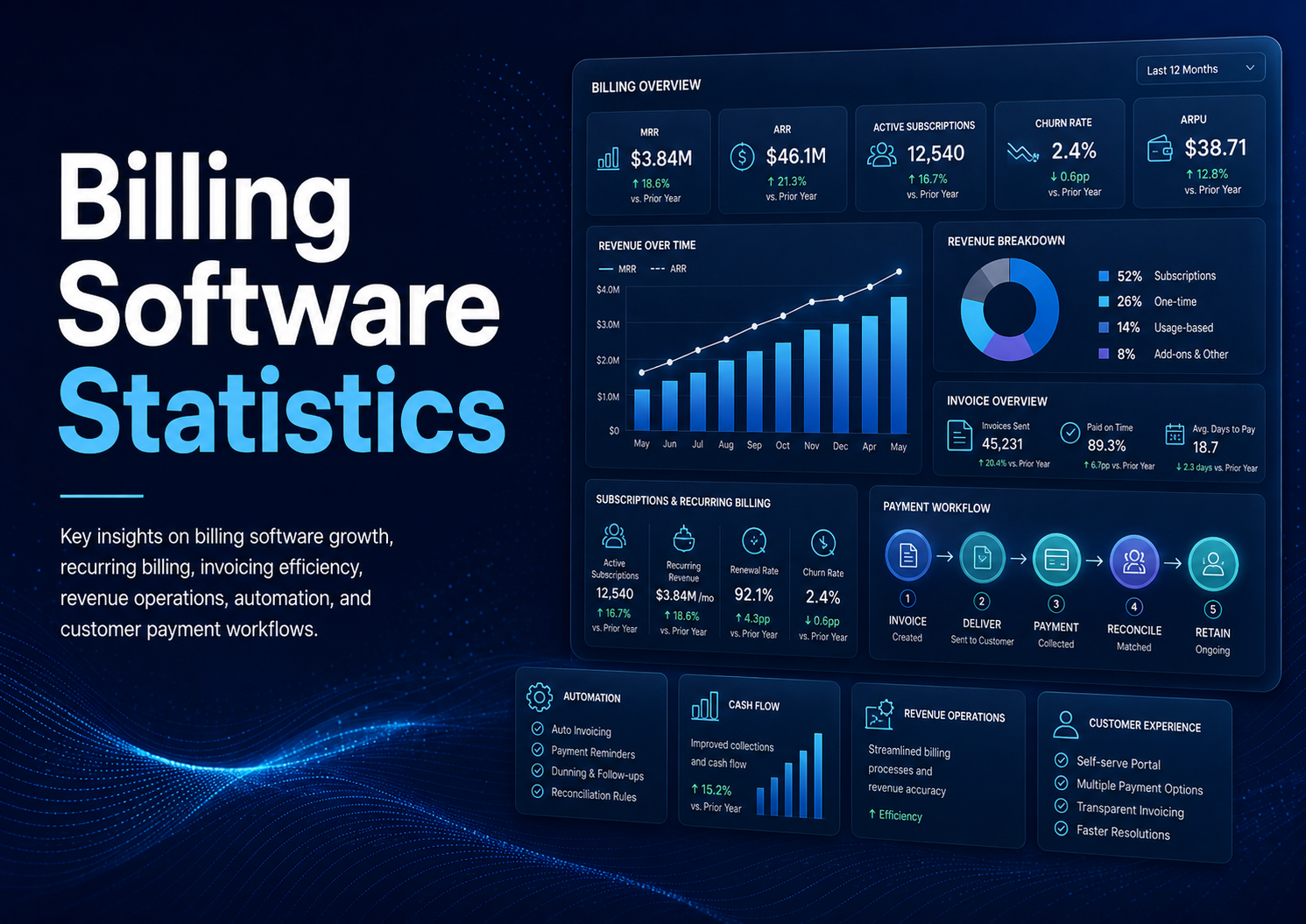
Billing software has moved from a simple invoice-making tool to a broader operating system for how companies price, bill, collect, reconcile, and understand customer revenue. The shift is especially visible in businesses that sell recurring services, usage-based products, online subscriptions, professional services, utilities, telecom plans, property charges, or multi-location customer accounts.
The statistics around billing software tell a practical story. Market forecasts show strong demand for subscription billing, utility billing, consumer billing management, tenant billing systems, and invoice-processing software. At the same time, late-payment data shows why billing matters beyond document creation. When invoices are delayed, unclear, hard to pay, or poorly tracked, cash flow suffers and teams spend more time chasing customers.
Billing software statistics are useful because the category is broad. A freelancer may need quick invoice creation and payment links. A subscription company may need proration, renewals, tax handling, plan changes, and failed-payment recovery. A utility may need meter-based charges, tariff logic, customer self-service, and regulatory reporting. An enterprise may need multi-currency billing, approval controls, revenue-system integration, audit trails, and analytics.
Because the market includes several adjacent software categories, individual estimates should be read directionally rather than as one universal measurement. Subscription billing management, consumer billing management, utility billing, tenant billing, invoicing, payment processing, and invoice workflow software overlap, but they are not identical. The consistent pattern is clear: billing is becoming more digital, more automated, and more connected to cash-flow visibility.
Key billing software statistics
- Grand View Research estimated the global subscription billing management market at $7.15 billion in 2024 and projected it to reach $17.95 billion by 2030.
- Mordor Intelligence estimated the subscription billing management market at $7.98 billion in 2025, $9.25 billion in 2026, and $19.36 billion by 2031.
- Precedence Research estimated the subscription billing management market at $8.51 billion in 2025 and projected it to reach $37.02 billion by 2035.
- Mordor Intelligence estimated the utility billing software market at $6.23 billion in 2025, $6.72 billion in 2026, and $9.82 billion by 2031.
- Research and Markets placed the consumer billing management software market at $20.1 billion in 2024 and projected $25.6 billion by 2030.
- Grand View Research valued the tenant billing software market at $417.9 million in 2024 and projected 8.9 percent CAGR from 2025 to 2030.
- SkyQuest estimated the invoice processing software market at $3.17 billion in 2024, $3.63 billion in 2025, and $10.49 billion by 2033.
- QuickBooks reported that 56 percent of surveyed US small businesses were owed money from unpaid invoices, with affected firms owed an average of $17,500.
How to Read Billing Software Statistics Correctly
Billing software statistics are easy to misread because the category includes many different workflows. A market estimate for subscription billing management does not measure the same thing as a utility billing software forecast, an invoice-processing software forecast, or a small-business late-payment survey. Each number is useful, but only when it is connected to the process it actually measures.
The cleanest way to interpret the data is to separate market statistics from operating statistics. Market statistics show vendor revenue, software demand, and investment direction. Operating statistics show billing pain points such as overdue invoices, staff time spent chasing payment, manual reconciliation, payment delays, or the need for better customer self-service. A market can grow quickly while many companies still struggle with basic invoice follow-up.
Definitions also matter. Some billing software focuses on creating invoices and accepting payments. Subscription billing tools manage recurring plans, upgrades, downgrades, renewals, cancellations, and usage-based charges. Utility billing software handles tariffs, meters, customer accounts, regulatory reporting, and service cycles. Consumer billing systems support high-volume customer accounts, multiple channels, and large-scale payment operations.
Small businesses and enterprises also experience billing software differently. A small business may care most about sending accurate invoices, adding online payment options, and reducing late follow-up. A larger company may care more about automated billing rules, revenue-system integration, customer portals, tax logic, approval controls, audit trails, and the ability to support new pricing models.
The strongest billing software statistics answer a specific business question. Market forecasts answer whether the category is attracting investment. Late-payment statistics answer whether invoice collection is still a pain point. Subscription billing numbers answer whether recurring revenue models are changing billing needs. Deployment statistics answer whether cloud systems are becoming the default operating model.
What to separate before comparing numbers
- Market statistics measure vendor revenue and software growth, not the performance of one billing team.
- Late-payment statistics measure cash-flow pressure and collection friction, not software adoption by themselves.
- Subscription billing statistics are most relevant to companies using recurring, usage-based, tiered, or contract-based pricing.
- Utility and tenant billing statistics reflect specialized use cases that often require industry-specific billing rules.
- Invoice processing statistics are adjacent to billing because they show how automation is changing document, approval, and reconciliation workflows.
Market Size and Growth Outlook
Billing software is not one single market. The strongest growth signals often come from subscription billing management, where companies need systems that can handle recurring revenue, plan changes, trials, renewals, usage, tax, invoice timing, failed payments, and customer account updates. Public estimates consistently show double-digit growth for this part of the market.
Grand View Research estimated subscription billing management at $7.15 billion in 2024 and projected $17.95 billion by 2030, implying 16.9 percent compound annual growth from 2025 to 2030. Mordor Intelligence estimated $7.98 billion in 2025 and $19.36 billion by 2031, with 15.9 percent CAGR from 2026 to 2031. Precedence Research projected a longer-term rise from $8.51 billion in 2025 to $37.02 billion by 2035.
The differences between these estimates should not be treated as simple disagreement. They usually reflect different coverage. Some models may emphasize software revenue. Others may include services, cloud subscriptions, payment workflows, enterprise modules, or broader subscription management capabilities. The shared direction is what matters most: billing has become a strategic software category because more businesses are monetizing through recurring, hybrid, and digital models.
Specialized billing markets also show meaningful demand. Utility billing software is being pulled forward by cloud modernization, distributed energy resources, real-time settlement needs, and API-driven integrations. Tenant billing software is growing as property managers automate recurring charges, invoices, consumption-based billing, and payment tracking. Consumer billing management software remains large because telecom, utilities, pharmacy, and other high-volume sectors depend on accurate customer billing at scale.
For buyers, these forecasts suggest that billing software will continue to receive product investment. That should mean better payment integrations, stronger customer portals, more flexible pricing tools, improved tax handling, AI-assisted collections, richer analytics, and better connections to accounting, ERP, CRM, and revenue-recognition systems.
Market-growth statistics to know
- Grand View Research projected the subscription billing management market to reach $17.95 billion by 2030.
- Mordor Intelligence projected the same category to reach $19.36 billion by 2031.
- Precedence Research projected subscription billing management to reach $37.02 billion by 2035.
- Utility billing software was projected by Mordor Intelligence to rise from $6.23 billion in 2025 to $9.82 billion by 2031.
- Consumer billing management software was valued by Research and Markets at $20.1 billion in 2024 and projected at $25.6 billion by 2030.
- Tenant billing software was valued at $417.9 million in 2024 and projected to grow at 8.9 percent CAGR from 2025 to 2030.
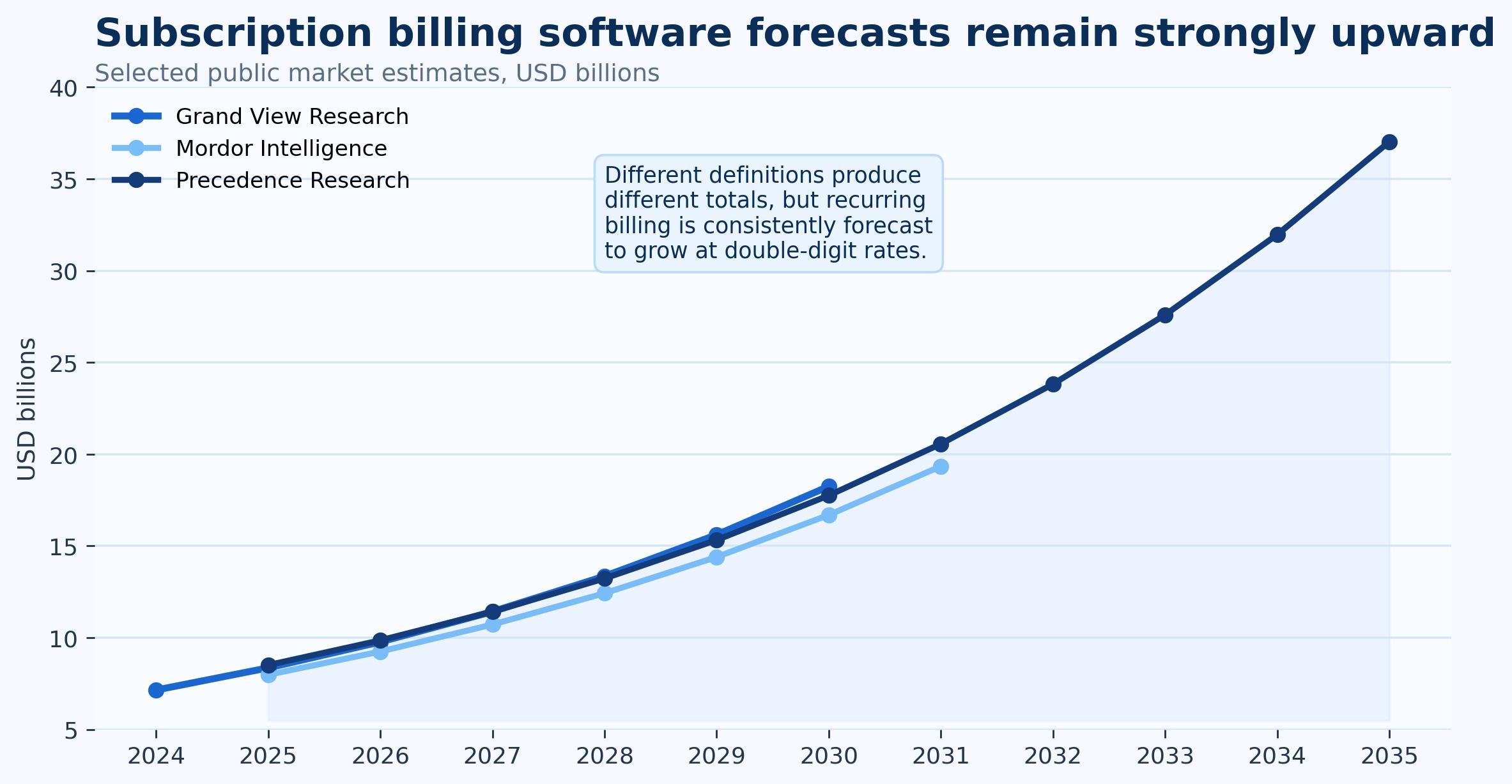
Figure 1. Public subscription billing management forecasts show strong directional growth, even when research firms define the category differently.
Why Billing Software Matters for Cash Flow
Billing is the first formal step in collecting revenue. If an invoice is late, inaccurate, difficult to understand, or difficult to pay, the cash-conversion cycle starts with friction. A strong billing system helps teams issue bills quickly, include the right details, send them to the right contact, provide convenient payment options, track status, and follow up before a balance becomes a serious problem.
Late-payment data shows why this matters. QuickBooks reported that 56 percent of surveyed US small businesses were owed money from unpaid invoices. Among those affected, the average amount owed was $17,500, and 47 percent had invoices more than 30 days overdue. Those numbers are not only collections statistics. They are billing statistics because invoice clarity, delivery, tracking, and payment experience influence whether customers pay on time.
A billing system cannot control every customer payment decision. Some late payment comes from customer cash constraints, approval delays, disputes, or intentional payment behavior. But software can reduce avoidable delays. It can send invoices immediately, add payment links, trigger reminders, show customers their balances, record payment promises, and connect billing activity to accounting records without rekeying information.
Cash-flow value also comes from visibility. Many businesses know they have invoices outstanding, but they do not always know which invoices are at risk, which customers need reminders, which payment methods are failing, which invoices are disputed, or which balances are waiting for internal action. Billing software can turn invoice status into a measurable workflow rather than a scattered collection of emails and spreadsheets.
For small businesses, the benefit may be as simple as getting paid faster and spending fewer hours chasing customers. For larger companies, the benefit may be cleaner revenue operations, better forecasting, stronger customer account data, and fewer manual handoffs between sales, finance, support, and accounting. In both cases, billing software affects the reliability of cash coming into the business.
Billing and cash-flow statistics to know
- QuickBooks reported that 56 percent of surveyed US small businesses were owed money from unpaid invoices.
- The average outstanding amount among those affected US small businesses was $17,500.
- Nearly half of affected US small businesses had invoices more than 30 days overdue.
- A UK late-payment research summary reported that 22 percent of surveyed businesses spent staff time chasing late payments.
- The same UK research estimated 86 hours per affected business per year spent chasing late payments.
- That research estimated 133 million staff hours across the economy spent on late-payment chasing.
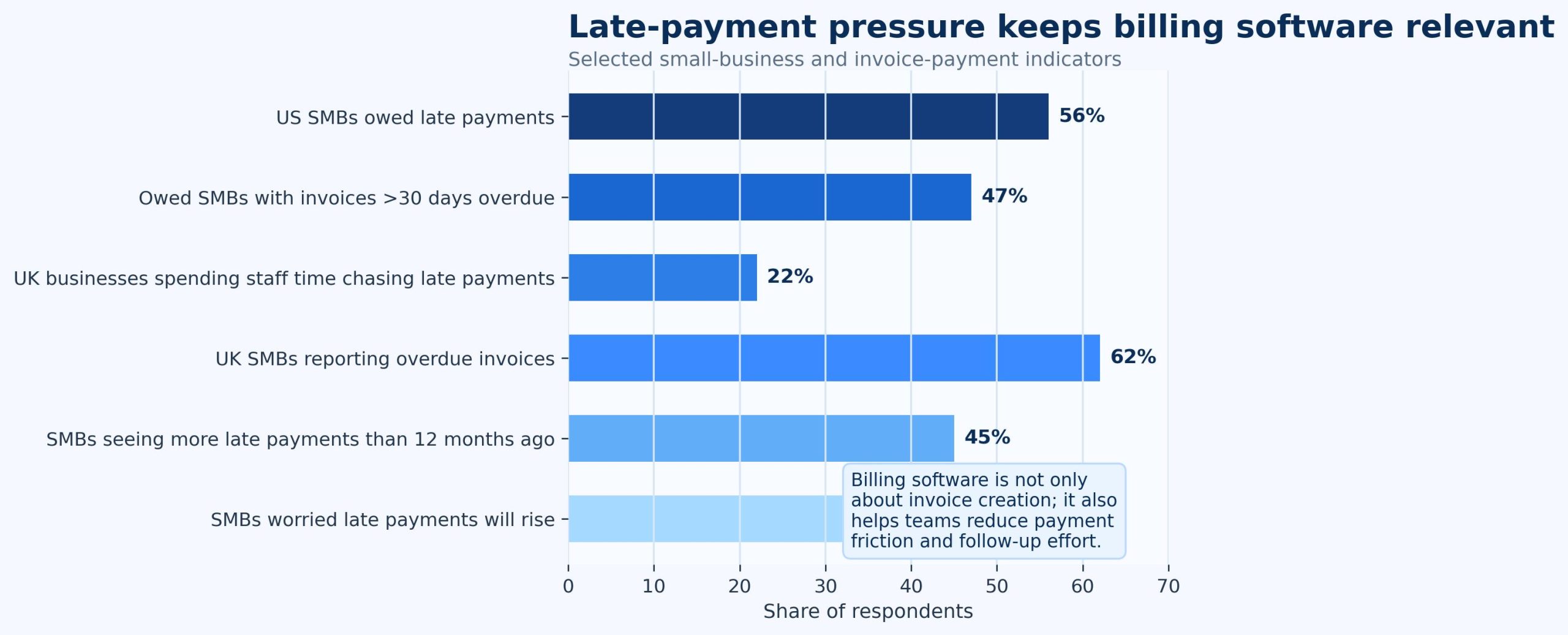
Figure 2. Late-payment pressure keeps billing software relevant because invoice clarity, delivery, payment options, and follow-up all affect cash flow.
Small Business Billing and Late-Payment Pressure
Small businesses often feel billing problems more sharply because they have less cash cushion and fewer people to manage follow-up. A large enterprise can absorb some customer delay through treasury planning or credit facilities. A small business may need one overdue invoice to cover payroll, rent, tax, materials, subcontractors, or software subscriptions.
Late payment also creates hidden administrative work. Someone has to check whether the invoice was sent, confirm the customer’s contact information, resend the document, ask whether the invoice was approved, update the aging report, reconcile partial payments, and decide when to escalate. When that work is manual, it can pull owners and managers away from sales, service delivery, and customer work.
Billing software helps by standardizing the process. It can create invoices from approved estimates, recurring charges, projects, or time entries. It can send reminders automatically, show whether the invoice has been viewed, attach payment links, and update accounting records when payment is received. Those features may sound simple, but they reduce the number of moments where a bill can disappear into an inbox.
The strongest small-business billing systems also keep language clear. Customers are more likely to pay quickly when invoices show what was delivered, what period was covered, what payment methods are available, and when payment is due. A vague invoice creates room for questions, disputes, and delays. Software cannot replace good billing discipline, but it can make discipline easier to repeat.
For very small teams, billing software is also a recordkeeping tool. It helps preserve customer history, payment notes, tax details, recurring charges, and outstanding balances. That history is useful when discussing renewals, handling disputes, preparing taxes, or deciding whether to continue working with a slow-paying customer.
Small-business billing statistics to know
- QuickBooks’ 2025 US report was based on a survey of more than 2,000 small businesses.
- The report found that 56 percent of US small businesses were owed money from unpaid invoices.
- Affected firms were owed an average of $17,500.
- Nearly 10 percent of all invoices among affected firms were more than 30 days late on average.
- GoCardless and FSB research reported that 45 percent of surveyed small businesses were experiencing more late payments than 12 months earlier.
- The same research found that 50 percent were concerned late payments would rise over the next 12 months.
- Nearly one quarter of surveyed SMBs in that research said they received payments up to 60 days late.
Subscription Billing Is Driving New Software Demand
Subscription billing is one of the clearest reasons billing software has become more sophisticated. Recurring revenue sounds simple from the outside, but the billing rules can become complex quickly. Customers may upgrade, downgrade, pause, cancel, renew, use more than their plan allows, receive discounts, start mid-cycle, change billing frequency, or need charges split across entities or departments.
Manual billing struggles with these situations because every exception adds work. A pricing change may require proration. A usage-based product may need metered data. A customer expansion may require a co-termed renewal. A downgrade may trigger a credit. A failed card payment may need a retry sequence. Each step creates financial and customer-experience risk when it is handled through spreadsheets or one-off edits.
Subscription billing software automates repeatable logic. It can calculate recurring charges, manage plans, apply discounts, handle taxes, issue invoices, process payments, retry failed transactions, and sync customer data with accounting or revenue systems. For SaaS, media, telecom, membership, and digital-service businesses, these capabilities are part of the revenue engine rather than a back-office convenience.
The market forecasts reflect that need. As more companies adopt recurring, consumption-based, or hybrid pricing, billing systems must support pricing agility without breaking invoice accuracy. The finance team needs to know not only what was billed but why it was billed, which contract rule applied, and whether the revenue and tax treatment are correct.
The strategic value of subscription billing is therefore flexibility with control. Businesses want to experiment with pricing, packaging, usage, and contract terms, but finance needs a system that can execute those models cleanly. Billing software becomes the bridge between commercial strategy and reliable financial operations.
Subscription billing statistics to know
- Grand View Research projected 16.9 percent CAGR for subscription billing management from 2025 to 2030.
- Mordor Intelligence projected 15.9 percent CAGR from 2026 to 2031.
- Mordor Intelligence estimated the category at $7.98 billion in 2025 and $9.25 billion in 2026.
- Grand View Research estimated the category at $7.15 billion in 2024 and $8.24 billion in 2025.
- Subscription billing growth is tied to recurring revenue, usage-based pricing, transparent invoice practices, and subscription-based business models across industries.
- Cloud deployment led the subscription billing market in Mordor’s segmentation with 75.35 percent share in 2025.
Online Payments and Digital Billing Experience
Billing software increasingly includes the payment experience because invoice delivery and payment acceptance are closely connected. A customer who receives an invoice but must call, mail a check, request bank details, or log into a confusing process may delay payment even when the invoice is valid. Payment friction becomes a billing problem.
Digital payment links, saved payment methods, recurring payment authorization, card processing, bank transfer options, and customer portals can reduce that friction. They also create better status visibility. Finance can see whether a customer opened an invoice, whether a payment attempt failed, whether a card expired, or whether a balance is still waiting for approval.
The payment experience matters for business-to-business customers as well as consumers. B2B buyers often need invoices routed internally, coded to the right department, checked against purchase orders, and approved before payment. A clear billing portal can make those steps easier by keeping documents, statements, balances, and payment options in one place.
Payment automation can also reduce reconciliation work. When payment data flows back into the billing or accounting system, finance teams spend less time matching deposits to invoices. This is especially valuable for businesses with many small transactions, recurring payments, or customers paying multiple invoices at once.
The risk is that payment options must be managed carefully. Card fees, ACH timing, chargebacks, failed payments, refunds, and customer authorization rules all affect billing operations. Strong billing software gives companies more payment flexibility while preserving controls and accurate records.
Digital payment and billing-experience metrics to track
- Digital payment links can shorten the path from invoice receipt to payment action.
- Customer portals reduce basic invoice-status questions when customers can view balances, statements, invoices, and payment options themselves.
- Recurring payment authorization is especially useful for subscriptions, retainers, memberships, property charges, and recurring services.
- Failed-payment recovery is a core billing workflow for subscription businesses because expired cards and declined transactions can create involuntary churn.
- Payment integration has more value when it also improves reconciliation, not only payment acceptance.
- Billing teams should track payment method mix, failed-payment rate, days to payment, payment-link usage, and reconciliation exceptions.
Utility, Tenant, and Consumer Billing Are Specialized Markets
Specialized billing markets show why billing software cannot be treated as one generic category. Utility billing, tenant billing, telecom billing, healthcare-related customer billing, and other consumer billing environments have rules that are more complex than a simple invoice for services delivered. The billing engine must reflect industry-specific usage, rates, fees, tax rules, service periods, customer communications, and compliance needs.
Utility billing software is a good example. It may need to handle meter reads, tiered rates, time-of-use pricing, distributed energy resources, late fees, service changes, customer portals, payment plans, and regulatory reporting. A generic invoice generator cannot manage those operating requirements at scale. That is why utility billing software is often analyzed as its own market.
Tenant billing software has its own patterns. Property managers may bill rent, utilities, maintenance charges, common-area expenses, deposits, late fees, and recurring service charges. Cloud-based billing tools can reduce manual invoice preparation, track payments, and make tenant account history easier to manage across properties.
Consumer billing management software is broader and often applies to industries with large customer bases. These systems need transparency, scale, payment choice, dispute support, account balance management, and consistent communication. They may also need to support multiple currencies, jurisdictions, service plans, and channel preferences.
The existence of these specialized markets is important for buyers. A company should not choose billing software only because it can create invoices. It should choose a system that fits its billing logic. The more complex the pricing, customer base, regulatory environment, or payment workflow, the more important the fit becomes.
Specialized billing market statistics to know
- Mordor Intelligence projected utility billing software to grow from $6.23 billion in 2025 to $9.82 billion by 2031.
- Grand View Research valued tenant billing software at $417.9 million in 2024 and projected 8.9 percent CAGR through 2030.
- Research and Markets valued consumer billing management software at $20.1 billion in 2024 and projected $25.6 billion by 2030.
- Research and Markets identified the US consumer billing management software market at $5.4 billion in 2024.
- China was forecast by that source to reach $5.4 billion by 2030, with 7 percent CAGR in the consumer billing management software category.
- Utility billing software demand is being shaped by cloud-native platforms, real-time settlement, distributed energy resources, and API-driven integrations.
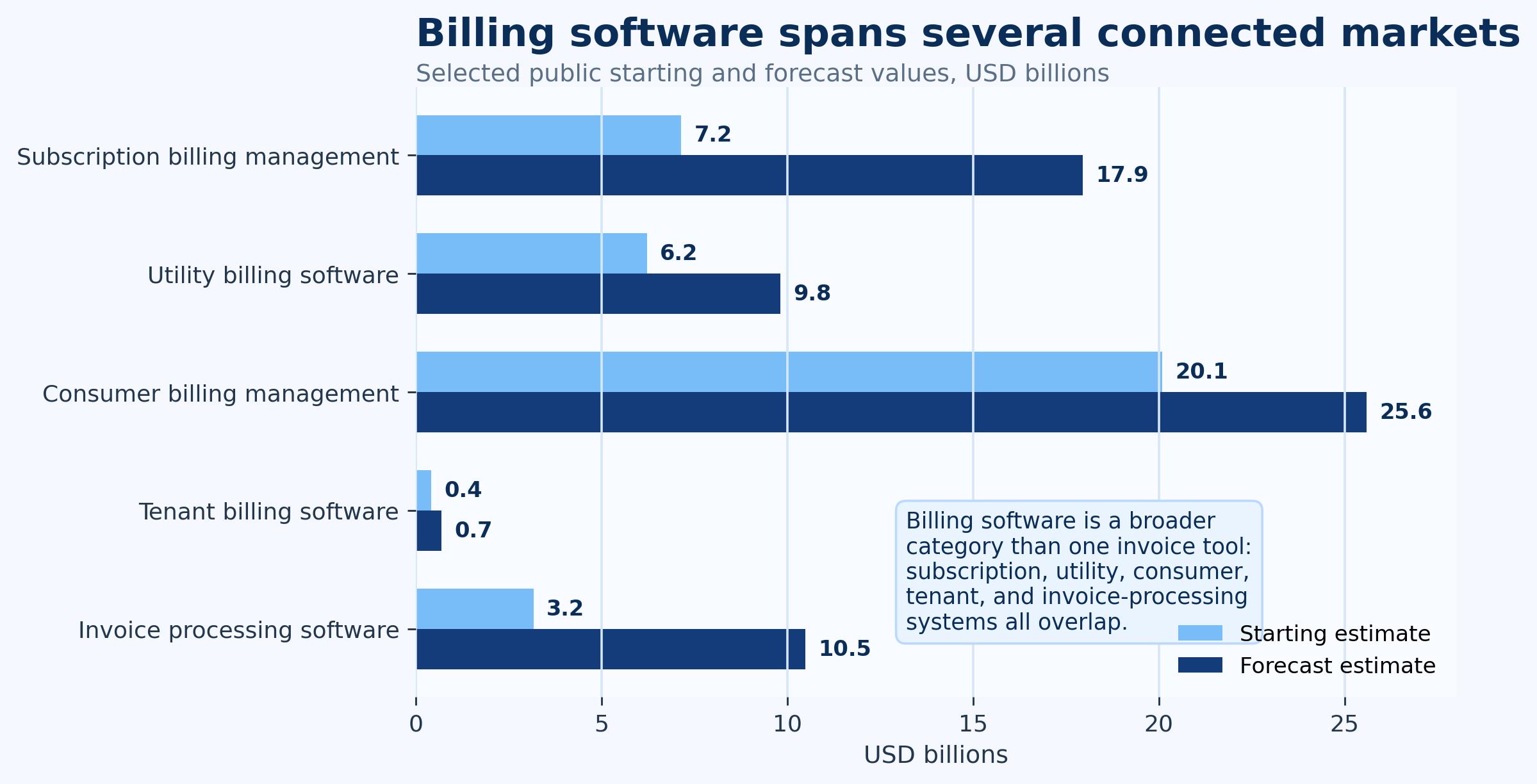
Figure 3. Billing software spans several connected markets, from subscription billing and utility billing to consumer, tenant, and invoice-processing systems.
Cloud Deployment and Integration Shape the Category
Cloud deployment is one of the strongest forces in billing software because billing rules change frequently. Pricing plans change, tax rules change, payment methods change, customer expectations change, and companies add new products or locations. Cloud systems can be updated more frequently than legacy on-premise tools and can connect more easily with payment, CRM, accounting, and analytics systems.
Integration is often the difference between a useful billing system and another layer of work. Billing software must often connect to CRM for customer and contract data, ERP or accounting systems for financial records, payment processors for collections, tax systems for compliance, subscription systems for plan rules, and data warehouses for reporting. Weak integration can force teams to rekey information even after buying automation software.
Mordor Intelligence reported cloud deployment leading the subscription billing management market with 75.35 percent share in 2025. That figure aligns with the practical needs of billing teams. Buyers want elastic infrastructure, easier updates, remote access, and fewer maintenance burdens. They also want billing systems that can support product changes without long technical delays.
Cloud billing systems can be especially useful for distributed teams. Sales, finance, customer success, support, and operations may all need access to the same customer billing information. A cloud workflow makes it easier to see invoice status, payment history, failed payment notes, credit memos, and disputes without asking one person to export a spreadsheet.
The challenge is governance. Cloud billing software should still enforce roles, approvals, audit trails, data security, and integration controls. Flexibility without control can create billing errors at scale. The best implementations balance configuration speed with clear ownership of pricing, customer data, invoice rules, taxes, and payment settings.
Cloud and integration statistics to know
- Cloud deployment led the subscription billing management market with 75.35 percent share in 2025 under Mordor Intelligence’s segmentation.
- Cloud billing software supports remote approvals, customer portals, automated updates, scalable usage, and easier payment integrations.
- Integration with CRM, ERP, accounting, tax, payment, and revenue systems often determines whether billing automation removes work or only moves work between tools.
- Billing changes should be governed because small pricing, tax, or customer-record errors can multiply across many invoices.
- API-driven integrations are becoming a procurement criterion in utility billing and broader billing systems.
- Legacy billing migrations should include data cleanup, customer-record validation, product catalog review, and invoice-template testing.
Invoice Accuracy and Customer Trust
Billing software has a direct effect on customer trust because the invoice is one of the most visible financial documents a customer receives. If the invoice is wrong, confusing, late, or missing supporting detail, the customer may question the company’s professionalism. Even when the amount is correct, unclear billing can create disputes and delay payment.
Accuracy starts with source data. Customer name, address, tax treatment, purchase order, service period, product description, price, quantity, discount, currency, and payment terms all need to be correct. A billing system can reduce errors when it pulls those fields from controlled records instead of relying on manual typing each time.
Invoice clarity also matters. Customers should understand what they are being charged for, when the service was delivered, what period is covered, which contract or quote applies, and how to pay. Billing software can standardize invoice templates so required information appears consistently. That reduces follow-up questions and makes approval easier for the customer’s accounts payable team.
For recurring and usage-based businesses, accuracy is even more important because customers may compare charges against plans, usage dashboards, contract terms, or previous invoices. A billing error can become a churn risk if customers lose confidence in the system. Automation helps by applying rules consistently, but it must be tested carefully when pricing changes.
Customer trust is also affected by correction workflows. Credit notes, refunds, voided invoices, revised invoices, and dispute notes should be documented clearly. A billing system that preserves the audit trail helps both sides understand what changed and why.
Invoice accuracy and trust checkpoints
- Billing accuracy depends on controlled customer data, product data, pricing data, tax rules, and payment terms.
- Invoice disputes often arise from unclear descriptions, missing purchase orders, wrong service periods, incorrect quantities, or mismatched contract terms.
- Recurring billing requires extra testing around proration, renewals, upgrades, downgrades, discounts, and cancellations.
- Customer-facing invoice clarity can reduce approval delays inside the customer’s accounts payable process.
- Credit-note and correction workflows should preserve a clear record of what changed, who approved the change, and how the customer balance was updated.
Automation Features Buyers Should Evaluate
Billing software buyers should evaluate features based on the actual billing workflow rather than a generic checklist. A company that sends simple one-time invoices needs a different system from a company that bills usage, subscriptions, property charges, utilities, retainers, milestone work, or high-volume customer accounts. The best feature set is the one that reduces the company’s specific billing friction.
Invoice creation is the starting point. Teams should ask whether invoices can be generated from quotes, contracts, projects, time entries, usage records, recurring plans, or imported data. They should also test whether the system handles taxes, discounts, credit notes, partial payments, payment terms, multi-currency billing, and required customer fields cleanly.
Payment and collection features should be evaluated together. Online payments, payment links, automatic reminders, late-fee rules, failed-payment recovery, customer statements, and portal access all influence whether invoices turn into cash quickly. A system that creates attractive invoices but lacks follow-up visibility may still leave the business chasing payment manually.
Reporting and analytics are also important. Finance leaders need to see invoice volume, revenue billed, overdue balances, aging, payment trends, disputed amounts, recurring revenue, failed payments, and customer-level patterns. Without reporting, billing software becomes a transaction tool rather than a management tool.
Finally, buyers should test integration and controls. The system should connect to accounting, CRM, tax, payment, and reporting tools without forcing duplicate entry. It should also support user roles, audit trails, approval rules, secure payment handling, and clean exports for finance review.
Billing automation features to evaluate
- Core features include invoice generation, recurring billing, payment links, customer records, tax handling, credit notes, reminders, and reporting.
- Subscription businesses should test proration, renewals, upgrades, downgrades, cancellations, trials, coupons, usage charges, and failed-payment retries.
- Service businesses should test estimates-to-invoices, time billing, milestone billing, retainers, project references, and client approval workflows.
- High-volume businesses should test customer portals, batch billing, payment reconciliation, account statements, and audit trails.
- Finance teams should track invoice creation time, average time to payment, overdue balances, failed-payment rate, payment method mix, and correction volume.
AI and Analytics in Billing Software
AI is entering billing software in practical areas rather than as a replacement for finance judgment. It can help detect unusual charges, recommend invoice descriptions, identify customers likely to pay late, prioritize follow-up, suggest dunning sequences, classify disputes, and improve cash-flow forecasts. These use cases matter because billing teams often have more data than they can manually interpret.
Predictive analytics can help teams move from reactive billing to proactive billing management. Instead of waiting for an invoice to become overdue, the system can flag risk based on customer payment history, invoice amount, dispute frequency, industry, past promises, or failed-payment patterns. That helps teams focus attention earlier.
AI can also support customer communication. Systems may suggest reminder timing, identify the best contact, draft payment follow-up messages, or recommend which invoices should receive a softer or firmer tone. The value is consistency and prioritization, not removing human judgment from sensitive customer relationships.
Invoice anomaly detection is another promising area. Billing systems can flag unusual amounts, missing fields, duplicated charges, unexpected discounts, or changes from normal billing patterns. This can reduce customer disputes and prevent revenue leakage before invoices are sent.
The governance challenge is important. AI outputs should be explainable enough for finance teams to trust. High-value invoices, tax-sensitive items, contract changes, and disputed balances still need controls. AI should help people see what needs attention, not hide decisions inside a black box.
AI and analytics statistics to watch
- AI use cases in billing include late-payment prediction, dunning optimization, anomaly detection, customer-risk scoring, and cash-flow forecasting.
- Billing analytics should connect invoice data with payment data, customer data, dispute data, and revenue trends.
- AI-generated customer communication should be reviewed for tone, accuracy, and compliance before being deployed at scale.
- Anomaly detection can help identify unusual discounts, duplicate charges, missing fields, or unexpected billing changes before invoices are sent.
- Predictive payment behavior is most useful when combined with clear collector actions and customer communication workflows.
Billing Software Metrics Leaders Should Track
Billing software creates value when it gives finance leaders better metrics. Invoice count alone is not enough. Teams need to understand how quickly invoices are issued, how accurately they are created, how often they are corrected, how quickly customers pay, and where billing exceptions slow down cash collection.
A good billing dashboard should include invoice creation volume, total billed amount, average days to invoice, average days to payment, overdue balances, aging by customer, payment method mix, failed-payment rate, reminder effectiveness, dispute volume, credit-note volume, and recurring revenue changes. Each metric tells a different part of the story.
Correction metrics are especially useful. If a team issues many credit notes, revised invoices, or manual adjustments, the billing process may have upstream issues. The problem could be inaccurate sales orders, unclear pricing, missing purchase orders, poor product data, or weak contract handoff. Billing software should help identify the source of these errors, not just process corrections faster.
Collection metrics should connect billing to payment outcomes. A company should know which invoices are paid through links, which reminders lead to payment, which customers often pay late, which invoices are disputed, and whether recurring payment retries recover failed charges. These metrics show whether billing automation is improving cash flow.
Leaders should also track user adoption. If teams continue creating invoices outside the system, editing records manually, or using spreadsheets for follow-up, the software is not fully embedded. Adoption metrics help managers spot training issues, process gaps, or features that do not match real workflow needs.
Billing metrics worth adding to the scorecard
- Invoice creation time measures how quickly billable activity becomes a customer-facing invoice.
- Average time to payment shows whether billing and payment workflows are supporting cash conversion.
- Overdue balance by aging bucket shows where follow-up and escalation are needed.
- Credit-note and revised-invoice rates show whether billing accuracy is improving or creating rework.
- Payment-link conversion shows whether digital payment options are actually used by customers.
- Failed-payment recovery rate is essential for subscription and recurring billing businesses.
- Dispute rate and dispute aging show where invoice clarity, contract terms, or customer communication need improvement.
Common Billing Software Implementation Barriers
The biggest billing software barriers usually appear before the first invoice is sent. Customer data may be inconsistent, product catalogs may be messy, pricing rules may be undocumented, tax settings may be unclear, and sales teams may use contract terms that finance cannot easily translate into invoice logic. Software can expose these problems quickly, but it cannot solve them without operational cleanup.
Data migration is often underestimated. Customer records, open invoices, credit balances, recurring subscriptions, payment methods, historical invoices, tax settings, and product references may need to move into the new system. If the migration is poor, the first billing cycle can create customer confusion and finance rework.
Integration can also become a barrier. Billing systems need to exchange data with accounting, ERP, CRM, payment processors, tax tools, revenue-recognition systems, and reporting platforms. If integration is incomplete, teams may still export files, rekey payments, or reconcile spreadsheets manually, which reduces the benefit of automation.
Change management matters because billing touches several teams. Sales may own contract terms, operations may confirm delivery, finance may issue invoices, support may answer customer questions, and accounting may reconcile payments. A billing software implementation should define who owns each step and what happens when an exception appears.
Testing is the final barrier. Teams should test common invoices, edge cases, credits, taxes, discounts, failed payments, renewals, cancellations, and customer communications before going live. Billing errors are visible to customers, so a weak launch can damage trust quickly.
Implementation barriers to watch
- Common barriers include poor customer data, unclear pricing rules, weak tax setup, incomplete product catalogs, and inconsistent contract handoff.
- Migration should include open invoices, customer balances, subscriptions, credit notes, payment methods, and historical records where needed.
- Integration gaps can preserve manual work even when invoice creation is automated.
- Billing implementation should define ownership across sales, finance, operations, support, and accounting.
- Teams should test edge cases such as proration, partial refunds, failed payments, tax changes, discounts, renewals, and cancellation timing before launch.
Future Outlook for Billing Software
The future of billing software is likely to be more flexible, more connected, and more analytics-driven. Businesses want to launch new pricing models without rebuilding finance processes each time. That means billing systems will need stronger product catalogs, usage data, tax logic, payment integrations, and customer account controls.
Subscription and usage-based pricing will continue to influence billing software design. Even companies that do not identify as SaaS businesses are experimenting with recurring services, memberships, consumption charges, maintenance plans, managed services, and hybrid pricing. Billing software must support that commercial flexibility while keeping invoices accurate and understandable.
Customer self-service will also become more important. Customers expect to view invoices, update payment methods, download statements, see balances, and pay online. A billing system that forces every question through email creates unnecessary work for both sides. Portals and payment experiences will become part of the product experience, not only the finance workflow.
AI and automation will expand, especially in risk scoring, anomaly detection, payment prediction, failed-payment recovery, and cash-flow forecasting. The most valuable systems will not simply automate invoice generation. They will help companies understand which invoices are likely to be paid, which ones are at risk, and what action should happen next.
The companies that get the most value will treat billing software as part of revenue operations. They will connect pricing, contracts, invoices, payments, customer communication, reporting, and accounting. Billing will become less of an isolated finance task and more of a controlled, data-rich system for turning sales into collected cash.
Outlook statistics and watch points
- Subscription billing management forecasts point to strong double-digit growth across multiple public market models.
- Cloud deployment, API integration, and customer self-service will remain central buying criteria.
- Usage-based pricing and hybrid pricing models will increase demand for flexible billing engines.
- AI will likely expand first in anomaly detection, late-payment prediction, failed-payment recovery, and billing analytics.
- Customer portals and embedded payment options will continue to reduce friction between invoice delivery and payment completion.
- Billing software will increasingly connect with revenue operations, not only accounting operations.
Frequently Asked Questions
What is billing software?
Billing software helps businesses create, send, manage, and track invoices or customer charges. Depending on the system, it may also handle recurring billing, subscription plans, payment links, customer portals, taxes, reminders, failed-payment recovery, reporting, and integration with accounting or ERP systems.
How is billing software different from invoicing software?
Invoicing software usually focuses on creating and sending invoices. Billing software can be broader, especially when it manages recurring charges, usage-based pricing, customer accounts, payment workflows, subscriptions, statements, credits, and revenue-system integration.
Why are billing software market estimates different?
Research firms define the category differently. Some focus on subscription billing management, while others measure utility billing, consumer billing management, tenant billing, invoice processing, or broader billing platforms. The exact totals vary, but the shared direction is continued digital billing growth.
What is the strongest reason to use billing software?
The strongest reason depends on the business. Small businesses may want faster invoice creation and fewer late payments. Subscription companies may need recurring billing and failed-payment recovery. Utilities may need specialized rate and customer-account logic. Enterprises may need control, integration, analytics, and auditability.
Can billing software reduce late payments?
Billing software can reduce avoidable late-payment friction by sending invoices faster, adding payment links, automating reminders, improving invoice clarity, showing customers their balances, and tracking follow-up. It cannot make every customer pay on time, but it can make the billing process more consistent and visible.
What billing metrics should companies track?
Useful metrics include invoices issued, total billed amount, average time to invoice, average time to payment, overdue balance, aging by customer, payment-link usage, failed-payment rate, credit-note rate, dispute volume, and collection effectiveness.
Does billing software matter for subscription businesses?
Yes. Subscription businesses need billing systems that can manage renewals, upgrades, downgrades, cancellations, proration, usage-based charges, discounts, failed payments, taxes, and customer account changes. Manual billing becomes risky as the customer base grows.
What is the biggest billing software implementation mistake?
The biggest mistake is implementing software before cleaning billing rules and data. Customer records, product catalogs, pricing logic, tax setup, payment settings, and contract handoff should be reviewed before launch so the system does not automate bad data.
Final Takeaway
Billing software statistics show a category that is expanding because billing is no longer only an administrative task. It now connects pricing, customer experience, payment speed, subscription growth, cash-flow visibility, and finance control. The strongest market forecasts are in subscription billing, but utility, tenant, consumer billing, and invoice-processing systems all show why billing software has become a wider operating layer.
The best billing software programs do not start with technology alone. They start with clear billing rules, clean customer data, accurate pricing, simple customer payment options, and visibility into overdue balances. When software supports those fundamentals, billing becomes a more reliable path from completed work or active service to collected cash.


