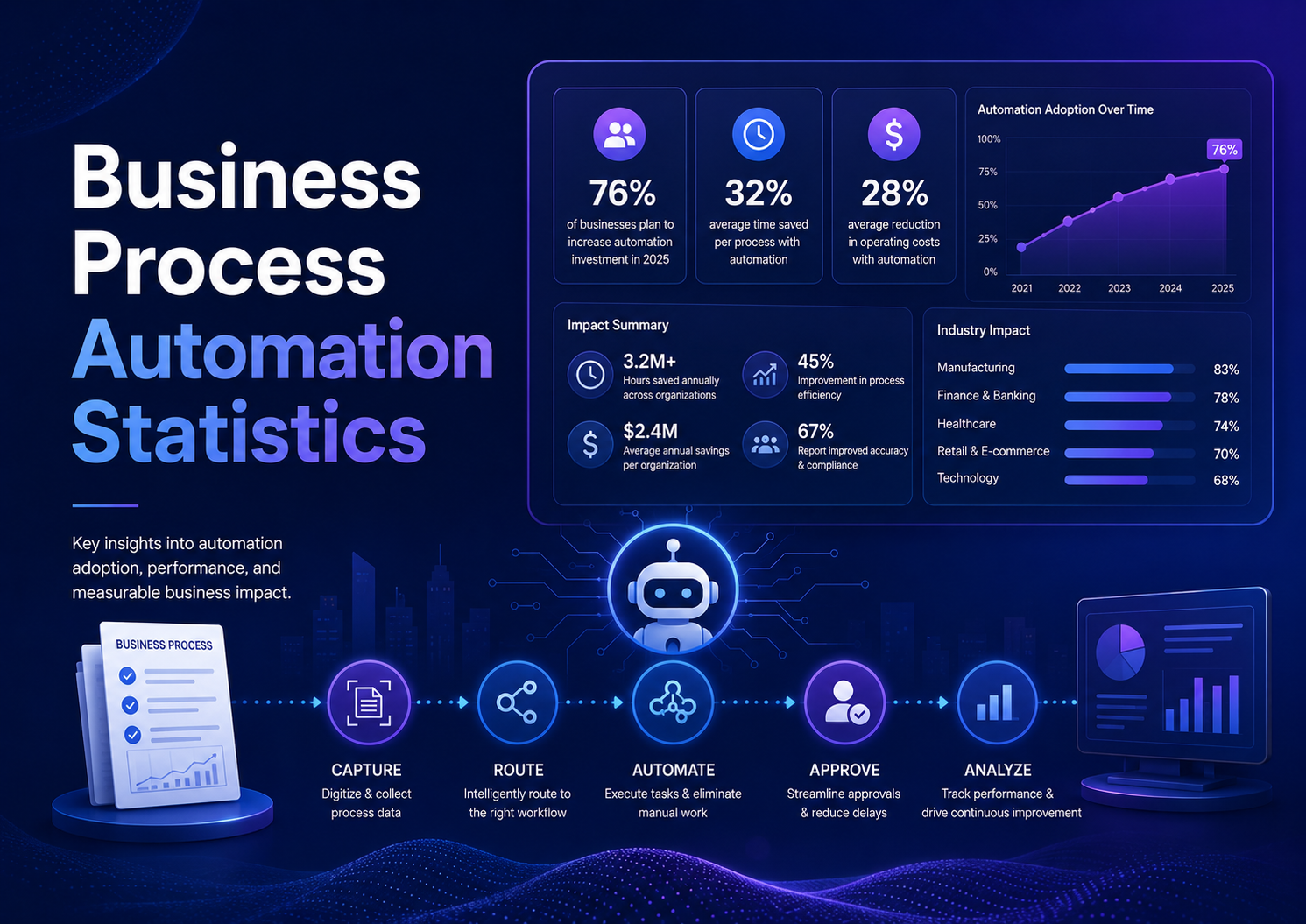
Business process automation uses software to reduce repetitive manual work across finance, HR, procurement, sales operations, customer service, IT, and operations. The strongest programs do not simply digitize an old workflow; they redesign how work moves, who approves it, what data is captured, and how exceptions are handled. The statistics around business process automation are useful because they separate market enthusiasm from operating reality. A category can grow quickly in revenue while many companies are still managing the underlying work through spreadsheets, email, manual approvals, and fragmented systems. The gap between market forecasts and day-to-day maturity is where the most useful business insight usually sits.
This report looks at business process automation through a practical finance and operations lens. Market-size estimates show how much capital, vendor activity, and customer demand are moving into the category. Adoption metrics show whether teams are changing their real workflows. Operating benchmarks show whether the tools are improving speed, accuracy, visibility, compliance, and cash outcomes rather than simply adding another software layer.
The numbers should be read with care because publishers define these markets differently. Some estimates include only software revenue. Others include services, implementation, transaction volume, platform fees, financing balances, or related workflow categories. That is why directional movement, segment differences, and operational interpretation matter more than treating any single dollar estimate as final. The strongest use of these statistics is to understand what businesses are actually trying to fix and which measurements prove progress.
Headline Statistics and Benchmarks
-
Research and Markets Industry Evaluation: Research and Markets valued the global business process automation (BPA) market at USD 14.8 Billion in 2025 and projected it to scale to USD 39.5 Billion by 2034, registering a robust compound annual growth rate (CAGR) of 11.5% over the forecast period.
-
Mordor Intelligence Workflow Assessment: Corroborating this momentum, Mordor Intelligence valued the global workflow automation market at USD 23.77 Billion in 2025, estimating that it will grow to USD 26.01 Billion in 2026 and reach USD 40.77 Billion by 2031, powered by a steady 9.41% CAGR.
-
Financial Yields of Intelligent Automation: Combining Robotic Process Automation (RPA) with AI-driven cognitive capabilities delivers massive cost savings, achieving an average return on investment (ROI) of 200% to 300% within the first 12 months while cutting overall operational expenses by 30%.
-
Procurement Workflow Friction and Complexity: Procurement and finance surveys identify systemic operational complexity as a primary driver for automation; the average modern enterprise orchestrates more than 900 cloud-based applications, leading to fractured data handoffs that demand centralized orchestration layers.
-
Cycle Time Reductions as a Core Metric: Tracking process cycle time remains a vital internal performance metric; organizations adopting unified BPA architectures realize an immediate 40% to 65% reduction in cycle times for multi-step processes like invoice routing, claims handling, and billing reconciliation.
-
Shrinking the Exception Rate with Rule-Based Logic: Automated BPA deployment directly compresses corporate exception rates—the frequency of process failures requiring human review—by introducing system-generated, rules-based decisioning that reduces data transcription errors by up to 90%.
-
Minimizing Corporate Manual Touch Counts: Analyzing manual touch count metrics reveals that 80% of business leaders are actively accelerating automation to systematically eliminate redundant friction, with a direct goal of wiping out repetitive back-office tasks for 50% of their workforce.
-
Finance Automation and Accounts Payable Yields: High-value use cases cluster heavily around finance automation, where deploying software bots cuts the cost of processing individual incoming supplier invoices by up to 75%, generating clear structural savings of over USD 5 Million annually for enterprise-scale finance departments.
-
Procurement Lifecycle and Vendor Routing Speed: In automated procurement workflows, replacing physical approval routing and unstructured purchase orders with algorithmic validation loops speeds up vendor onboarding and transaction processing velocities by 5x.
-
Human Resources and Onboarding Cost Containment: HR onboarding workflows present prime optimization opportunities; integrating automated portals drops standard new-hire onboarding times by 80% and cuts the administrative cost per hire by 30%, saving roughly USD 2,342 per open role.
-
Accelerating Employee Time-to-Productivity: By automating onboarding modules, security permission provisioning, and training paths, organizations witness a 50% reduction in time-to-productivity for new hires, successfully shifting personnel from administrative setup to active execution.
-
Banking Sector Cost-Cutting Benchmarks: In the banking vertical, 76% of financial institutions have deployed automated workflows for back-office operations, with 36% of banks confirming that automation has cut their annual operating costs by more than 10%.
-
Risk Abatement in Banking via Automated Checks: Financial institutions leveraging intelligent process automation tools to perform risk and compliance checks report an immediate 28% reduction in compliance-related costs and up to a 70% decline in fraudulent false positives.
-
Industrial Manufacturing Throughput Gains: Manufacturing companies are aggressively shifting capital toward automation, with 25% of all manufacturing capital investments over the next five years allocated to automation and AI, driving a 45% increase in production throughput.
-
Retail Inventory and Order Fulfillment Speeds: Within the retail sector, where workflow automation penetration stands at 49%, deploying synchronized supply-chain automation engines slashes inventory management costs by 38% while doubling standard order fulfillment velocities.
-
Healthcare Administrative Cost Relief: The healthcare and pharmaceuticals vertical is expanding its automation footprint at an 11.22% CAGR, driven by medical health systems using digital platforms to eliminate paper administrative processes—resulting in a 40% drop in administrative overhead costs.
-
Worker Empowerment and Administrative Time Liberation: A useful operational benchmark is whether tool adoption alters employee productivity; global workforce data shows that internal staff spend up to 57% of their time on purely administrative duties, but automation successfully returns an average of 4 hours per week back to each worker.
-
Shifting Corporate Capital to Cloud Architectures: The massive shift from legacy digitization toward connected workflows is evidenced by deployment metrics, with cloud-hosted process automation software securing a dominant 62.15% market share due to its elastic scaling properties and out-of-the-box integration capabilities.
-
The Enterprise Scaling Concentration: Large corporate ecosystems remain the leading buyers of automated platforms, commanding a 71.05% revenue share of the workflow automation market, as fragmented legacy processes create severe data visibility and control gaps at global scale.
-
Leadership Liberation from Routine Work: The absolute long-term horizon for connected operating systems is profound; market research indicates that up to 69% of traditional managerial and administrative tasks will be fully handled by underlying process automation platforms, allowing leadership teams to re-focus entirely on corporate strategy.
How to Read These Statistics Correctly
The first step in reading business process automation statistics is separating market revenue from workflow performance. Market revenue shows how much businesses and platforms are spending. Workflow performance shows whether users are saving time, reducing errors, accelerating cash, or improving compliance. A market can be growing because vendors are selling more seats or processing more transactions even if the average buyer is still early in operational maturity.
A second distinction is between adoption and maturity. A company may count as an adopter after adding a digital intake form, connecting an API, or deploying a basic workflow. That does not mean the process is fully automated, governed, or optimized. Mature adoption usually means the team has clear rules, good data quality, exception handling, audit trails, and management metrics that are reviewed regularly.
A third distinction is between volume and value. Higher volumes are helpful for proving that a system is being used, but value comes from the quality of outcomes. A workflow that handles thousands of transactions but still requires manual correction may be less valuable than a smaller workflow with high accuracy and strong controls. The best statistics combine volume, cycle time, cost, accuracy, and risk indicators.
Market Size and Growth Outlook
The market outlook for business process automation (BPA) points to sustained, non-linear demand, but the fundamental reasons for growth differ sharply by operational segment. Modern buyers are no longer purchasing software licenses simply because interface dashboards look sleek. Instead, they are demanding rapid, data-backed decisions, cleaner audit trails, and the complete elimination of manual handoffs. Research indicates that 59% of businesses now cite direct cost reduction as their primary operational motivation, while 50% of organizations look to automation specifically to wipe out human compliance errors. When an automation tool directly touches corporate cash, payment rails, credit terms, invoice templates, or multi-party regulatory approvals, the investment profile shifts entirely from a simple productivity utility to an indispensable mechanism of financial control.
Published market sizes in this category frequently diverge because the precise boundaries of the enterprise automation market remain fluid. A narrow architectural definition might capture only pure-play subscription SaaS software revenues. In contrast, a comprehensive definition includes transactional processing fees, professional implementation services, custom integration packages, and managed cloud platform operations. This variance makes it risky to directly overlay disparate market forecasts without parsing their underlying methodologies. For strategic planning, it is far more informative to track the velocity of capital allocation: for instance, platform and software architectures currently command 63.95% of total market value, but high integration complexity is causing post-sale professional deployment services to scale aggressively at a 23.6% compound annual growth rate.
Growth patterns also clearly reflect a massive transformation in buyer expectations. Corporate finance and operational teams are refusing to purchase standalone, siloed software tools. Instead, 33.3% of enterprise leaders are actively executing “hyperautomation” roadmaps designed to seamlessly bind front-office customer data with backend accounting platforms, supply chain databases, and automated bank reconciliation systems. This cross-functional pressure is visible in accounting environments, where 54.2% of finance teams confess they are currently trapped in “partial automation” loops—meaning they are still forced to waste critical human labor hours correcting flaky OCR outputs and resolving workflow exceptions. The ultimate business cases emerge when a software architecture unifies upstream and downstream data, converting a single-purpose tool into a core corporate operating system.
For small and medium-sized enterprises (SMEs), cloud-native delivery models and pre-built workflows have effectively democratized automation, allowing smaller firms to scale their deployment footprint at a rapid 21.6% CAGR without heavy upfront capital expenditure. For massive, multi-entity conglomerates, the exact same trend is critical for a different reason: fragmented legacy software workflows create dangerous visibility gaps and control liabilities at scale. In both market tiers, the justification for automation capital comes down to a hard, mathematical proof: whether the platform can reliably compress process cycle times, lower the cost-per-transaction, and protect profit margins from escalating operational friction.
Market and Adoption Statistics to Know
-
Research and Markets Global Forecast: Research and Markets valued the global business process automation market size at USD 14.8 Billion and projects it to reach a scaled valuation of USD 39.5 Billion by 2034, moving forward at a steady 11.5% Compound Annual Growth Rate (CAGR).
-
The Business Research Company Acceleration Matrix: Highlighting shorter-term velocity, parallel analysis from tracking groups indicates a rapid near-term market spike from USD 16.32 Billion to USD 18.83 Billion, expanding at an aggressive localized 15.4% CAGR driven by corporate hyperautomation initiatives.
-
Mordor Intelligence Workflow Valuation: Focusing purely on the underlying orchestration layer, Mordor Intelligence valued the global workflow automation market at USD 23.77 Billion, forecasting a steady expansion up to USD 40.77 Billion over a multi-year cycle.
-
Intelligent Process Automation (IPA) Sizing: The global market for intelligent process automation—where rule-based logic is paired with cognitive machine learning—is projected to climb from USD 15.42 Billion to USD 37.54 Billion by 2031, sustaining a 15.98% CAGR.
-
RPA and Cognitive AI Financial Returns: Integrating traditional Robotic Process Automation (RPA) with advanced generative AI features yields immediate fiscal impacts, with enterprises logging an average return on investment (ROI) of 200% to 300% within the first 12 months of full-scale deployment.
-
The Technical Anchor of RPA: Robotic Process Automation continues to serve as the structural anchor for corporate digital transformation programs, capturing a dominant 42.84% share of the total intelligent process automation technology mix.
-
The Expense of Partial Automation Exceptions: Operational fragmentation remains high; 54.2% of corporate finance chiefs report that their departments are stuck in a state of partial automation, forcing personnel to spend 15% to 25% of their working hours manually reconciling data errors and handling processing exceptions.
-
Enterprise Application and Integration Overload: The core driver behind workflow automation demand is software complexity, with the average modern enterprise now coordinating more than 900 disconnected, cloud-based applications across its global operating units.
-
Measurable Cycle Time Compression: Shifting toward unified business process automation architectures delivers massive efficiency gains, yielding a standard 50% to 60% reduction in total process cycle times for multi-step back-office transactions.
-
Operational Cost Take-Outs in Procurement: Digitizing the end-to-end source-to-pay (S2P) procurement cycle allows corporate procurement departments to immediately automate up to 60% of manual administrative tasks, driving down total operational procurement costs by 30% to 50%.
-
Protecting Enterprise Operating Margins: Speed is no longer the sole metric of success; 71% of global Chief Procurement Officers (CPOs) rank margin protection and strict spend compliance as their absolute highest priorities when evaluating new workflow automation platforms.
-
The Purchase Order Fulfillment Delta: Transactional data reveals severe performance gaps between manual and automated workflows; elite automated organizations generate an approved purchase order in just 5 hours, whereas laggard firms relying on manual routing require up to 48 hours to complete the identical task.
-
Hard Operational KPIs Replace AI Hype: Corporate finance executives are abandoning vague software adoption metrics; 34.2% of leading organizations now audit automation vendors strictly against four core, hard-number metrics: cost-per-invoice, end-to-end processing time, system error rates, and manual exception frequencies.
-
Direct Labor Cost Reduction Benchmarks: Implementing automated machine vision, algorithmic routing, and data validation steps cuts localized labor costs by up to 40% in high-volume, highly repeatable transactional ecosystems like manufacturing, warehousing, and billing data centers.
-
Corporate Capital Allocation and Cloud Share: The enterprise shift toward flexible operational expenditure models is accelerating, with cloud-deployed business process automation architectures capturing a dominant 53.90% share of total industry revenue.
-
Enterprise Scaling vs. SME Acceleration: Large scale corporate environments maintain the largest deployment footprint, controlling a dominant 67.90% market share of automated solutions, while small-to-medium enterprises (SMEs) represent the fastest-growing buyer segment.
-
Geographic Revenue and Adoption Densities: On a global scale, North American enterprises lead procurement, commanding a 36.92% share of global automation revenue, while the Asia-Pacific corporate landscape represents the fastest-growing region with a 20.7% CAGR.
-
Simplifying Banking Operations: Financial services lead vertical spending, with the Banking, Financial Services, and Insurance (BFSI) sector controlling 28.95% of the total automation market share as executive teams push to automate up to 25% of all traditional banking tasks.
-
Risk Abatement and Threat Mitigation Speed: Deploying automated process auditing and validation scripts inside enterprise networks lowers compliance management overhead by 28% while boosting the real-time detection of data anomalies and cybersecurity threats by 70%.
-
Human Resources and Onboarding Improvements: Automating the internal human resources matrix eliminates massive administrative friction, compressing employee onboarding timelines by 80% while cutting localized cross-departmental processing costs by 30%.
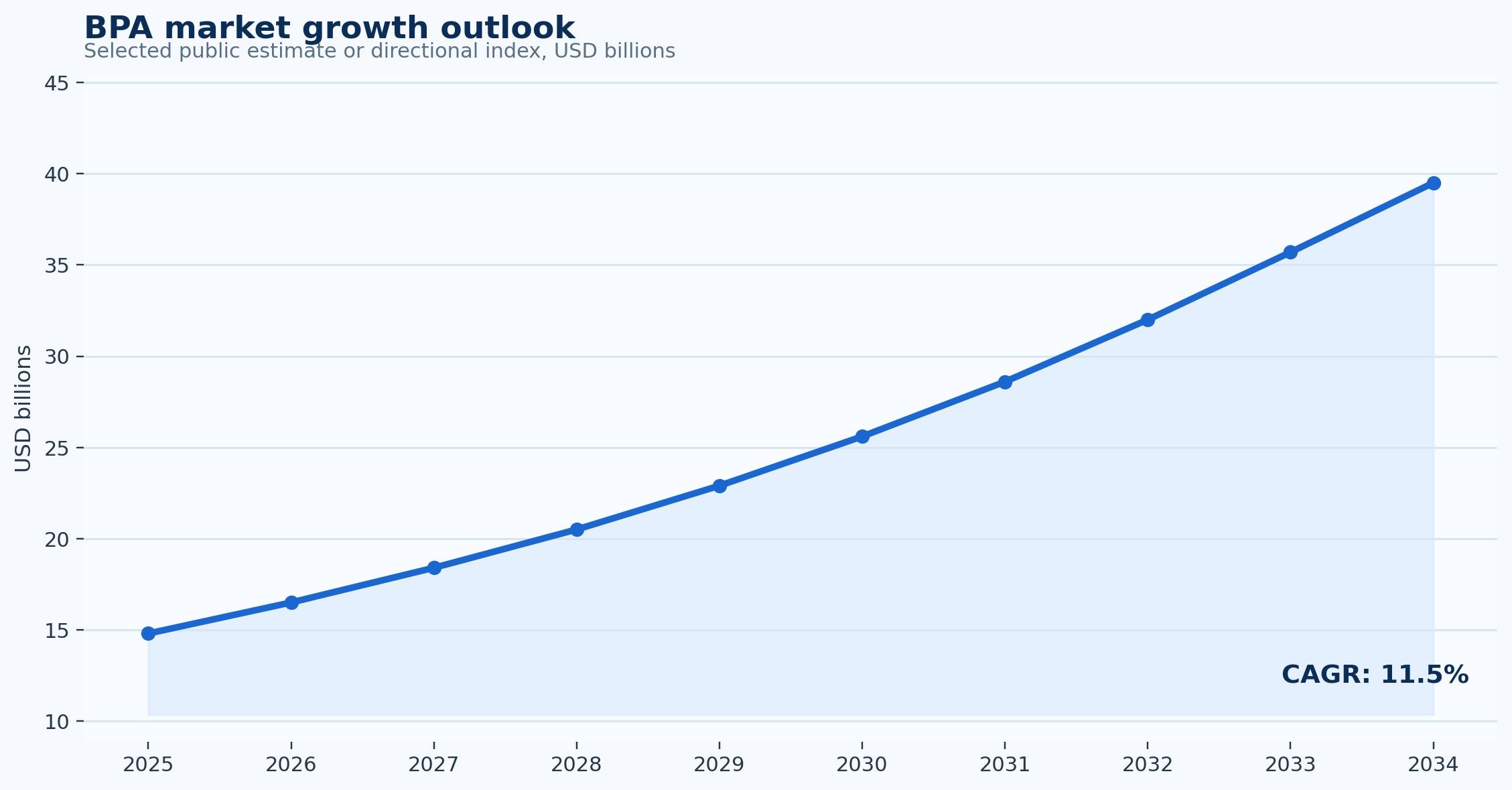
Figure 1. BPA market growth outlook shows the direction of category growth and should be interpreted as a market signal rather than a single operating benchmark.
Why the Workflow Matters Operationally
The operational case for business process automation begins with work that repeats often enough to create measurable friction. Repetition does not always look dramatic. It can be a manager checking the same spreadsheet every morning, a finance clerk re-entering data, a sales team rebuilding similar estimates, or a lender requesting the same documents from every applicant. Each touch may be small, but the combined workload becomes material when volume grows.
Technology only helps when the workflow is clear. If approval rules are inconsistent, source data is incomplete, or teams disagree about ownership, software can make the confusion faster but not necessarily better. Strong programs usually define the intake channel, required data fields, routing logic, exception categories, approval thresholds, and reporting cadence before scaling automation. That process discipline is often the difference between a successful deployment and a stalled project.
The most useful operational statistics are the ones that point to a decision. A cycle-time metric should tell leaders where work is waiting. An error metric should show whether the problem comes from data capture, policy gaps, missing information, or user behavior. A cost metric should identify whether savings come from fewer touches, less rework, faster approval, better cash timing, or reduced risk exposure.
In practice, teams should treat business process automation as a workflow redesign project rather than a single technology purchase. The system should make common work easier, route unusual work to the right person, and generate enough data for leaders to see whether the process is improving. When those three outcomes are present, the statistics become management tools rather than marketing claims.
Operational statistics and signals
- A baseline should capture current volume, current cycle time, and the amount of manual work involved before the first workflow change is made.
- Teams should separate normal-path work from exceptions because the exception queue usually explains why averages do not improve as expected.
- A practical pilot should start with a high-volume and relatively repeatable workflow before expanding into unusual or high-risk cases.
- The best evidence of progress is an improvement in process cycle time, exception rate, and cost reduction without creating weaker controls.
- Workflow visibility is often valuable even before full automation because it reveals where work waits and who needs to act next.
Adoption Maturity and Segment Differences
Segment differences matter because business process automation rarely delivers value the same way for every buyer. Smaller companies often care about simplicity, speed, cost, and avoiding administrative overload. Mid-market companies usually care about standardization across teams, locations, or customer groups. Enterprise buyers focus more heavily on integration, controls, reporting, auditability, security, and governance.
Industry differences are just as important. In banking and manufacturing, the workflow may be tied to high transaction volume and customer experience. In retail and healthcare, the same category may be more closely tied to operational accuracy, project control, compliance, or working-capital visibility. This is why a generic adoption percentage can be misleading without context.
The business model also changes the metric set. A company with recurring revenue may measure retention, renewals, and payment reliability. A project-based company may focus on margin protection, estimate accuracy, milestone billing, and revenue recognition. A finance-heavy buyer may focus on cash timing, credit risk, audit trails, and compliance. Useful reporting should reflect the way the business actually makes money and manages risk.
The practical takeaway is that leaders should benchmark against similar workflows rather than only similar company sizes. A small company with complex transactions may need stronger controls than a larger company with simpler repeatable work. A high-growth firm may value speed more than cost reduction. A regulated firm may value documentation and auditability even when the direct labor savings look modest.
Segment statistics and interpretation points
- Small businesses usually prioritize fast setup, simple workflows, and direct savings because administrative capacity is limited.
- Mid-market teams often need stronger standardization across departments, locations, customer groups, or business units.
- Enterprise buyers usually require audit logs, permissions, reporting, data governance, and deeper integration with existing systems.
- Industry use cases differ: banking and manufacturing may focus on volume, while retail and healthcare may focus on accuracy or control.
- The right benchmark should compare workflows that share similar volume, complexity, and risk rather than only comparing companies of similar size.
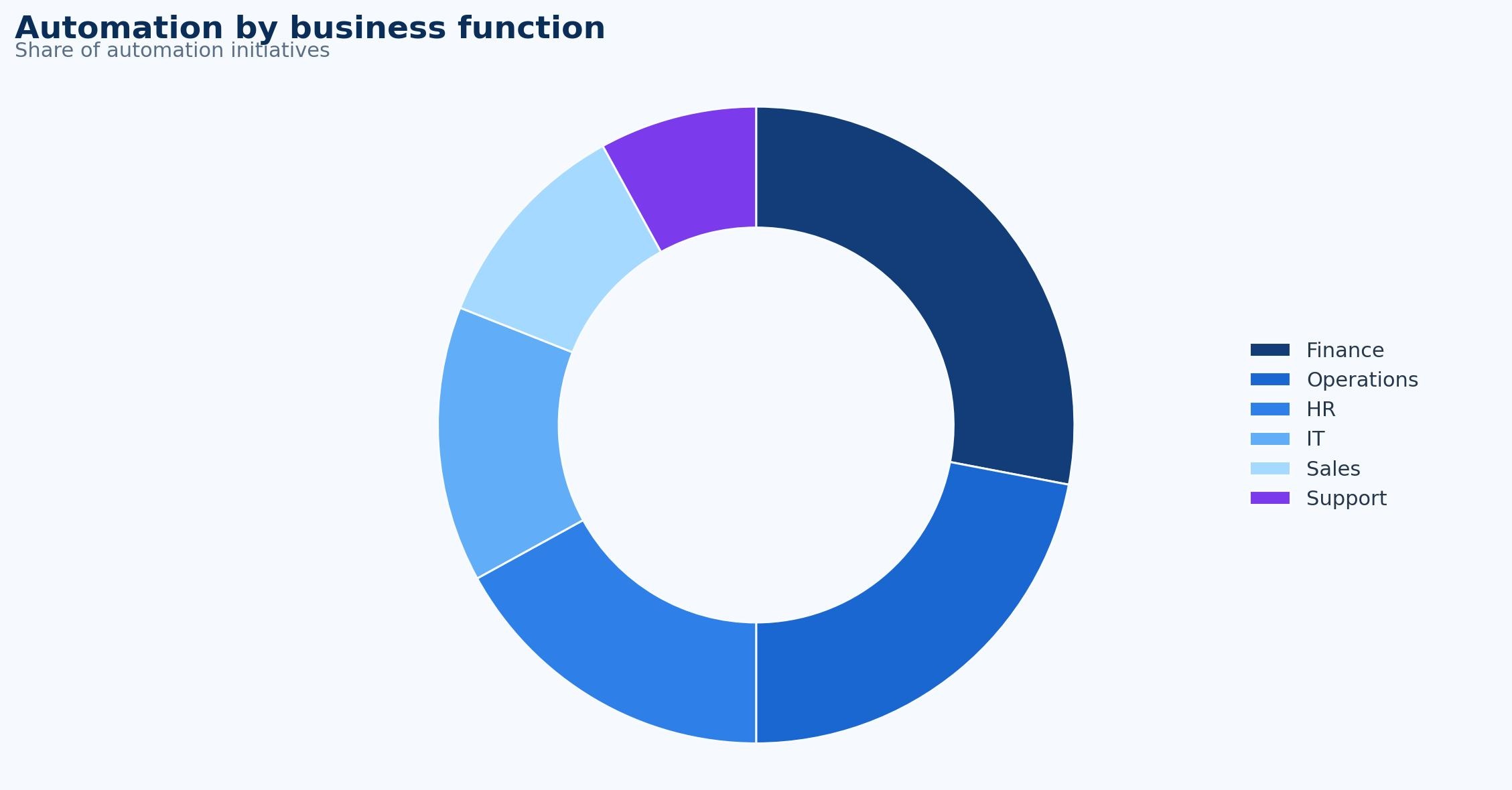
Figure 2. Automation by business function gives a practical segment view of where activity is concentrated across the category.
Technology, AI, and Integration Trends
Technology in this category is moving toward connected data rather than isolated task automation. The most valuable systems pull information from source documents, customer records, bank feeds, payment rails, accounting platforms, workflow tools, and user actions. They then use that data to route work, surface exceptions, calculate risk, and update dashboards without forcing teams to rebuild the same dataset manually.
AI and machine learning are becoming more common, but their role should be understood carefully. In most business workflows, AI is most useful when it helps classify data, detect patterns, recommend next actions, flag anomalies, and reduce repetitive review. It should not remove accountability from financial, credit, compliance, or customer-facing decisions. The strongest deployments combine automation with clear human review points.
Integration is often the limiting factor. A tool that works well by itself may create extra effort if data must still be copied into accounting, CRM, ERP, document storage, payment, or reporting systems. Integration quality affects adoption because users quickly reject workflows that make the first step easier but create reconciliation work later. A strong integration plan should include data ownership, field mapping, exception handling, and backup procedures.
Security and governance are also part of the technology story. The more a system touches payments, customer data, financial records, documents, or approvals, the more important permissions, audit logs, retention rules, encryption, and access controls become. Buyers should ask not only what the system automates, but how it proves what happened after the work is complete.
Technology and integration statistics to watch
- AI is most useful when it improves classification, recommendations, anomaly detection, or data extraction without hiding accountability.
- Integration depth should be measured by how much data moves automatically into accounting, CRM, ERP, payment, reporting, or document systems.
- Poor data quality can create more exceptions after automation, so master data cleanup is often part of the implementation work.
- Permission design matters because more automated workflows can also move sensitive financial, customer, or operational data faster.
- A system should make review easier by showing why an item was routed, approved, rejected, funded, matched, or escalated.
ROI, Cost Savings, and Business Impact
The ROI case for business process automation should not rely on a single headline saving. A narrow model might count only hours saved. A stronger model also includes lower error correction, faster cycle time, reduced exception queues, fewer customer or supplier inquiries, better cash timing, avoided hiring, fewer compliance issues, and stronger management visibility. These benefits appear in different parts of the organization, so the business case needs to look beyond the immediate user team.
A useful ROI model starts with baseline metrics. Leaders should measure the current volume, manual touch count, average processing time, exception rate, approval delay, error rate, and downstream rework before implementation. Without a baseline, the team may still feel improvement but struggle to prove it. The baseline also helps prioritize which workflow should be automated first.
Hard savings and soft savings should be separated but not treated as unrelated. Hard savings may include fewer manual hours, lower processing cost, reduced outside service spend, or avoided penalties. Soft savings may include better customer experience, stronger employee morale, improved control, and faster access to information. In many operational systems, the strongest value comes from the combination rather than one category alone.
The payback period depends on complexity. A lightweight workflow for a small business may show value quickly because setup is simple. A larger deployment may require process redesign, system integration, data cleanup, training, and governance work. That does not weaken the business case; it means leaders should set expectations around phased rollout, measurable milestones, and operating ownership after launch.
ROI statistics and calculations
- ROI should include hard savings, avoided hiring, lower rework, faster cycle time, reduced error handling, and improved management visibility.
- A one-minute saving across 100,000 annual transactions equals more than 1,600 hours of process capacity before considering error reduction.
- A 10 percent improvement in process cycle time can matter more than a larger improvement in a low-volume metric that does not affect cash, customers, or controls.
- The strongest business cases connect cost reduction to a financial or operating outcome rather than describing it only as a dashboard metric.
- Payback depends on implementation complexity, but staged deployments reduce risk by proving the workflow before scaling it across all teams.
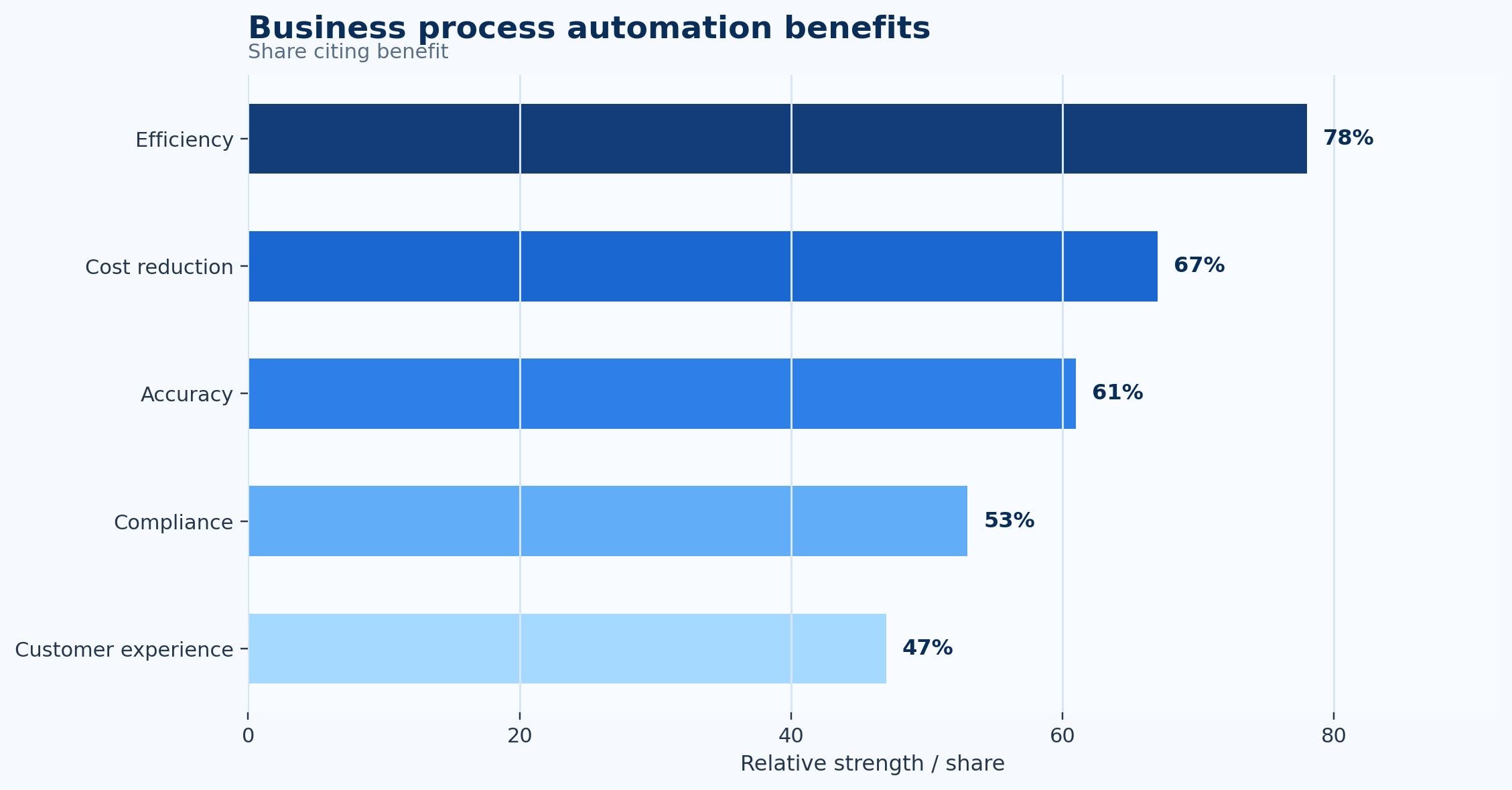
Figure 3. Business process automation benefits highlights the business reasons that commonly move the category from experimentation to budgeted adoption.
Controls, Risk, and Governance
The main implementation risk is automating a weak process before fixing the process design. If data is inconsistent, approvals are unclear, or accountability is spread across too many teams, automation may simply move the bottleneck to another place. A well-designed project should identify where decisions are made, what information is required, how exceptions are escalated, and who owns final outcomes.
A second risk is over-automation. Not every transaction, document, application, estimate, or approval should move without review. High-value, unusual, first-time, disputed, regulated, or risky items often need stronger human oversight. The goal is not to remove judgment; it is to reserve judgment for the cases where it matters most.
A third risk is poor measurement after rollout. Many teams measure go-live completion but not operating performance. A system can be technically live while users still route work around it through email, spreadsheets, messaging apps, or offline approvals. Post-launch measurement should track adoption, exceptions, cycle time, accuracy, and user behavior to confirm that the workflow is truly changing.
Governance should also evolve as the workflow matures. Early rules may work for a pilot but break when more teams, regions, products, or transaction types are added. Leaders should review thresholds, permissions, integration logs, exception reasons, and metric definitions periodically. This keeps automation aligned with how the business actually operates.
Risk and control metrics
- High-risk items should keep human review even when low-risk items move through a mostly automated workflow.
- Audit trails should record who changed the data, who approved the action, when it happened, and what rule or evidence supported the decision.
- Exception categories should be tracked over time because they often reveal recurring data, policy, training, or integration problems.
- Governance should include role-based permissions, approval thresholds, review queues, and periodic audits of unusual activity.
- A mature process treats automation as controlled speed, not speed at the expense of accountability.
Metrics Leaders Should Track
The best scorecard for business process automation should include both activity and outcome metrics. Activity metrics show whether the workflow is being used. Outcome metrics show whether the workflow is producing better results. For example, adoption rate and transaction volume matter, but they should be paired with cycle time, accuracy, cost, conversion, funding, or cash-flow outcomes depending on the topic.
Leaders should track process cycle time, automation adoption rate, exception rate, and manual touch count as early operating indicators. These metrics usually reveal whether the process is faster and more visible. They should then add cost reduction, employee productivity, SLA compliance, and error rate to understand quality, risk, and business impact.
The scorecard should also separate averages from exceptions. Average performance can look healthy while a small share of cases create most of the risk or rework. Exception aging, rejected items, manual overrides, late approvals, or high-risk transactions often reveal more about workflow health than a single average number.
Finally, the scorecard needs ownership. A dashboard without an owner becomes background noise. Each metric should have a person or team responsible for investigating movement, explaining variance, and deciding what changes next. This turns statistics into management action.
Scorecard statistics
- Process cycle time should be tracked by segment so leaders can see whether improvement is broad or concentrated in one area.
- Automation adoption rate helps reveal whether adoption is expanding or whether users are staying inside old workarounds.
- Exception rate and manual touch count show whether the process is becoming faster and more reliable.
- Cost reduction and employee productivity connect the workflow to financial value or operating quality.
- Sla compliance and error rate are important for understanding risk, scale, and long-term maturity.
Implementation Priorities
Implementation should begin with a narrow but meaningful use case. Teams often get better results by automating a repeatable workflow with clear rules than by trying to redesign every process at once. The first use case should be large enough to measure, simple enough to stabilize, and important enough for leadership to care about the results.
Data preparation is usually more important than expected. The team should review field definitions, source systems, duplicate records, approval rules, customer or supplier records, historical exceptions, and reporting requirements before rollout. This work can feel slower than software configuration, but it prevents avoidable problems later.
Training should focus on new responsibilities, not only new screens. Users need to understand what the system will do automatically, what they must still review, how to handle exceptions, and which metrics will be used after launch. This reduces resistance because people can see how the workflow will change their daily work.
After launch, leaders should hold a short operating review every month. The review should cover adoption, exceptions, cycle time, errors, user feedback, integration issues, and metric movement. This turns the system into a continuous improvement tool rather than a one-time deployment.
Implementation statistics and checkpoints
- Start with the workflow where process cycle time, exception rate, or cost reduction is most visibly underperforming.
- Create a baseline before launch so improvement can be measured without relying on anecdotes.
- Document exception reasons during the pilot because they show where process design needs more work.
- Assign ownership for the post-launch scorecard before the system goes live.
- Expand only after users trust the workflow and the data is clean enough to support decisions.
Future Outlook
The future of business process automation (BPA) is shifting from siloed, single-task software utilities to deeply embedded, intelligent operating ecosystems. This evolution is structurally visible in the hyperautomation market, which reached a valuation of USD 68.2 Billion and is projected to expand aggressively to USD 278.3 Billion by 2035 at a 16.9% CAGR. Modern enterprise buyers are no longer content with point tools that automate an isolated step while leaving the surrounding workflow dependent on manual labor. Instead, they demand end-to-end systems that handle data capture, rule verification, exception management, and reporting dynamically within a single framework. This trend toward fully connected pipelines is driven by immediate operational rewards: organizations integrating comprehensive automated workflows report an average 42% reduction in process processing times alongside a 35% net decrease in operating costs.
Artificial intelligence is expanding first in operational zones where financial risk is manageable and pattern recognition yields maximum value. The global AI automation footprint crossed USD 169.46 Billion, maintaining an intensive 31.4% CAGR toward an estimated USD 1.14 Trillion by 2033. This expansion is heavily characterized by task-specific AI agents, which are on track to be embedded in 40% of all enterprise applications, up from under 5% a year prior. While machine learning, anomaly detection, routing recommendations, and classification scale exponentially across back offices, sensitive corporate choices still demand strict human-in-the-loop accountability. The companies achieving the highest performance do not treat AI as an unmonitored shortcut; rather, they achieve a 333% average ROI by coupling cognitive models with rigorous process ownership and immutable digital audit trails.
Data quality will emerge as the definitive barrier between automation success and total project failure. As end-to-end processing speeds accelerate, underlying database deficiencies become instantly visible and highly disruptive to automated engines. The scope of this structural challenge is immense: institutional research reveals that 47% of newly created data records contain at least one critical error, while a staggering 10% to 30% of all business records suffer from duplicate entries. Furthermore, only 3% of organizations’ master data currently meets basic quality standards, forcing knowledge workers to waste up to 50% of their operational time managing data-related bottlenecks. Companies that proactively fund clean data foundations and automated deduplication architectures achieve 15% to 20% higher overall operational efficiency over competitors plagued by data decay.
The long-term outlook for automation remains positive, though realizing its full capacity is far from automatic. While mainstream enterprise adoption has hit a massive milestone—with 88% of organizations utilizing AI automation in at least one business function—a severe implementation gap remains. Currently, only 33% of enterprises have successfully scaled AI workflows across their wider organization, and a mere 39% report a measurable impact on their bottom-line EBIT. This performance discrepancy underscores that market growth does not automatically guarantee localized success. Organizations that carefully define their workflows, choose precise operational metrics, and continuously audit results over time achieve consistent value, whereas those that blindly chase the newest tech tool face a steep 42% project abandonment rate.
Outlook Statistics and Watch Points
-
Hyperautomation Market Scale: The global hyperautomation sector—the core architecture supporting connected data capture, approvals, and workflows—is valued at USD 68.2 Billion and is forecasted to hit USD 278.3 Billion by 2035 at a 16.9% CAGR.
-
Mainstream AI Integration: Moving past isolated digitizations, 88% of enterprises now utilize AI-driven automation within at least one core function, up sharply from 55% in previous operational cycles.
-
The Rise of Agentic AI: The dedicated market for autonomous AI agents capable of routing recommendations, data extraction, and decisioning reached USD 10.91 Billion, growing at an explosive 46.3% CAGR to hit a projected USD 52.62 Billion by 2030.
-
App-Embedded Automation: By the conclusion of the current cycle, 40% of all commercial enterprise applications will natively embed task-specific AI agents, a monumental jump from a baseline of less than 5% a year prior.
-
The Enterprise Implementation Gap: Despite high procurement rates, an optimization gap remains; only 33% of corporations have successfully scaled automated workflows across all operating units, and only 39% can mathematically prove a positive EBIT impact from their current setups.
-
Project Abandonment Pressures: Demonstrating that software value is not automatic, 42% of organizations abandoned or scraped major AI automation initiatives over the past year due to high integration complexity and poor initial workflow definition.
-
The Financial Returns of Platform Maturity: Organizations that overcome implementation hurdles and deploy mature, structured automation platforms log a 333% average ROI with a rapid 6-month financial payback period.
-
Accelerated Time-to-Value: Enterprises migrating legacy point tools into comprehensive operating systems capture a 5.8x average return on investment within 14 months of full operational rollout.
-
Critical Master Data Errors: Data reliability is becoming the ultimate differentiator, as 47% of newly created enterprise records contain at least one critical error that severely compromises downstream automated routing and verification rules.
-
The Baseline Data Quality Crisis: Highlighting the hidden drag on automated systems, Harvard Business Review metrics reveal that only 3% of corporate datasets meet basic quality standards, creating massive friction when processed by automated systems.
-
Wasted Human Labor on Data Decay: Due to poor master data foundations and inconsistent field definitions, corporate knowledge workers are forced to waste up to 50% of their working hours manually fixing data challenges and data decay.
-
The Proliferation of Duplicate Records: Duplicate data continues to compromise workflow security and reporting accuracy, systematically impacting between 10% and 30% of all active business records across legacy databases.
-
Data Governance Efficiency Dividends: Companies addressing data reliability through formal governance frameworks capture a 15% to 20% higher overall operational efficiency rate over unmanaged architectures.
-
The Deduplication Technology Surge: To secure automated pipelines, the global market for automated data deduplication tools is expanding rapidly to reach USD 12.5 Billion by 2028, tracking a 13.2% CAGR.
-
Total AI Infrastructure Allocation: Reflecting massive executive demand for embedded intelligence, global enterprise spending on AI systems scaled to USD 301 Billion, up 35% from the prior year’s USD 223 Billion allocation.
-
Direct Cost and Efficiency Yields: End-to-end process synchronization generates immediate operational returns, enabling 36.6% of organizations to slash their total operating costs by at least 25% while boosting general efficiency by 48.6%.
-
Shifting Labor to Analytical Oversight: Long-range business benchmarks indicate that comprehensive process automation will absorb up to 69% of routine managerial and administrative tasks, successfully redirecting workforce hours to governance and strategic choice roles.
Editorial Interpretation and Decision Quality
The final editorial lens for business process automation is practical decision quality. A statistic is useful only when it helps a business choose a better workflow, set a better target, or avoid a costly blind spot. For example, a market CAGR explains growth momentum, but it does not tell a finance leader which process to fix first. A cycle-time statistic is more actionable when it is tied to a specific bottleneck, owner, and improvement target.
This is why the best report structure combines market data with operating interpretation. Market data explains why the category is expanding. Workflow analysis explains where value is created. Segment analysis explains why different buyers need different roadmaps. Risk analysis explains what should not be automated blindly. Together, these layers make the statistics useful for planning rather than simply interesting to read.
Decision-quality statistics
- Every statistic should answer 1 of 4 questions: scale, adoption, performance, or risk.
- A strong dashboard should show at least 5 operating indicators before leadership relies on it for planning.
- A meaningful improvement target should be time-bound, such as 30, 60, or 90 days after implementation.
- The best benchmark compares before-and-after performance inside the same workflow, not only external averages.
- A useful report should connect market growth to operational choices, not leave market statistics isolated at the top.
Benchmark planning statistics
- Set a 30-day baseline window before launch so volume, cycle time, exceptions, and rework can be compared after rollout.
- Use a 60-day stabilization window after launch before making broad conclusions about ROI or adoption quality.
- Review the top 10 recurring exception reasons and assign owners for the 3 highest-volume causes.
- Track at least 5 operating metrics and 3 business-impact metrics so the scorecard does not become too narrow.
- Compare results across 3 company-size bands and 5 workflow categories before setting long-term targets.
- A mature process should show improvement in at least 2 outcome metrics without increasing risk exceptions by more than 1 review period.
- For high-volume teams, even a 2 percent reduction in rework can matter if the workflow touches thousands of cases per month.
Regional and Company-Size Planning
Regional planning adds another layer to business process automation because business infrastructure, payment behavior, regulation, bank connectivity, cloud adoption, and customer expectations are not the same everywhere. A workflow that depends on instant bank data, automated approvals, or digital document exchange may scale quickly in one market and require more manual fallback steps in another. This is why regional statistics should be interpreted alongside infrastructure readiness, not only buyer interest.
Company size changes the roadmap as well. Microbusinesses and smaller firms often want one practical improvement: faster estimates, better funding access, cleaner documents, easier cash visibility, or fewer manual follow-ups. Mid-market companies need repeatability across teams and locations. Large enterprises usually need policy enforcement, audit trails, identity controls, system integration, and reporting consistency across many entities.
A sensible rollout therefore uses different maturity targets by segment. A small company may be successful when 60 percent of a workflow is standardized and visible. A larger organization may need 85 percent or more of routine work to move through controlled rules before the process feels scalable. Highly regulated workflows may need lower automation thresholds but stronger evidence for every exception.
This segment view prevents the article’s statistics from becoming abstract. Market growth explains the category. Company-size and regional planning explain implementation. A business that connects both views can choose a realistic first target, measure progress, and decide when the workflow is ready for wider rollout.
Regional and segment planning statistics
- A small-business target might be 60 percent workflow visibility within the first 90 days rather than full automation from day one.
- A mid-market target might be 75 percent standardized intake across teams before advanced analytics are introduced.
- An enterprise target might be 85 percent routine-path coverage with documented exception queues and monthly governance review.
- A regulated workflow may intentionally keep 10 percent to 20 percent of cases under human review even after automation matures.
- Regional readiness should be scored across 5 areas: digital data availability, payment infrastructure, regulation, integration options, and user adoption.
- A quarterly review should compare at least 3 segments: small accounts, mid-sized operations, and complex enterprise workflows.
- The implementation plan should avoid using a single benchmark when the business operates across multiple regions or customer segments.
- A practical expansion gate is 2 consecutive review periods with stable cycle time, lower exception volume, and no increase in control issues.
Research Depth and Methodology Notes
A deeper research view of business process automation starts by asking what economic pressure creates demand. In some categories the pressure is liquidity, in others it is labor cost, error risk, compliance exposure, customer experience, or revenue leakage. The same market-size number means different things depending on which pressure is strongest. A buyer that is trying to reduce a two-day approval delay evaluates the category differently from a buyer trying to reduce funding gaps or improve data extraction accuracy.
The second research question is whether the category changes a decision or only changes a task. A task-level tool helps a user complete work faster. A decision-level system changes how the business prices, approves, funds, routes, forecasts, or controls an outcome. Categories that reach decision-level impact usually justify stronger investment because they affect margin, liquidity, customer retention, audit quality, or risk exposure.
A third question is how much of the workflow is measurable after implementation. Better systems leave a data trail around intake, routing, timing, exceptions, approvals, and outcomes. That trail matters because it lets leaders compare teams, identify bottlenecks, and run continuous improvement instead of relying on anecdotal user feedback.
The research also needs to separate durable trends from temporary buying waves. A temporary wave may come from budget cycles, vendor hype, or a narrow regulatory deadline. A durable trend appears when several independent forces point in the same direction: volume growth, buyer pain, measurable ROI, easier integration, stronger data availability, and greater need for control.
Methodology statistics and interpretation rules
- Market estimates should be treated as directional when one source includes services or transaction value and another includes only software revenue.
- Adoption percentages should be read together with maturity indicators such as straight-through processing, exception rate, and integration depth.
- Survey results can overstate maturity when respondents count partial digitization as full workflow automation.
- Operational benchmarks should be normalized for volume because a low-volume process can show different economics from a high-volume process.
- Regional comparisons should account for regulation, banking infrastructure, cloud adoption, and local business-payment behavior.
- Internal baselines should be captured before implementation; otherwise teams may not know whether a 10 percent or 30 percent improvement is realistic.
- A reliable benchmark combines at least 2 external references with the company’s own baseline operating data.
Industry and Use-Case Deep Dive
Industry context changes how business process automation should be evaluated. In banking, the workflow often involves high-frequency activity, many handoffs, and a need for fast visibility. In manufacturing, the same category may be judged by how well it supports margin control, credit timing, or operational capacity. These distinctions matter because one set of statistics cannot explain every business model equally well.
For retail organizations, the most important improvement may be reducing rework and standardizing data. For healthcare, the priority may be faster approvals, clearer documentation, or better exception management. For software, the strongest value may come from creating a repeatable process that reduces dependence on individual employees remembering every detail.
Industry-specific adoption also depends on data readiness. A sector with structured digital inputs can often automate faster than a sector where the same information arrives through email, PDFs, phone calls, informal notes, or spreadsheets. This does not mean the second sector has less need. It usually means implementation must spend more time on intake rules, document capture, validation, and user training.
A useful industry benchmark should therefore compare both outcomes and constraints. Leaders should ask whether peers have similar transaction volume, similar approval complexity, similar regulation, similar customer behavior, and similar integration requirements. Without those adjustments, a benchmark can push teams toward unrealistic targets or understate the value of incremental improvement.
Industry-specific statistics and signals
- Banking use cases often need faster throughput and clearer handoff visibility.
- Manufacturing use cases often depend on better margin, funding, or operational timing.
- Retail use cases usually need stronger data quality and standardized records.
- Healthcare use cases often require careful approval design and exception ownership.
- Software use cases tend to benefit when repeatable tasks are turned into governed workflows.
- The strongest benchmark compares similar workflow complexity, not only similar company revenue.
Operating Example and Practical Business Case
Consider a company that handles 8,000 relevant workflow items each month and still depends on spreadsheet tracking, email approvals, and manual status updates. If each item requires only 4 minutes of avoidable handling, the business is spending more than 530 hours a month on work that does not create additional strategic value. That example is intentionally simple, but it shows why small time savings become meaningful when volume repeats.
Now add quality problems. If 3 percent of those items require rework, 240 cases a month need extra attention. If each rework case takes 20 minutes to investigate, the team loses another 80 hours. If some of those errors affect customers, suppliers, financing decisions, estimates, documents, or compliance evidence, the cost is not only internal labor. It also becomes delay, trust loss, cash uncertainty, or risk exposure.
The same example explains why leaders should not measure only license cost. If a system reduces average handling by 90 seconds, cuts rework from 3 percent to 1.5 percent, and makes exceptions visible earlier, the value may show up across multiple departments. Finance may see cleaner records. Operations may see faster decisions. Sales or service teams may see better customer follow-up. Leadership may see more reliable reporting.
This type of operating example is more useful than a generic ROI claim because it converts statistics into a local baseline. Every organization can replace the volume, time, rework, and cost assumptions with its own numbers. The result is a business case that is grounded in actual workflow economics rather than broad market averages.
Practical operating calculations
- If a team processes 8,000 items per month, every 1 minute of avoidable handling equals about 133 hours of monthly capacity.
- A 3 percent exception rate on 8,000 monthly items creates 240 cases that require investigation before the process can be considered stable.
- Reducing average cycle time by 20 percent can be more valuable than reducing software cost by 5 percent when the workflow affects cash, customers, or compliance.
- A useful target is to review the top 5 exception reasons every month and remove at least 1 recurring root cause each quarter.
- Management dashboards should compare at least 3 views: total volume, exception volume, and business outcome movement.
- For business process automation, the scorecard should connect process cycle time with cost reduction so leaders can see whether activity translates into value.
- Teams should segment results by at least 4 dimensions: business unit, workflow type, company size, and risk level.
Frequently Asked Questions
What does business process automation measure?
Business Process Automation statistics measure market growth, adoption, workflow volume, operating performance, and business impact. The most useful numbers are not only market-size figures. They also show how teams use the tools, where manual work remains, which segments are growing fastest, and which metrics prove that the process is improving.
Why do published business process automation estimates differ?
Estimates differ because research firms define the market differently. Some include only software revenue. Others include services, transaction value, financing volume, implementation, platform fees, or adjacent workflow tools. The best approach is to compare direction, assumptions, and operational relevance rather than treating every estimate as directly interchangeable.
Which metrics matter most for business process automation?
The strongest scorecard includes process cycle time, automation adoption rate, exception rate, manual touch count. More mature teams also track cost reduction, employee productivity, SLA compliance, error rate. This combination shows speed, quality, value, and risk rather than only showing whether a tool has been deployed.
How should small businesses use these statistics?
Small businesses should use these statistics as a way to prioritize practical improvements. The goal is not to copy enterprise benchmarks. It is to identify where manual work, payment timing, data quality, approval delays, or customer experience problems are creating avoidable pressure.
How should enterprises use these statistics?
Enterprises should use the statistics to compare process maturity across teams, countries, business units, and systems. At scale, the value often comes from standardization, integration, auditability, and exception management rather than only from time saved by individual users.
What is the most common implementation mistake?
The most common mistake is buying technology before clarifying the workflow. Teams need to define data requirements, approval rules, exception handling, ownership, integrations, and success metrics before expecting the tool to produce consistent results.
How does AI affect business process automation?
AI can improve classification, data extraction, recommendations, anomaly detection, and workflow guidance. It should still operate inside clear controls, especially when the process affects payments, credit decisions, customer data, financial reporting, or contractual commitments.
What should leaders do before investing?
Leaders should document the current baseline: volume, cycle time, cost, error rate, manual touch count, exception reasons, and downstream rework. That baseline makes it easier to choose the right first use case and prove whether the investment actually improves the business.
Final Takeaway
Business Process Automation Statistics show a category shaped by the same forces affecting modern finance and operations: demand for faster workflows, better data, stronger controls, and clearer visibility. The market numbers show investment momentum, but the more useful story is operational. Businesses want tools that reduce friction, improve decisions, and make work easier to manage as volume and complexity grow.
The most important lesson is that statistics should lead to better questions. Which workflow is slowest? Which errors create the most rework? Which metric would change a customer, supplier, lender, finance, or operations outcome? Which process can be improved first without weakening control? Companies that answer those questions carefully will get more value from business process automation than companies that only follow market growth headlines.


