Food starch is one of the quiet ingredients behind modern food processing. It gives sauces body, keeps bakery products soft, improves frozen-food stability, helps confectionery set cleanly, supports plant-based textures, and gives manufacturers a cost-efficient way to manage structure, consistency, and shelf performance. In market terms, starch is both a commodity-linked ingredient and a functional formulation tool.
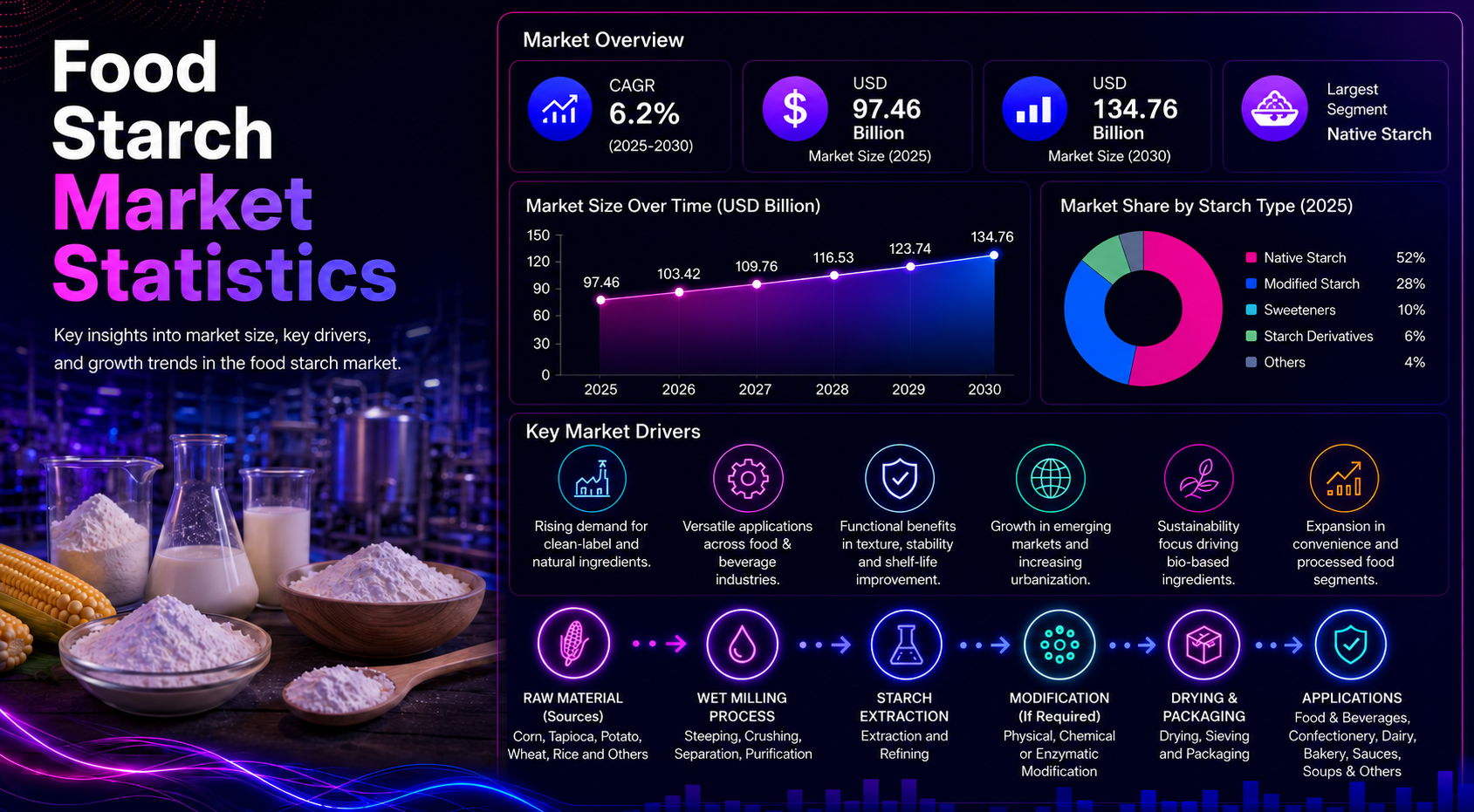
The strongest food starch statistics show a market moving on several tracks at once. Market.us places the global food starch market at USD 22.3 billion in 2024 and projects it to reach USD 37.4 billion by 2034. Other market sources place the broader food starch or modified starch opportunity in a similar multibillion-dollar range, while Starch Europe reports 70 starch production facilities operating across 18 EU member states. These figures show why food starch should be analyzed by source crop, starch type, food application, and regional processing base.
Executive Food Starch Market Benchmarks
The numbers that define the food starch market
The food starch market should be read through market value, functional demand, raw-material availability, and food-processing applications. The headline benchmarks below give the market scale before the article moves into detailed source, type, region, and application data.
- Global food starch market value reached about USD 22.3 billion in 2024 in one leading benchmark.
- The same benchmark projects the market to reach about USD 37.4 billion by 2034.
- The implied long-term CAGR is about 5.3% across the 2024 to 2034 forecast window.
- Modified starch remains the performance-led category because it supports stability, thickening, freeze-thaw tolerance, and texture control.
- Native starch and clean-label starch are gaining attention because manufacturers want simpler ingredient statements without losing functionality.
- Corn / maize is the largest source family in many markets because of scale and cost efficiency, while potato, cassava, wheat, rice, and pea starches serve differentiated use cases.
- Powder starch remains the dominant physical form because it is easier to store, ship, blend, and dose in food manufacturing.
- Asia-Pacific is the strongest growth region because it combines food processing expansion, cassava supply, and rising packaged food demand.
- Europe is important because Starch Europe reports 70 starch production facilities across 18 EU member states.
- Bakery, confectionery, sauces, processed foods, dairy, desserts, frozen foods, and plant-based foods are the most important food applications.
- Clean-label pressure is reshaping the balance between modified starch performance and native starch ingredient statements.
- Food starch risk is tied to corn, wheat, potato, and cassava crop volatility, energy costs, logistics, and formulation alternatives.
Food starch market readout
The headline data shows that food starch demand is driven by food processing scale, functional performance, and reformulation. A useful market review separates starch by source, type, form, application, region, and crop supply rather than treating starch as one generic ingredient category.
Why Food Starch Carries Food Processing and Ingredient Stakes
Food starch sits inside a broad range of everyday foods, but its market importance comes from the jobs it performs. It thickens sauces, stabilizes dairy desserts, improves bakery softness, helps frozen foods survive freeze-thaw cycles, provides binding in plant-based products, and supports crispness in coated snacks. That makes starch demand strongly connected to food manufacturing volume and formulation complexity.
A market-size figure alone does not explain starch demand. Growth also comes from convenience meals, sauces, bakery items, confectionery, frozen foods, plant-based products, and clean-label reformulation.
- Market value shows the economic scale of the food starch ingredient category.
- CAGR shows how quickly starch demand is expected to expand across food and beverage applications.
- Source-crop data explains raw-material exposure across corn, wheat, potato, cassava, and rice.
- Type data separates modified starch performance from native and clean-label positioning.
- Application data shows why bakery, sauces, dairy, snacks, frozen foods, and plant-based foods should be tracked separately.
- Regional data identifies where food processing, crop supply, and consumer reformulation trends overlap.
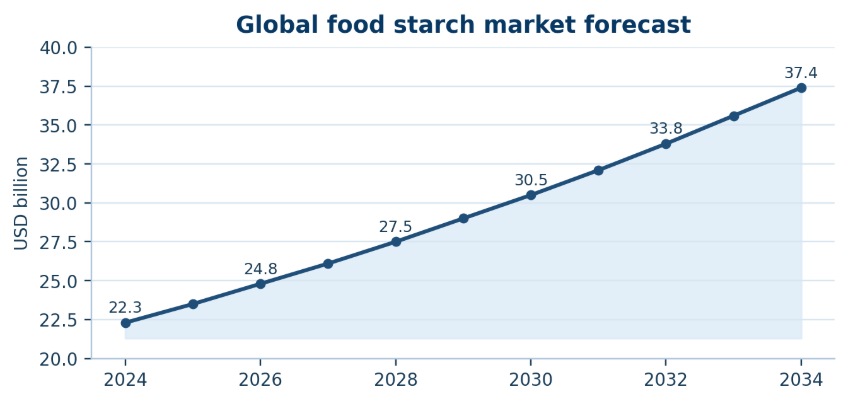
Figure 1. Food starch growth reflects processed food demand and clean-label reformulation.
Food Starch Market Signal Map
| Signal | What It Shows | Why It Matters |
|---|---|---|
| Market value | USD 22.3 billion in 2024 | Shows current scale of the category |
| Forecast value | USD 37.4 billion by 2034 | Shows long-term growth opportunity |
| CAGR | About 5.3% | Shows market momentum |
| Leading source | Corn / maize | Shows scale and raw-material dependency |
| Label trend | Native and clean-label starch | Shows reformulation pressure |
| Functional trend | Modified starch | Shows performance-led demand |
Global Food Starch Market Size Statistics
Market-size estimates vary because sources define food starch, modified starch, native starch, and specialty starch differently. The useful signal is that each benchmark still points to a large, growing functional ingredient category.
- Market.us reports the food starch market at USD 22.3 billion in 2024.
- Market.us projects a 2034 value of USD 37.4 billion for the food starch market.
- Future Market Insights places one starch-related benchmark around USD 22.7 billion.
- IMARC Group reports a broader starch benchmark near USD 25.4 billion.
- Markets and Markets places a modified starch benchmark near USD 24.6 billion in a recent estimate.
- Global Market Insights places a comparable starch market benchmark near USD 26.1 billion.
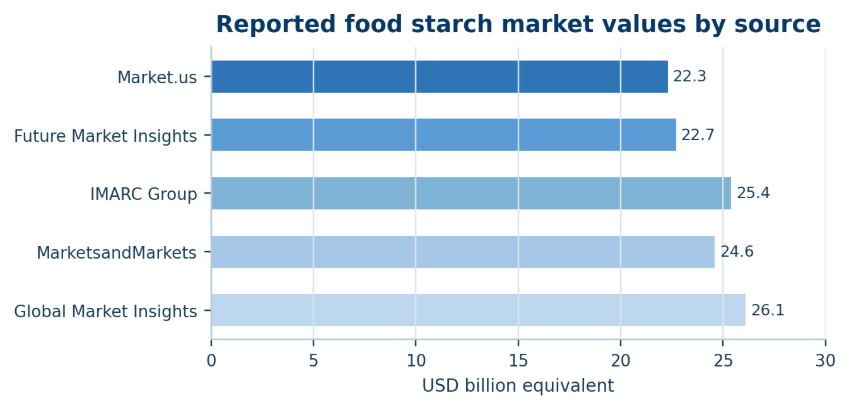
Figure 2. Market estimates differ by definition, but all sources point to a large multibillion-dollar ingredient category.
Global Food Starch Market Snapshot
| Metric | Latest Benchmark | Why It Matters |
|---|---|---|
| Global market size | USD 22.3 billion in 2024 | Current market scale |
| Forecast size | USD 37.4 billion by 2034 | Long-term opportunity |
| CAGR | About 5.3% | Growth pace |
| Leading source | Corn / maize | Raw material scale |
| Leading form | Powder starch | Storage and handling advantage |
| Important trend | Clean-label starch | Reformulation opportunity |
Market-size readout
Food starch growth is not only caused by higher food consumption. It is supported by processed food demand, convenience meals, sauces, bakery expansion, clean-label reformulation, and the need for stable, cost-effective functionality.
Food Starch Type Statistics: Modified, Native, and Specialty Starches
Starch type determines how the ingredient behaves in processing and how it appears on the label. Modified starch is used when manufacturers need tolerance to heat, shear, acid, freezing, or storage. Native starch is used when simple labels, recognizable ingredients, and clean-label claims matter. Specialty starches extend the category into nutrition, texture, instant viscosity, organic claims, and non-GMO positioning.
- Modified starch supports stability, thickening, processing tolerance, texture control, and freeze-thaw performance.
- Native starch supports clean-label positioning and is especially relevant in sauces, bakery, snacks, and simple-label foods.
- Pregelatinized starch provides instant viscosity and is useful in dry mixes, soups, fillings, and convenience foods.
- Resistant starch supports nutrition positioning because it can contribute fiber-like benefits in certain applications.
- Organic starch supports premium, natural, and certified food formulations.
- Non-GMO starch demand is strongest in markets where retailers and consumers closely examine ingredient sourcing.
- Specialty starches compete on both functionality and label appeal, not only price.
- Clean-label systems often require trials because native starch may not always match modified starch performance under harsh processing conditions.
Food Starch Type Diagnostic
| Starch Type | Core Use Case | Market Role |
|---|---|---|
| Modified starch | Stability, texture, processing tolerance | Functional workhorse |
| Native starch | Clean-label thickening and texture | Simple-label formulation |
| Pregelatinized starch | Instant viscosity | Dry mixes and convenience foods |
| Resistant starch | Nutrition positioning | Health-oriented products |
| Organic starch | Certified organic foods | Premium and natural positioning |
Starch-type readout
Food starch demand is split between performance and label simplicity. Modified starch supports demanding processing conditions, while native, organic, non-GMO, and clean-label starches support consumer-facing formulation claims.
Food Starch Source Statistics: Corn, Potato, Cassava, Wheat, and Others
The source crop matters because every starch behaves differently. Corn starch is widely used because of scale and cost efficiency. Potato starch is valued for high viscosity and clean taste. Cassava or tapioca starch is useful in gluten-free and clean-label products. Wheat starch is linked to wheat-processing systems and bakery-related applications, while rice, pea, sweet potato, and sago starches serve specialized regional or functional needs.
- Corn / maize is the largest food starch source family in many markets because it offers scale, availability, and cost efficiency.
- Potato starch is valued for high viscosity, neutral flavor, and premium texture in processed foods.
- Cassava / tapioca starch supports gluten-free, clean-label, and neutral-taste formulations, especially in Asia-Pacific and export markets.
- Wheat starch is important in Europe and bakery-linked systems but must be managed carefully in gluten-sensitive applications.
- Rice starch is useful in infant food, hypoallergenic positioning, smooth texture systems, and premium foods.
- Pea starch is gaining relevance in plant-based systems and alternative protein applications.
- Sweet potato and sago starches are more regional, but they contribute to specialty texture and local supply chains.
- Raw-material availability, crop yields, logistics, and price volatility directly affect starch cost and sourcing decisions.
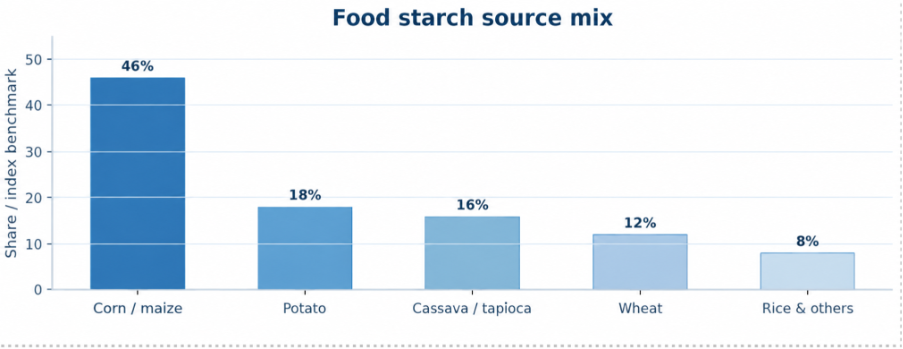
Figure 3. Corn remains the dominant food starch source.
Food Starch Source Map
| Source | Main Strength | Food Market Relevance |
|---|---|---|
| Corn / maize | Scale and cost efficiency | Largest source in many markets |
| Potato | High viscosity and clean taste | Premium texture and processed foods |
| Cassava / tapioca | Neutral taste and gluten-free positioning | Clean-label and Asia-Pacific strength |
| Wheat | Integrated wheat processing | European and bakery-linked uses |
| Rice | Smooth texture and hypoallergenic appeal | Infant food and specialty products |
| Pea | Plant-based functionality | Alternative protein systems |
Source readout
Food starch sourcing matters because each crop creates different functionality, labeling, pricing, and regional supply exposure. Source data helps explain both formulation choices and supply risk.
Food Starch Application Statistics
Food starch demand is strongest in applications where texture, consistency, shelf stability, processing tolerance, and cost control matter. Bakery products use starch for softness and moisture management. Sauces need controlled viscosity. Dairy and desserts need body and creaminess. Frozen foods need freeze-thaw stability. Plant-based foods use starch to bind, thicken, and create a more familiar bite.
- Processed foods are the largest application group because complex recipes often require thickening, binding, and stabilization.
- Bakery uses starch to support softness, moisture retention, crumb structure, and shelf-life performance.
- Sauces, dressings, soups, and gravies depend on starch for viscosity and consistent pour behavior.
- Dairy and desserts use starch to create body, creaminess, suspension, and stable texture.
- Confectionery uses starch for gelling, molding, dusting, texture, and coating performance.
- Snacks and coated foods use starch for crispness, adhesion, binding, and appearance.
- Frozen foods use starch to reduce texture breakdown during freezing, thawing, and reheating.
- Plant-based foods use starch for structure, binding, juiciness, and mouthfeel in meat and dairy alternatives.
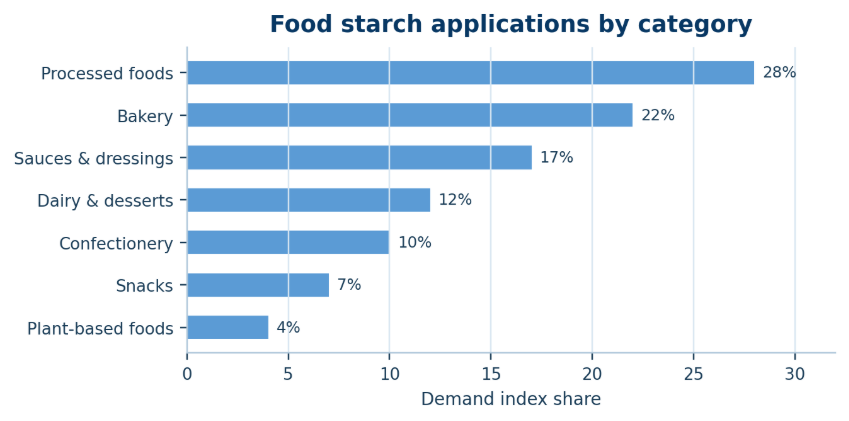
Figure 4. Food starch application demand is led by processed foods, bakery, sauces, and texture-sensitive categories.
Food Starch Application Diagnostic
| Application | Why Starch Is Used | Market Interpretation |
|---|---|---|
| Bakery | Structure, moisture, softness | Quality and shelf-life support |
| Confectionery | Gelling, texture, coating | Candy and sweets performance |
| Sauces and dressings | Thickening and stability | Core processed food use |
| Dairy and desserts | Creaminess and body | Texture and mouthfeel support |
| Snacks | Crispness and binding | Processed snack quality |
| Frozen foods | Freeze-thaw stability | Less texture breakdown |
| Plant-based foods | Binding and texture | Meat and dairy alternative systems |
Application readout
Food starch demand is strongest where texture, consistency, stability, and processing efficiency matter. Application data should be separated because bakery, sauces, dairy, snacks, frozen foods, and plant-based products use starch for different reasons.
Modified Food Starch Market Statistics
Modified food starch remains a major performance category because many modern foods need stability under conditions that native starch cannot always handle. Heat, shear, acidity, freezing, retorting, and long storage can break down ordinary starch systems. Modified starch helps manufacturers keep products consistent through production, distribution, and consumption.
- Modified starch is commonly used where stability and processing tolerance are more important than a simple ingredient statement.
- Freeze-thaw stability is important in frozen meals, desserts, sauces, and chilled products.
- Thickening and stabilizing applications remain central to modified starch demand.
- Convenience food manufacturers use modified starch to maintain texture during storage and reheating.
- Processed food systems use modified starch to manage viscosity, mouthfeel, and production consistency.
- Clean-label pressure has encouraged some brands to reduce modified starch use where native alternatives can perform well.
- Modified starch still remains difficult to replace in harsh processing conditions.
- The opportunity is to match starch modification, source, and food matrix to the exact performance need.
Modified Food Starch Market Diagnostic
| Signal | What It Shows | Why It Matters |
|---|---|---|
| Market size | Functional starch scale | Performance ingredient demand |
| CAGR | Growth momentum | Future adoption |
| Food applications | Usage in processed foods | Manufacturer demand |
| Freeze-thaw stability | Processing performance | Frozen and chilled foods |
| Label pressure | Consumer-facing challenge | Clean-label alternatives |
Modified starch readout
Modified starch solves practical processing problems, but clean-label demand means manufacturers must balance functionality with consumer perception and label preferences.
Native and Clean-Label Starch Statistics
Native and clean-label starches have become more important as food brands simplify ingredient statements. Consumers may not know the technical difference between native and modified starch, but they often respond to shorter, more recognizable labels. This has made tapioca, potato, rice, corn, and specialty native starches more attractive in reformulation projects.
- Native starch demand is linked to simple-label positioning and recognizable ingredients.
- Tapioca starch is popular in clean-label and gluten-free products because it has a neutral taste and flexible texture.
- Potato starch supports premium texture, high viscosity, and clean taste in many processed foods.
- Organic starch demand is connected to premium, certified, natural, and organic product lines.
- Non-GMO starch matters in North America and Europe where retailer standards and consumer trust are important.
- Gluten-free product growth supports cassava, potato, rice, corn, and other non-wheat starch sources.
- Clean-label reformulation can be technically difficult because native starch may not perform under heat, shear, acid, or freezing.
- The strongest clean-label opportunity is targeted replacement, not universal replacement of modified starch.
Native and Clean-Label Starch Diagnostic
| Signal | What It Reveals | Why It Matters |
|---|---|---|
| Native starch use | Simple ingredient demand | Label-friendly foods |
| Tapioca starch | Gluten-free and neutral taste | Clean-label reformulation |
| Potato starch | Texture and premium positioning | Quality-focused foods |
| Organic starch | Premium product demand | Natural and organic claims |
| Non-GMO starch | Consumer trust signal | North America and Europe relevance |
Clean-label readout
Clean-label starch growth comes from consumer preference for simpler ingredient statements, but performance still matters. The best formulations use native starch where it can deliver acceptable texture and stability.
Regional Food Starch Market Statistics
Regional starch demand depends on food manufacturing scale, raw material supply, eating habits, and ingredient regulation. Asia-Pacific combines strong growth with cassava and corn processing. North America has a mature corn starch base. Europe has mature processing capacity and strong clean-label pressure. Latin America combines corn and cassava opportunities, while the Middle East and Africa are shaped by food imports and processing modernization.
- Asia-Pacific is the leading growth region because of processed food expansion, cassava supply, and rising packaged food consumption.
- North America remains a mature ingredient market connected to corn starch, snacks, sauces, convenience foods, and frozen meals.
- Europe has a strong starch production network, with 70 facilities across 18 EU member states reported by Starch Europe.
- Latin America is important for cassava and corn raw materials as well as rising processed food demand.
- Middle East and Africa markets are smaller but supported by food manufacturing modernization and import-driven food systems.
- China is important because of its large food processing base and crop supply scale.
- Thailand is strategically important because of cassava and tapioca starch production.
- Germany, France, the Netherlands, and Poland are important in the European starch system.
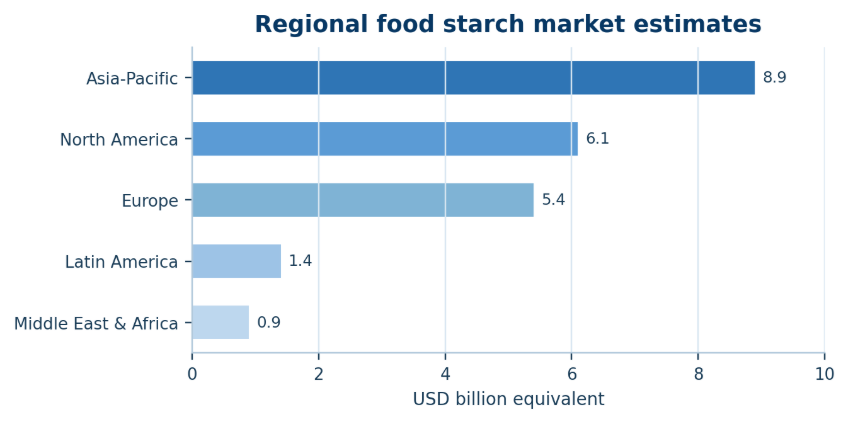
Figure 5. Regional starch demand is shaped by food processing scale, crop supply, and clean-label pressure.
Regional Food Starch Market Snapshot
| Region | Market Pattern | Article Interpretation |
|---|---|---|
| Asia-Pacific | Food processing and cassava / corn use | High growth and production relevance |
| North America | Corn starch and processed food demand | Mature ingredient market |
| Europe | Strong starch processing network | Technical and clean-label demand |
| Latin America | Cassava, corn, and processed food growth | Source and consumption opportunity |
| Middle East & Africa | Food import and manufacturing modernization | Emerging starch demand |
| China | Large food processing base | Major demand and production role |
| Thailand | Cassava / tapioca strength | Important export and ingredient source |
Regional readout
Food starch demand is global, but regional patterns differ. Asia-Pacific combines growth and raw-material supply, North America is tied to corn starch scale, and Europe combines mature processing with label-sensitive food innovation.
Country-Level Food Starch and Raw Material Statistics
Country-level analysis is essential because food starch is linked to crops. A strong market may depend on corn, wheat, potato, cassava, rice, or pea availability. The same country can be important as a raw material supplier, a food manufacturing hub, a starch processor, or a consumer market.
- The United States is important for corn and corn starch scale.
- China is important for corn, potato, wheat, and large food processing demand.
- India has a diverse starch base connected to maize, potato, wheat, and cassava.
- Brazil contributes corn and cassava raw material relevance in Latin America.
- Thailand is one of the most important cassava and tapioca starch supply markets.
- Indonesia and Vietnam support cassava-linked starch systems in Southeast Asia.
- Germany and France are important in European starch processing and crop supply.
- Nigeria is important for cassava production and long-term raw material potential.
- Mexico is relevant because of corn-based food systems and processed food demand.
- Turkey and GCC markets support food manufacturing and ingredient import demand.
Country-Level Food Starch Raw Material Intelligence
| Country | Relevant Raw Material | Why It Matters |
|---|---|---|
| United States | Corn / maize | Corn starch scale |
| China | Corn, potato, wheat | Food processing and starch demand |
| India | Maize, potato, wheat, cassava | Diverse starch source base |
| Thailand | Cassava | Tapioca starch relevance |
| Brazil | Cassava and corn | Latin American raw material base |
| Germany | Potato and wheat | European starch context |
| France | Wheat and maize | European starch processing |
| Nigeria | Cassava | Raw material supply potential |
Country readout
Country-level starch analysis should not only look at market revenue. Raw material production matters because starch availability, pricing, and specialization depend on crop systems.
Europe Food Starch and Starch Industry Statistics
Europe deserves a separate view because it has mature starch processing infrastructure and strong food manufacturing demand. Starch Europe reports 70 starch production facilities across 18 EU member states, a useful benchmark for the region’s processing base. The European sector uses maize, wheat, potato, and pea raw materials and supplies food, feed, paper, fermentation, and bio-based applications.
- Starch Europe reports 70 starch production facilities in the European Union.
- Those facilities are spread across 18 EU member states.
- Europe uses maize, wheat, potato, and pea raw materials in the starch sector.
- Food and drink applications are important because Europe has a mature processed food industry.
- Germany, France, the Netherlands, Belgium, and Poland are important starch-related markets.
- European clean-label demand supports native starch, specialty starch, and reformulation activity.
- European starch capacity also links to bio-based material discussions beyond food.
- Food manufacturers in Europe often balance technical performance, label simplicity, and sustainability claims.
Europe Food Starch Industry Diagnostic
| Europe Signal | What It Shows | Market Meaning |
|---|---|---|
| 70 facilities | Processing infrastructure | Shows maturity |
| 18 EU member states | Regional production spread | Shows supply network |
| Maize, wheat, potato, pea | Raw material mix | Shows source diversity |
| Food applications | Food and drink demand | End-market strength |
Europe readout
Europe’s starch market is shaped by mature processing capacity, diversified raw materials, food manufacturing demand, and label-sensitive consumers.
Food Starch Form and Function Statistics
Food starch is valuable because it performs multiple formulation roles. Powder starch dominates because it is easy to store and transport. Pregelatinized starch gives instant viscosity. Liquid starch is useful in certain industrial systems. Across food applications, starch can thicken, stabilize, bind, gel, coat, retain moisture, improve mouthfeel, and protect texture through storage.
- Powder starch is the most common form because it is easy to ship, store, blend, and dose.
- Liquid starch is more limited but useful in certain continuous industrial systems.
- Pregelatinized starch supports instant viscosity in dry mixes and convenience foods.
- Thickening is one of the most important functions in sauces, soups, gravies, and fillings.
- Stabilizing is important in dairy, frozen foods, dressings, and emulsified products.
- Binding is important in meat, snacks, and plant-based foods.
- Coating supports crispness, adhesion, and appearance in fried or snack products.
- Moisture retention supports bakery softness and shelf-life performance.
Food Starch Form and Function Map
| Form / Function | Use Case | Market Role |
|---|---|---|
| Powder starch | Dry mixes, bakery, sauces | Dominant and transportable form |
| Liquid starch | Industrial formulation | Specific processing systems |
| Pregelatinized starch | Instant viscosity | Convenience foods |
| Thickening | Sauces, soups, fillings | Core food application |
| Stabilizing | Dairy, frozen foods, dressings | Protects quality |
| Binding | Meat, snacks, plant-based foods | Supports structure |
| Coating | Fried foods and snacks | Crispness and appearance |
Function readout
Food starch is valuable because it can thicken, stabilize, bind, coat, improve texture, retain moisture, and support quality during processing and storage.
Food Starch Market Drivers
The main drivers of food starch demand are not isolated. Processed food growth increases the need for texture systems. Convenience foods need shelf stability. Bakery and confectionery require structure and consistency. Plant-based foods need binding and mouthfeel. Clean-label reformulation pushes native and specialty starch demand, while cost pressure keeps starch attractive against more expensive functional ingredients.
- Processed food growth increases starch use because more products need texture and stability systems.
- Convenience foods require shelf-stable, easy-prep, and reheatable formulations.
- Bakery demand supports starch use for softness, structure, moisture control, and shelf life.
- Sauces and dressings require thickening, suspension, and consistent pour behavior.
- Plant-based foods use starch for binding, structure, and sensory performance.
- Frozen foods require freeze-thaw stability and texture protection.
- Emerging markets increase packaged food consumption and ingredient demand.
- Cost-effective functionality keeps starch competitive against gums, fibers, proteins, and other hydrocolloids.
Food Starch Market Growth Drivers
| Driver | Why It Increases Starch Demand |
|---|---|
| Processed food growth | More products need texture and stability |
| Convenience foods | Requires shelf-stable formulation |
| Clean-label demand | Supports native and label-friendly starches |
| Bakery demand | Uses starch for softness and structure |
| Sauces and dressings | Requires thickening and consistency |
| Plant-based foods | Uses starch for binding and mouthfeel |
| Frozen foods | Requires freeze-thaw performance |
| Emerging markets | Increases packaged food consumption |
Driver readout
Food starch demand grows when manufacturers need affordable functionality. Processed food growth, clean-label reformulation, plant-based foods, frozen meals, and bakery demand often reinforce each other.
Food Starch Market Challenges and Risks
Food starch markets face risk from both agriculture and formulation. Crop volatility can raise raw material costs. Weather can reduce yields. Energy prices can affect processing costs. Clean-label expectations can reduce the use of some modified starches even when performance is strong. Competing ingredients can also replace starch in specific high-value formulations.
- Crop price volatility affects corn, wheat, potato, and cassava starch economics.
- Weather risk can affect crop yields and raw material availability.
- Energy and processing costs can increase starch production expense.
- Clean-label pressure can limit the use of some modified starches in consumer-facing products.
- Native starch can underperform in high-heat, high-shear, acidic, or frozen applications.
- GMO concerns affect corn starch selection in some retail and regional markets.
- Wheat starch requires careful communication in gluten-sensitive and allergen-sensitive markets.
- Gums, fibers, proteins, and hydrocolloids can replace starch in some applications.
Food Starch Market Risk Diagnostic
| Challenge | Why It Matters | Practical Response |
|---|---|---|
| Crop volatility | Affects raw material cost | Track maize, potato, wheat, cassava supply |
| Weather risk | Impacts crop yield | Diversify sourcing |
| Clean-label pressure | Limits some modified starches | Use native alternatives where possible |
| Functionality gap | Native starch may underperform | Match starch to conditions |
| Competing ingredients | Gums and fibers may replace some uses | Compare texture and cost |
| Regional regulation | Labeling rules differ | Match formulation to market |
Challenge readout
Food starch markets face risk from raw-material volatility and formulation pressure. The best response is source diversification, methodical reformulation, and application-specific performance testing.
Food Starch Market Diagnostic Framework
This diagnostic framework keeps the article from becoming a stats dump. Every number should answer one question: what is the market size, which starch type is growing, which source crop matters, where demand is strongest, and which supply or formulation risk should manufacturers track?
Food Starch Market Diagnostic Framework
| Problem Area | Core Signals to Measure | Useful Benchmark Type |
|---|---|---|
| Market scale | Market size, CAGR, forecast value | Market-size data |
| Source crop | Corn, potato, wheat, cassava supply | FAO/USDA/country data |
| Starch type | Modified, native, clean-label | Product-type data |
| Application | Bakery, sauces, dairy, snacks | Food category data |
| Region | Asia-Pacific, Europe, North America | Regional data |
| Country supply | U.S., China, Thailand, Brazil, EU | Raw material data |
| Function | Thickening, stabilizing, binding | Formulation data |
| Risk | Crop volatility, label pressure | Strategic risk data |
90-Day Food Starch Benchmark Plan
Food ingredient teams can use a 90-day benchmark review to translate market statistics into sourcing and formulation decisions. The process should begin with market size and application mapping, then move into raw-material risk and clean-label opportunity, before ending with a practical starch strategy for priority food categories.
90-Day Food Starch Benchmark Plan
| Timing | What to Do | Output |
|---|---|---|
| Days 1–30 | Build baseline for market size, type, source, application, and region | Food starch market map |
| Days 31–60 | Compare crop supply, regional demand, clean-label needs, and application growth | Opportunity and risk scorecard |
| Days 61–90 | Review modified vs native starch strategy, supplier exposure, and food category fit | Starch growth and sourcing plan |
Planning principle
The best food starch review should not list every available statistic. It should connect market demand, raw material supply, formulation performance, application growth, and regional opportunity.
Metrics Food Ingredient Leaders Should Track
Food starch leaders should track both market metrics and formulation metrics. Market value, CAGR, source mix, regional demand, and country-level crop data show where the category is moving. Functional performance metrics show whether a starch actually solves the food manufacturer’s problem.
- Global food starch market value
- Forecast market value
- CAGR
- Modified starch share
- Native starch demand
- Corn starch demand
- Potato starch demand
- Cassava / tapioca starch demand
- Wheat starch demand
- Powder form share
- Bakery application demand
- Processed food application demand
- Clean-label formulation demand
- Regional market share
- Country raw material supply
- Crop price indicators
- Supplier concentration
- Functional performance metrics
Food Starch Metrics Scorecard
| Metric | Why It Matters |
|---|---|
| Market value | Shows category scale |
| CAGR | Shows growth pace |
| Source mix | Shows crop dependency |
| Application mix | Shows where demand is strongest |
| Clean-label demand | Shows reformulation pressure |
| Regional share | Shows geographic opportunity |
| Crop prices | Shows input-cost risk |
| Functional performance | Shows whether starch fits the product |
Food Starch Ingredient Economics and Pricing Signals
Food starch economics are shaped by more than ingredient demand. The category depends on crop prices, extraction yields, transportation costs, energy prices, drying costs, packaging, and the ability of processors to secure consistent raw material supply. This is why food starch buyers review corn, wheat, potato, and cassava markets alongside food formulation trends.
- Corn starch pricing is closely connected to maize supply, ethanol demand, feed demand, and regional basis movements.
- Potato starch pricing can be more volatile because potato starch output is linked to regional crop conditions and processing capacity.
- Cassava / tapioca starch pricing is exposed to Southeast Asian weather, export demand, and freight costs.
- Wheat starch economics are connected to milling economics, gluten co-products, and European wheat supply.
- Energy costs matter because starch extraction, drying, and modification are processing-intensive steps.
- Food manufacturers often compare starch against gums, fibers, proteins, and hydrocolloids on both cost and performance.
- Supplier concentration can increase risk when a formulation depends on a specific modified, clean-label, or specialty starch.
- Long-term contracts, dual sourcing, and regional qualification help reduce exposure to crop and freight shocks.
Food Starch Pricing and Cost Signal Map
| Cost Signal | Why It Matters | Typical Business Response |
|---|---|---|
| Crop prices | Raw material cost moves through starch pricing | Track corn, wheat, potato, and cassava markets |
| Energy costs | Extraction and drying can be energy-intensive | Review processor cost exposure |
| Freight costs | Starch is bulky and supply chains are regional | Use regional sourcing where possible |
| Specialty grades | Clean-label and modified grades can carry premium pricing | Match grade to required functionality |
| Supplier concentration | Single-source starch increases risk | Qualify backup suppliers |
Pricing readout
Food starch pricing should be reviewed as a crop-linked and process-linked cost system. The strongest procurement teams compare ingredient performance with raw material exposure, supplier concentration, and application value.
Food Starch Innovation and Reformulation Statistics
Innovation in food starch is increasingly connected to clean-label reformulation, plant-based foods, gluten-free products, and texture improvement. Manufacturers do not usually reformulate because starch is new; they reformulate because a product needs better stability, simpler labeling, improved mouthfeel, lower cost, or better processing tolerance.
- Clean-label reformulation pushes demand for native starches that can deliver acceptable viscosity and texture without modified-starch labeling.
- Plant-based meat and dairy alternatives use starch to support binding, juiciness, body, and gel structure.
- Gluten-free bakery often uses starch blends because wheat gluten structure is absent and texture must be rebuilt.
- Reduced-sugar products may use starch systems to rebuild body and mouthfeel after sugar reduction.
- Frozen and chilled meals use starch to protect texture through temperature cycling and reheating.
- Instant foods rely on pregelatinized starch for fast hydration and viscosity development.
- Premium sauces and dressings use starch to control cling, pour behavior, suspension, and opacity.
- Reformulation success depends on testing starch performance in the finished food matrix, not only on supplier specification sheets.
Food Starch Innovation Use-Case Map
| Innovation Area | Starch Role | Why It Matters |
|---|---|---|
| Clean label | Native or label-friendly thickening | Simpler ingredient statements |
| Plant-based foods | Binding and texture | More familiar mouthfeel |
| Gluten-free bakery | Structure and softness | Texture recovery without gluten |
| Reduced sugar | Body and viscosity | Better sensory balance |
| Frozen meals | Freeze-thaw stability | Less separation and texture damage |
| Instant foods | Quick viscosity | Convenience and fast preparation |
Innovation readout
Food starch innovation is practical. It helps brands solve texture, stability, cost, and label problems at the same time, which is why starch remains relevant even in premium and clean-label product development.
Food Starch Supply Chain and Supplier Qualification
Food starch supply-chain management is especially important because starch is often embedded deeply in recipes. A change in starch source, grade, modification, moisture content, viscosity profile, or particle behavior can alter texture, processing yield, and finished-product stability. That makes supplier qualification a technical and commercial decision.
- Supplier qualification should review crop source, production location, food-grade certification, traceability, and specification consistency.
- Food safety documentation matters because starch is used in large volumes across bakery, sauces, dairy, snacks, and ready meals.
- Clean-label starch suppliers must prove that label-friendly alternatives can survive the target process and shelf life.
- Modified starch suppliers should document performance under heat, shear, pH, freezing, and storage conditions.
- Country-of-origin exposure matters when a starch relies on cassava, potato, corn, wheat, or rice supply from a narrow region.
- Substitution risk should be tested before procurement teams switch grades for price reasons.
- Quality teams should track viscosity, moisture, microbiology, granulation, and batch consistency.
- R&D, procurement, QA, and operations should agree on a controlled approval process for every material change.
Food Starch Supplier Qualification Checklist
| Checklist Area | What to Verify | Why It Matters |
|---|---|---|
| Source crop | Corn, potato, cassava, wheat, rice, pea | Functional and price exposure |
| Production location | Plant and country of origin | Supply-chain continuity |
| Specification | Viscosity, moisture, particle profile | Finished product consistency |
| Food safety | Certification and documentation | Compliance and retailer approval |
| Processing fit | Heat, shear, pH, freeze-thaw response | Application performance |
| Backup supply | Alternate supplier or grade | Business continuity |
Supply-chain readout
Food starch sourcing is not only a purchasing decision. It is a formulation decision because starch changes can affect texture, processing, shelf life, and label claims.
Food Starch in Clean-Label and Premium Product Positioning
Clean-label positioning has changed starch selection. Manufacturers still need texture, stability, and shelf life, but they increasingly compare modified starch against native, tapioca, potato, rice, corn, organic, and non-GMO alternatives.
- Clean-label opportunity is strongest when the product can tolerate a simpler starch without losing stability.
- Tapioca starch is often used where neutral taste and soft texture are important.
- Potato starch can support premium texture because of its high viscosity and clean flavor profile.
- Reformulation should compare label benefit against processing risk, shelf-life risk, and sensory performance.
Food Starch Competitive Landscape and Ingredient Substitutes
Food starch competes with gums, fibers, proteins, emulsifiers, and hydrocolloid blends, but it remains attractive because it offers scalable texture, cost control, and broad food-manufacturing familiarity.
- Gums compete strongly in sauces, dressings, and beverages because they can build viscosity at low dosage.
- Fibers compete in health-positioned foods but may also work with resistant starch systems.
- Proteins compete in plant-based foods but often need starch for binding and texture.
- Hydrocolloid blends can outperform single starches in demanding applications but can raise cost and label complexity.
- Starch remains strong where manufacturers need affordable, scalable, and familiar functionality.
Food Starch Commercial Strategy for Brands and Suppliers
Commercial strategy should connect market growth with application-specific proof. Suppliers need to show how each starch performs in sauces, bakery, snacks, dairy, frozen foods, or plant-based products, while brands need to align starch choice with cost, label strategy, sensory quality, and shelf life.
- Suppliers should position starch by application performance, not only by source crop.
- Food manufacturers should qualify starch by finished-product behavior, not only by ingredient specification.
- Procurement teams should review dual sourcing for critical starch grades.
- R&D teams should test starch under real process conditions before switching grades.
Food Starch Quality Control and Application Testing
Quality control matters because starch affects viscosity, gelatinization, moisture, microbiology, color, taste, batch consistency, and finished-product texture.
- Viscosity testing shows whether starch delivers the target thickness under process conditions.
- Freeze-thaw testing is critical for frozen meals, desserts, sauces, and chilled products.
- Shelf-life testing shows whether texture remains stable through storage and distribution.
- Batch consistency checks help protect manufacturing efficiency and product quality.
Food Starch Market Outlook
The outlook for food starch remains positive because the ingredient sits at the intersection of cost control, product quality, clean-label reformulation, and food-processing scale.
Over the next decade, growth is likely to come from Asia-Pacific food processing, North American corn starch scale, European clean-label reformulation, and wider cassava/tapioca use in gluten-free and specialty foods.
- Asia-Pacific should remain a key growth engine because of food processing expansion and cassava-linked supply.
- North America should remain important because corn starch scale supports processed and convenience foods.
- Europe should remain important because clean-label pressure and mature processing capacity shape innovation.
- Clean-label and specialty starches should gain attention, but modified starch will remain important in demanding applications.
Food Starch Market Statistics FAQ
Common questions
How large is the food starch market?
One benchmark places the market at USD 22.3 billion in 2024 and projects USD 37.4 billion by 2034, although definitions vary by source.
What is driving growth in the food starch market?
Growth is driven by processed foods, convenience meals, bakery, sauces, frozen foods, plant-based products, clean-label reformulation, and affordable texture systems.
Which starch source is used most in foods?
Corn / maize is the largest source family in many markets because of scale, availability, and cost efficiency. Potato, cassava, wheat, rice, and pea starches are important for differentiated functionality and labels.
What is the difference between native starch and modified starch?
Native starch supports simpler labels, while modified starch is adjusted for stronger performance under heat, shear, acid, freezing, or storage.
Why is corn starch important in the food industry?
Corn starch is important because it is widely available, cost efficient, and flexible across sauces, bakery, snacks, desserts, processed foods, and industrial food systems.
Why is tapioca starch growing in clean-label foods?
Tapioca starch is valued for neutral taste, gluten-free positioning, clean-label appeal, and flexible texture in bakery, sauces, snacks, and specialty products.
Which food categories use the most starch?
Processed foods, bakery, sauces, confectionery, dairy, desserts, snacks, frozen foods, and plant-based products are the most important categories.
Which regions are strongest in food starch demand?
Asia-Pacific is a major growth region, North America is tied to corn starch and processed food scale, and Europe has mature starch processing and clean-label pressure.
What metrics matter most for food starch market analysis?
Key metrics include market size, CAGR, source crop, starch type, application mix, regional share, country crop supply, clean-label demand, crop prices, and functional performance.
Final Takeaway
Food starch market statistics point to one conclusion: starch is a core food-processing ingredient because it controls texture, structure, stability, moisture, and cost.
Food starch performance depends on seven connected systems: raw material supply; modified, native, organic, clean-label, and specialty starch demand; food applications; functional performance; regional demand; country-level crop capacity; and risk from crop volatility, labeling pressure, and substitutes.
The strongest food starch strategy is not simply to track market size. It is to understand which starch source fits each application, where raw material supply is strongest, how clean-label pressure changes formulation choices, and which food categories create the most reliable demand. The companies that connect market data with formulation data will make better sourcing, innovation, and pricing decisions.