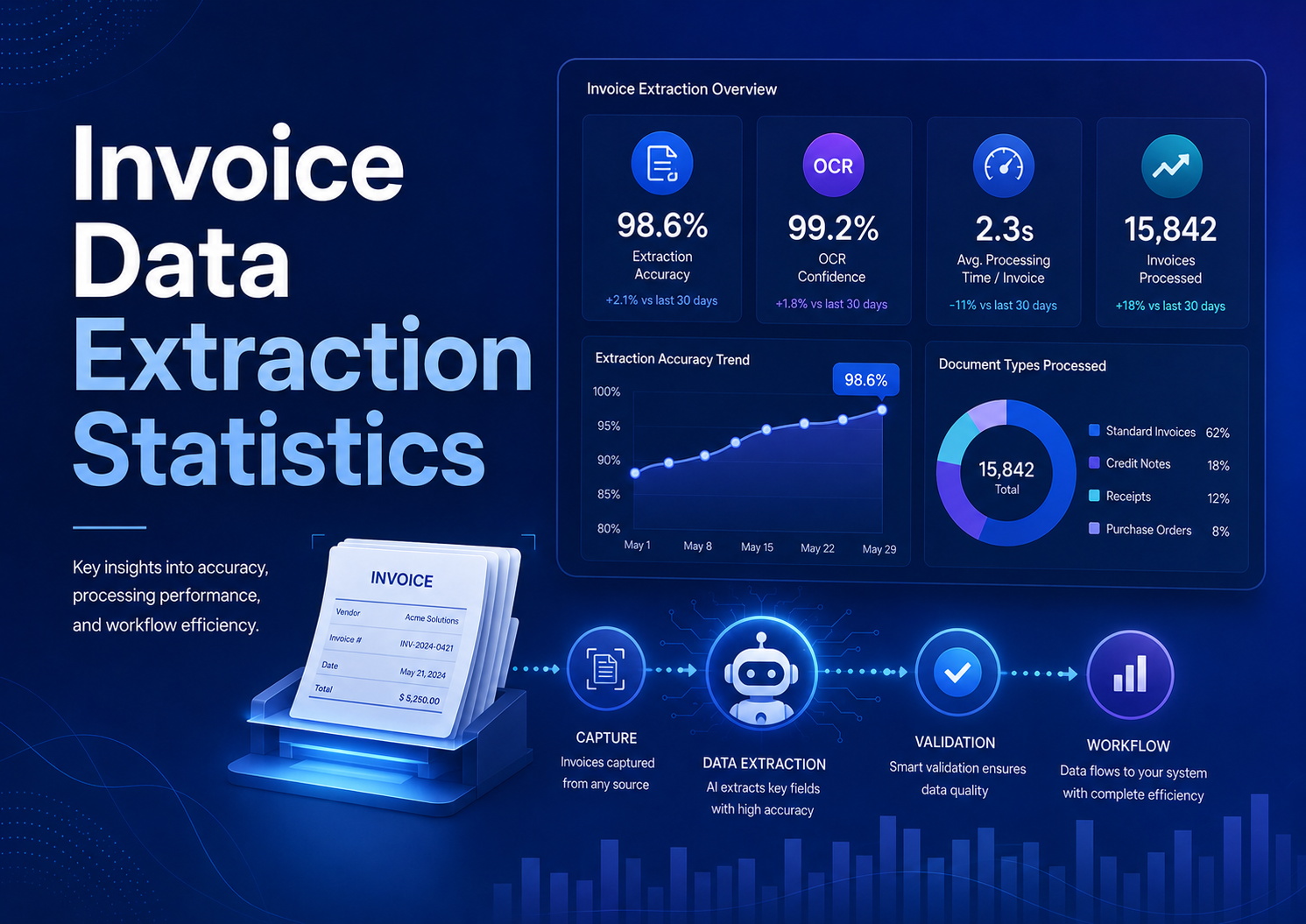
Invoice data extraction is where messy supplier documents become structured financial data. If the extraction layer is weak, every downstream accounts payable process becomes harder: supplier matching, coding, PO matching, approvals, tax validation, e-invoicing readiness, audit trails, payment timing, and supplier support. OCR is only one part of that system; the real control question is whether invoice data is clean enough to trust.
The strongest statistics show why this topic now sits between finance operations, compliance, and automation. The intelligent document processing market was estimated around $2.30 billion in 2024 and is projected by one major outlook to reach $12.35 billion by 2030. Broader forecasts push IDP even higher, with some outlooks reaching $43.92 billion by 2034. At the same time, e-invoicing forecasts climb toward $62.68 billion by 2031 and $70.3 billion by 2034, showing that invoice data is becoming more structured, regulated, and machine-readable.
This research report treats invoice extraction as an AP performance problem, not a generic AI feature. Good extraction lowers manual keying, reduces exception queues, improves matching, strengthens audit evidence, supports e-invoicing mandates, and gives finance teams cleaner data before payment decisions are made. Poor extraction does the opposite: it creates corrections, delays approvals, increases supplier follow-up, and allows bad invoice data to travel downstream.
Invoice Data Extraction Statistics: Key Benchmarks
These headline benchmarks frame the topic. They show the growth of document AI, OCR, AP automation, invoice processing, e-invoicing, and the manual-work burden that makes invoice data extraction financially important.
• The global intelligent document processing market was estimated at $2.30 billion in 2024.
• One IDP forecast projects the market will reach $12.35 billion by 2030, with a 33.1% CAGR from 2025 to 2030.
• A broader IDP outlook projects the market could reach $43.92 billion by 2034, showing how fast document AI definitions are expanding.
• North America held the largest IDP revenue share in 2024, with estimates around 32% to 32.8%.
• Asia Pacific is repeatedly identified as the fastest-growing IDP region across market forecasts.
• The global OCR market was estimated at $10.62 billion in 2022 and projected to reach $32.90 billion by 2030.
• North America accounted for more than 37% of OCR revenue in 2022, with one estimate placing the share at 38.3%.
• The global AP automation market was estimated at $3.07 billion in 2023 and projected to reach $7.1 billion by 2030.
• Another AP automation forecast places the market at $6.94 billion in 2026 and $12.46 billion by 2031.
• AP automation solutions held roughly 62.2% of 2023 market revenue in one benchmark and 67.30% in a 2025 estimate.
• Large enterprises captured about 60.20% of AP automation market size in 2025, but SMEs are projected to grow at an 18.15% CAGR from 2026 to 2031.
• The e-invoicing market was estimated at $12.47 billion in 2023 and projected to reach $62.68 billion by 2031.
• Another e-invoicing forecast projects the market at $70.3 billion by 2034.
• More than 80 countries have implemented e-invoicing mandates, while around 50 additional countries are planning new or expanded mandates.
• Cloud-based e-invoicing accounted for about 62% of market share in 2023.
• IFOL-linked AP research found 66% of finance teams still manually enter invoice information into ERP systems.
• Benchmarks in the research bank include manual invoice costs commonly ranging from roughly $10 to $25 per invoice, depending on process maturity and source definition.
• Several AP automation benchmarks put touchless processing as the key operating target, but exception handling remains the proof of whether extraction quality is actually improving.
• Australia has estimated potential annual e-invoicing benefits of about A$22.5 billion when broad business adoption is considered.
• New Zealand’s e-invoicing registry counted 52,071 registered businesses in the official snapshot included in the research bank.
Executive readout
The headline statistics point to one conclusion: invoice extraction has moved from a document-conversion task to a finance-control system. Market growth is being pulled by three pressures at once: AP teams want less manual entry, governments want structured invoice data, and companies want better visibility before invoices are approved and paid.
Why Invoice Extraction Is Now an AP Automation Control Layer
The value of invoice extraction depends on what happens after the document is received. A PDF or scanned invoice is not useful until the information inside it becomes clean enough to match against purchase orders, supplier records, tax rules, approval workflows, accruals, and payment controls.
A mature AP team does not judge extraction by whether software can read a supplier name once. It asks whether the extracted data is complete, trusted, and usable without excessive correction. The difference matters because a single wrong field can break downstream processing. A missing PO number can send an invoice into an exception queue. A wrong tax amount can create compliance work. An incorrect bank detail can raise fraud risk. A missing due date can affect payment timing and supplier relationships.
| AP stage | What extraction must provide | What breaks when data is weak |
|---|---|---|
| Invoice receipt | Supplier identity, document type, invoice number, date, and channel | Duplicate uploads, misclassified documents, missed invoices |
| Header capture | Vendor, invoice ID, date, due date, currency, tax IDs, payment terms | Bad ERP posting, approval delays, audit gaps |
| Line-item capture | SKU, description, quantity, unit price, tax, freight, discounts | PO matching failures and manual review |
| Validation | Totals, tax math, vendor master, PO duplicate check, bank details | Exceptions, duplicate payments, and fraud exposure |
| Approval and posting | Clean coding, routing, evidence, notes, and audit trail | Late approvals, supplier disputes, and month-end cleanup |
| Payment readiness | Approved amount, correct supplier, due date, method, and hold status | Late payment, wrong payment, or preventable rework |
This is why invoice data extraction should be measured as part of the full invoice-to-pay chain. OCR can make text searchable. IDP can classify the document, map fields, and apply validation. AP automation can route the invoice and connect it to the ERP. E-invoicing can remove some image-reading work by requiring structured data from the start. The operating benefit appears only when those layers reduce manual touches and improve first-pass processing.
Invoice Data Extraction Maturity Model
A premium invoice extraction strategy needs a maturity view because companies rarely move from manual keying to perfect touchless AP in one step. Most finance teams pass through several stages: email and spreadsheet handling, basic OCR, template capture, IDP validation, workflow automation, and finally structured invoice exchange. Each stage can be useful, but each stage also creates a different risk profile.
| Maturity level | What the process looks like | Main risk |
|---|---|---|
| Manual keying | AP staff manually enter invoice data into ERP or accounting software. | Volume grows faster than the team can review invoices cleanly. |
| Basic OCR | Documents become searchable and some header fields are captured automatically. | Text capture improves, but AP still repairs business fields manually. |
| Template extraction | Known supplier layouts are mapped to expected fields. | High-volume suppliers improve, but long-tail suppliers and layout changes still create exceptions. |
| IDP with validation | AI/ML classifies documents, extracts fields, checks confidence, and validates totals or supplier data. | Weak master data and PO quality still block full automation. |
| Touchless AP workflow | Invoices match, route, approve, post, and become payment-ready without manual intervention. | Lower manual review increases need for strong controls to prevent fraud or errors. |
| Structured invoice network | PDF, Peppol, clearance, supplier portals, XML, and tax platforms feed structured invoice data. | Global firms must normalize multiple invoice sources into one validated AP record. |
This model helps prevent a common implementation mistake: treating software purchase as the maturity goal. A team can buy IDP and still remain at a low maturity level if supplier data is inconsistent, PO data is unreliable, exception reasons are not tracked, or approval rules live in email. The real milestone is not that an invoice image was read. It is that the invoice can move from receipt to validated AP record with fewer avoidable human repairs.
Maturity readout
The strongest AP teams usually improve the process in layers. They first standardize intake channels, then clean supplier data, then measure exception reasons, then improve field-level extraction, and only then push more invoices toward touchless processing. That sequence produces better control than chasing a high automation percentage before the data is ready.
Market Size and Future Outlook
Market-size statistics are useful because they show how invoice extraction is being pulled into several adjacent categories: intelligent document processing, OCR, AP automation, invoice processing automation, e-invoicing, and compliance reporting. The estimates are not identical because publishers define the categories differently, but the direction is consistent: more invoice data is moving from manual entry to structured automation.
IDP, OCR, and document AI markets
• Grand View Research estimated the IDP market at $2.30 billion in 2024.
• The same outlook projected IDP to reach $12.35 billion by 2030 at a 33.1% CAGR.
• Precedence Research-style estimates in the expanded bank place the IDP opportunity as high as $43.92 billion by 2034.
• IDP solutions accounted for more than 63% of global IDP revenue in 2024.
• Machine learning accounted for the largest IDP technology revenue share in 2024.
• BFSI represented the largest IDP end-use revenue share in 2024, which matters because banking and finance processes depend heavily on document controls.
• Invoice processing and fraud detection are both identified use cases for IDP, connecting extraction directly to AP operations.
• OCR software represented more than 81% of global OCR revenue in 2022.
• B2B use cases accounted for more than 78% of OCR revenue in 2022.
• BFSI led OCR verticals with more than 19% of global revenue in 2022.
AP automation and e-invoicing growth
• The AP automation market was estimated at $3.07 billion in 2023 and projected to reach $7.1 billion by 2030.
• A 2026-to-2031 outlook places AP automation at $6.94 billion in 2026 and $12.46 billion by 2031.
• The same outlook lists AP automation CAGR near 12.44% from 2026 to 2031.
• Cloud AP automation deployments are forecast to grow at about 14.32% CAGR through 2031.
• AP automation services are projected to expand at about 15.25% CAGR to 2031.
• SME AP automation is projected to grow at an 18.15% CAGR between 2026 and 2031, faster than the broader market in the cited outlook.
• The e-invoicing market was estimated at $12.47 billion in 2023 and projected to reach $62.68 billion by 2031.
• A separate e-invoicing outlook projects growth from $18.5 billion in 2025 to $70.3 billion by 2034.
• Another forecast places e-invoicing at $16.37 billion in 2025 and nearly $44.63 billion by 2032.
• Retail and ecommerce e-invoicing is projected to grow at about 24.3% CAGR in one market segmentation.
How to read the forecasts
These forecasts should be read directionally rather than as one exact market total. OCR estimates often focus on converting images or PDFs into machine-readable text. IDP estimates include classification, extraction, validation, and workflow intelligence. AP automation adds routing, approvals, matching, and payment readiness. E-invoicing adds structured invoice exchange and compliance reporting. Invoice extraction sits where those markets overlap.
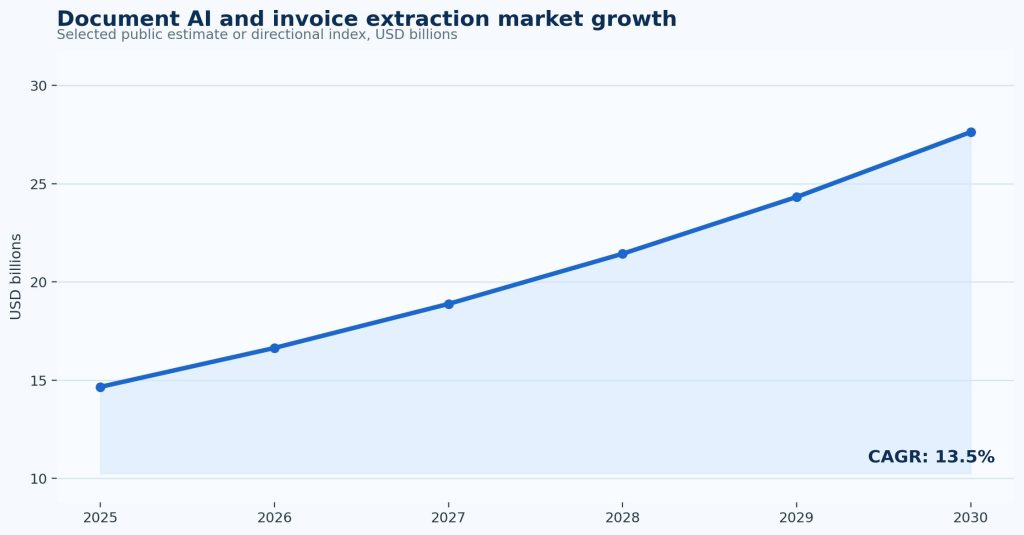
Figure 1. Invoice data extraction sits across OCR, IDP, AP automation, and e-invoicing markets, so forecasts should be interpreted by category boundary rather than treated as one interchangeable number.
Manual Invoice Processing, Cost, and Cycle-Time Benchmarks
The business case for invoice extraction is strongest when manual processing creates measurable cost, time, and control problems. Manual AP work is rarely one task. It includes opening emails, downloading PDFs, checking supplier names, typing invoice numbers, correcting dates, coding GL fields, searching for purchase orders, routing approvals, answering supplier status questions, and cleaning up exceptions near month end.
Manual work and invoice cost signals
• IFOL-linked research found 66% of finance teams still manually enter invoice information into ERP systems.
• Manual AP benchmarks in the research bank commonly place invoice processing cost in the $10 to $25 per invoice range, depending on process complexity and source definition.
• A low-maturity AP process often spends more on exceptions, approvals, and supplier follow-up than on the initial data-entry step itself.
• If a team processes 10,000 invoices per month and only 20% need manual correction, that still creates 2,000 monthly exception cases.
• At 10 minutes of review per exception, those cases consume more than 333 hours of AP capacity per month.
• At 20 minutes of review per exception, the same volume consumes more than 666 hours per month before supplier follow-up or approval delay is counted.
• A manual process that costs $15 per invoice creates $150,000 in monthly processing cost at 10,000 invoices.
• Reducing average cost from $15 to $7 per invoice would save $80,000 per month at the same 10,000-invoice volume, before discount capture or duplicate-payment risk is included.
• In a 100,000-invoice annual operation, even a $3 cost reduction per invoice equals $300,000 of annual process savings.
• If an invoice waits five extra days because the PO number or supplier record is missing, automation has not failed at payment; it failed earlier at data quality.
Why cycle time matters
• Invoice cycle time affects month-end accrual accuracy, working-capital forecasting, and supplier payment reliability.
• A slow extraction process can prevent AP teams from seeing liabilities before the invoice is fully keyed and approved.
• Late capture makes early-payment discounts harder to use because the discount clock starts before internal approval is complete.
• Slow data capture can also increase supplier inquiries because vendors ask for invoice status before AP has a clean record in the system.
• When manual keying is concentrated at period end, finance teams can create bottlenecks that hide spend until after reporting deadlines.
Manual-processing readout
The cost of invoice extraction is not only the salary cost of typing fields. It is the combined cost of delayed visibility, avoidable exceptions, supplier follow-up, late approvals, missed discounts, duplicate checks, tax correction, and audit cleanup. A stronger extraction process reduces manual entry, but the larger gain is usually fewer downstream interruptions.
Where manual AP effort hides
Manual invoice effort often hides outside the obvious keying step. Finance leaders may count data-entry time but miss the time spent chasing missing purchase orders, confirming supplier names, correcting tax fields, routing invoices to the right approver, answering supplier emails, or explaining accrual changes at month end.
• A missing PO number can turn a readable invoice into an approval exception because AP cannot prove what the invoice belongs to.
• A supplier-name mismatch can create a false duplicate, a false exception, or a payment hold even when the extracted amount is correct.
• A wrong due date can distort payment scheduling and make cash forecasts look better or worse than the actual liability position.
• A line-item mismatch can require purchasing, receiving, and AP to coordinate before the invoice can move forward.
• A tax-field error can shift work from AP processing to compliance review, especially in VAT/GST environments.
• A bank-detail difference should never be treated as a simple extraction correction; it is a payment-control event that needs supplier validation.
• A supplier inquiry usually means the vendor sees less process visibility than AP expects, which can reveal hidden delay between receipt and validated record.
• A month-end invoice backlog can hide unposted liabilities, weaken accruals, and make finance reporting less reliable.
This is the reason invoice extraction should be evaluated with exception categories, not just automation claims. If most exceptions are caused by weak PO data, the root fix may sit in procurement. If most exceptions involve supplier master records, the fix may sit in onboarding. If the main issue is unreadable attachments, the fix may be supplier submission standards. The extraction system becomes more valuable when it shows where the real operating problem lives.
Extraction Accuracy, OCR, IDP, and Field-Level Complexity
Invoice extraction is difficult because invoices are semi-structured documents. Two suppliers may send documents that contain the same information in completely different layouts. One invoice may have a clean PDF table, another may be scanned, another may include tax in a separate line, and another may attach a credit memo, freight charge, or handwritten reference.
OCR turns visual text into characters. IDP goes further by classifying documents, locating fields, mapping data to expected invoice concepts, validating totals, learning vendor layouts, and routing uncertain data for review. In accounts payable, the difference between reading text and trusting data is the difference between a searchable PDF and a postable invoice record.
Fields that make invoice extraction hard
| Field group | Examples | Why errors matter |
|---|---|---|
| Supplier identity | Supplier name, legal entity, tax ID, remittance address, bank data | Wrong supplier matching can create payment holds, fraud risk, or duplicate vendor records. |
| Document identity | Invoice number, invoice date, due date, credit memo flag | Weak document identity increases duplicate-payment and aging-report risk. |
| Purchase-order data | PO number, release number, buyer, receiving reference | Missing PO data sends invoices into exception queues. |
| Line items | SKU, description, quantity, unit price, discounts, freight, tax | Line-level errors break two-way and three-way matching. |
| Tax and compliance | VAT/GST, tax rate, tax registration, tax category, taxable base | Tax errors create compliance and audit work, not just AP corrections. |
| Totals and currency | Subtotal, total, tax total, balance due, multi-currency amounts | Total mismatches can block approval or cause incorrect ERP posting. |
| Terms and payment | Payment terms, bank details, hold status, early-payment discount | Wrong terms can change cash timing or create payment risk. |
Accuracy and extraction benchmarks
• OCR converts printed and physical documents into machine-readable text, but text conversion alone does not confirm that the invoice is ready for AP posting.
• IDP uses OCR, machine learning, natural language processing, and computer vision to classify documents and extract business fields.
• Machine learning accounted for the largest IDP technology revenue share in 2024, reflecting demand for systems that improve on rules-only extraction.
• Invoice processing is explicitly identified as an IDP use case in the market research bank.
• Fraud detection is also identified as an IDP use case, which connects invoice extraction to control monitoring.
• Line-item extraction is usually harder than header extraction because line tables vary by supplier, product category, tax treatment, discount format, and freight treatment.
• A header-only capture system may reduce typing but still leave AP teams with manual line review, GL coding, PO matching, and exception handling.
• A system that extracts totals but misses tax codes, PO numbers, or vendor identity may create a clean-looking record that still fails validation.
• For high-volume suppliers, layout learning can improve straight-through capture; for long-tail suppliers, exception design and human review remain important.
• The practical metric is not maximum theoretical accuracy; it is first-pass accuracy on the invoice types the company actually receives.
Extraction-quality readout
The most useful extraction scorecard separates field-level accuracy from document-level success. A document is not successfully extracted because most fields are right. It is successful when the fields required for matching, approval, compliance, and payment are complete enough to continue without avoidable human repair.
Where invoice extraction fails by document source
Extraction failures are not evenly distributed. A clean supplier PDF may work well, while a scanned freight invoice or a multi-page statement may create repeated repair work. AP teams should therefore measure source quality as well as software accuracy.
| Document source | Common extraction issue | Better operating response |
|---|---|---|
| Native PDF invoice | Fields may be readable but mapped inconsistently across suppliers. | Validate supplier layout, invoice number, totals, tax, PO, and line mapping. |
| Scanned paper invoice | Low resolution, skew, stamps, folds, and handwritten notes reduce confidence. | Use scan-quality rules and route low-confidence invoices before they delay posting. |
| Email image attachment | Screenshots or phone photos may miss edges, totals, or page order. | Set supplier submission rules and reject unusable images early. |
| Multi-page invoice | Header fields may appear on page one while line detail, freight, or tax appears later. | Require page-aware extraction and total reconciliation across all pages. |
| Statement or account summary | Document may list many transactions but not represent one payable invoice. | Classify separately so AP does not post statements as invoices. |
| Credit memo | The document reverses value and may reference prior invoices. | Use document-type classification before amount extraction. |
| International invoice | Language, currency, tax ID, VAT/GST, and local field names may differ. | Map regional fields to global ERP requirements and local compliance rules. |
| Structured e-invoice | Data arrives in machine-readable form but still needs ERP mapping and validation. | Validate payload, supplier, tax, PO, and duplicate status before posting. |
An AP team may not need one universal extraction target. It may need different thresholds for clean PDFs, scanned documents, long-tail suppliers, structured e-invoices, and high-risk document types. That is how automation becomes controlled rather than blindly aggressive.
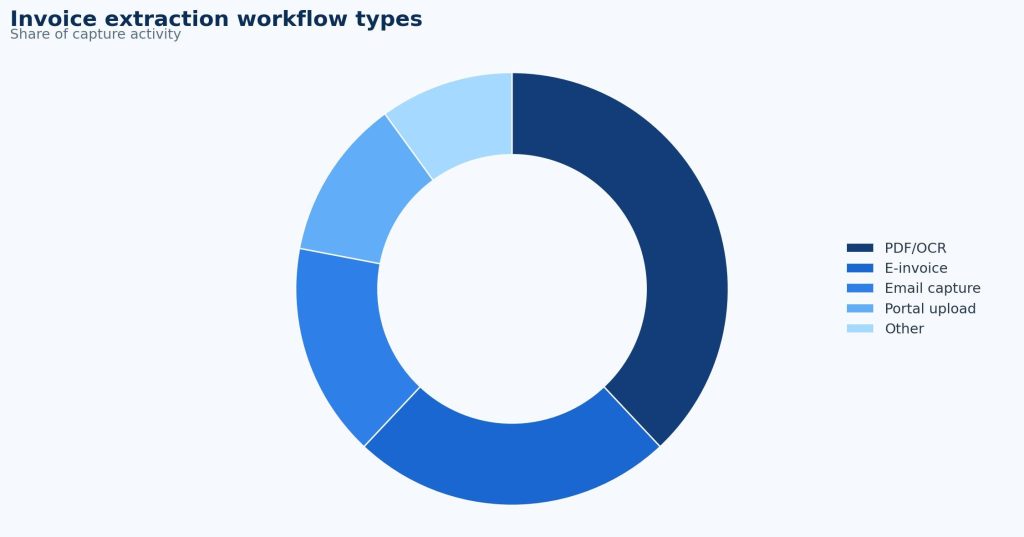
Figure 2. Invoice extraction quality depends on field-level complexity, document layout variation, validation logic, and exception routing rather than OCR alone.
Touchless Processing and Exception Handling
Touchless processing is the clearest operational test of invoice extraction. If an invoice can be captured, validated, matched, approved, and posted without manual repair, the extraction process is creating real AP capacity. If the invoice repeatedly lands in an exception queue, the organization may have automation software without automation outcomes.
Exception patterns AP teams should separate
• Touchless rate measures the share of invoices that move through the process without manual intervention.
• Exception rate measures the share of invoices that require review because extracted data, supplier records, PO data, or approval rules do not align.
• First-pass match rate shows how often extracted invoice data matches expected PO, receipt, supplier, and total information without correction.
• PO invoices usually fail when PO number, quantity, price, receipt status, or tax treatment does not match expected data.
• Non-PO invoices usually fail when coding, approval owner, supplier status, contract reference, or budget category is unclear.
• Duplicate detection depends on reliable invoice number, supplier, date, amount, and document identity extraction.
• A missing or inconsistent supplier ID can create false exceptions even when the invoice amount is correct.
• A wrong due date can make a technically approved invoice appear later or earlier in the payment run.
• A weak exception taxonomy makes it difficult to see whether the root problem is supplier behavior, extraction quality, PO discipline, or approval bottlenecks.
• The most useful AP dashboard separates extraction exceptions from business-rule exceptions, because the fixes are different.
| Exception type | Likely cause | Best operational response |
|---|---|---|
| Extraction error | Field missed, wrong total, poor scan, layout variation | Improve model, supplier template, validation, or capture channel |
| Master-data mismatch | Supplier name, tax ID, address, or bank detail does not match | Clean vendor master and strengthen supplier onboarding |
| PO mismatch | Quantity, price, receipt, or PO reference differs | Review purchasing, receiving, and supplier invoice behavior |
| Approval ambiguity | No owner, unclear cost center, missing contract reference | Improve routing rules and invoice coding |
| Compliance issue | Tax field, invoice format, or e-invoicing requirement not met | Add structured validation before posting |
| Fraud or duplicate risk | Duplicate invoice, altered bank detail, suspicious supplier behavior | Escalate through control workflow before payment |
The exception queue is where invoice extraction becomes visible to the finance team. If exceptions are concentrated around the same supplier, the fix may be supplier onboarding or document format. If exceptions cluster around tax fields, the fix may be validation logic. If exceptions are mostly PO mismatches, AP may not own the root problem; purchasing and receiving may need stronger data discipline.
Exception-handling readout
A lower exception rate is valuable only when it reflects better invoice quality, not weaker controls. The goal is not to push every invoice through automatically. The goal is to let clean invoices pass quickly while routing risky or incomplete invoices to the right person with enough context to resolve them.
Regional E-Invoicing and Compliance Statistics
Regional statistics are especially important for invoice data extraction because compliance rules are changing the source document itself. In older AP workflows, extraction often meant reading a supplier PDF or scanned paper invoice. In newer e-invoicing environments, the goal increasingly becomes validating structured invoice data, checking mandatory fields, and reconciling invoice data with tax or clearance platforms.
Global mandate momentum
• More than 80 countries have implemented e-invoicing mandates.
• Around 50 additional countries are planning new or expanded e-invoicing mandates.
• Asia Pacific e-invoicing is projected to grow at 24.5% CAGR in one market forecast.
• The U.S. e-invoicing market is projected to grow at 22.9% CAGR in one e-invoicing forecast.
• Cloud-based e-invoicing accounted for 62% of market share in 2023.
• North America dominated the e-invoicing market with about 29.8% share in 2023.
• North America remains the largest market in several AP automation and IDP forecasts.
• Asia Pacific is identified as the fastest-growing AP automation market in the 2026-to-2031 outlook.
• Asia-Pacific AP automation is expected to advance at about 13.96% CAGR in one forecast.
• Mandatory e-invoicing is repeatedly cited as a driver of AP automation and invoice data standardization.
Country and regional compliance examples
| Region / country | Important benchmark or rule signal | Invoice extraction implication |
|---|---|---|
| European Union | ViDA reforms are expected to make e-invoicing and digital reporting central to intra-EU transaction reporting from 2030 onward. | AP teams need structured data readiness, not only PDF capture. |
| EU reform impact | EU estimates point to up to EUR 11B in VAT fraud reduction and EUR 4.1B in compliance cost reduction from digital reporting reforms. | Tax and invoice fields become control data, not back-office detail. |
| Italy | Italy is one of Europe’s mature e-invoicing examples, with national e-invoicing used broadly in tax administration. | Extraction shifts toward validating structured invoice files and matching them to ERP records. |
| Brazil | Brazil’s NF-e model is a mature clearance-style e-invoicing environment. | AP systems must handle tax-authority-connected invoice data and local validation rules. |
| Saudi Arabia | ZATCA’s Fatoora program uses phased e-invoicing requirements and integration waves. | Invoice data capture must align with mandated digital invoice structure. |
| Australia | Australia’s e-invoicing opportunity has been estimated at about A$22.5B in annual benefits. | Peppol adoption can reduce manual invoice handling if suppliers and buyers both participate. |
| New Zealand | Official e-invoicing registrations counted 52,071 businesses in the included snapshot. | Supplier network adoption matters as much as the buyer’s internal AP tool. |
| Latin America | Latin America has several mature tax-driven e-invoicing models, including Brazil, Mexico, Chile, and Colombia. | Regional AP design must account for clearance, tax validation, and local invoice formats. |
| Asia Pacific | APAC is frequently identified as the fastest-growth region for IDP, AP automation, and e-invoicing adoption. | High growth means expanding supplier networks and more localized invoice formats. |
| Middle East | Saudi Arabia’s rollout shows a compliance-first adoption model. | Invoice extraction must support mandated fields, audit evidence, and tax reporting workflows. |
The regional lesson is that invoice extraction is no longer only about reading what suppliers send. In some markets, governments are changing what suppliers are allowed or expected to send. That changes the AP technology requirement. Finance teams need systems that can process PDFs, XML, Peppol documents, portals, email attachments, scans, and supplier network data without losing the connection between the invoice record and the compliance evidence behind it.
Regional readout
E-invoicing does not eliminate invoice extraction; it changes the work. In PDF-heavy environments, extraction focuses on reading and validating fields. In structured e-invoicing environments, extraction becomes data validation, workflow routing, ERP mapping, and compliance control. Global firms need both capabilities because suppliers and countries will not modernize at the same pace.
How regional rules change the extraction problem
The same AP software can face very different invoice data problems by country. In a PDF-heavy market, the priority may be supplier layout learning and field confidence. In a clearance market, the priority may be payload validation and tax-platform integration. In a Peppol market, the priority may be network onboarding and mapping structured fields into the ERP. Global AP teams need a model that respects those differences without creating separate finance processes for every country.
• EU ViDA pressure moves AP teams toward structured digital reporting and near-real-time invoice data readiness.
• Italy shows how mature e-invoicing can shift AP work away from document reading and toward validation, exception handling, and ERP mapping.
• Brazil and Mexico show why tax-connected invoice models require local compliance expertise, not only generic OCR capability.
• Saudi Arabia’s phased e-invoicing rollout shows how mandates can create integration waves that finance teams must plan for before deadlines arrive.
• Australia and New Zealand show how Peppol adoption depends on both buyer readiness and supplier participation.
• Germany, France, Poland, and other European markets require phased planning because invoice exchange, tax reporting, and domestic B2B obligations do not mature at exactly the same pace.
• For multinational companies, the AP target is one operating dashboard that can compare PDF extraction, structured invoice acceptance, rejection reasons, and manual exceptions across regions.
• Regional compliance programs should be paired with supplier onboarding because a buyer cannot reach high automation rates if suppliers continue to submit low-quality documents through uncontrolled channels.
The regional lesson is not that every firm needs the same mandate roadmap. It is that invoice extraction should be designed as a bridge between unstructured supplier documents and structured finance data. As mandates expand, the AP team that already understands field-level quality, supplier readiness, and exception ownership will adapt faster than a team that only measures how many PDFs were processed.
Industry and Invoice-Type Differences
Invoice extraction difficulty varies sharply by invoice type. A clean SaaS subscription invoice, a freight invoice, a construction progress bill, a utility invoice, a healthcare supplier invoice, and a retail supplier invoice can all contain payable obligations, but the fields that matter are different.
• Retail supplier invoices often require line-item detail because item, SKU, quantity, discount, tax, and freight fields affect inventory and margin reporting.
• Utilities and telecom invoices can include meter references, service periods, usage tiers, taxes, surcharges, and multiple locations.
• Freight and logistics invoices can include accessorial charges, weight, distance, fuel surcharge, shipment references, and carrier-specific codes.
• Construction invoices may include retainage, progress billing, subcontractor references, change orders, and project codes.
• Professional services invoices may contain time narratives, matter or project IDs, expenses, tax treatment, retainers, and client-specific approval references.
• Healthcare and regulated supplier invoices may require vendor validation, item categorization, compliance evidence, and tighter audit trails.
• Recurring SaaS invoices may be easy to recognize but can create problems when seats, usage tiers, renewals, credits, or entity names change.
• Credit memos and debit memos should be classified separately from standard invoices because the wrong document type can reverse the financial meaning of the transaction.
• Multi-currency invoices require extraction that preserves both transaction currency and posting currency rules.
• Scanned paper, low-resolution PDFs, email screenshots, and handwritten notes increase extraction uncertainty even when the financial fields are simple.
| Invoice type | Fields that often matter most | Automation risk |
|---|---|---|
| PO supplier invoice | PO, line items, receipt, quantity, price, tax, freight | Mismatches can block three-way match. |
| Non-PO services invoice | Cost center, approver, service period, project, contract | Routing and coding failures create approval delays. |
| Freight invoice | Shipment ID, carrier, surcharge, weight, route, accessorials | Line-level details often differ from standard PO logic. |
| Construction invoice | Progress %, retainage, change order, job code, subcontractor | Incorrect coding can distort project cost and retainage balances. |
| Utility invoice | Meter, service period, site, usage, tariff, tax | Period and location errors can affect accruals and cost allocation. |
| Credit memo | Original invoice, credit amount, reason, supplier, tax adjustment | Misclassification can create wrong payables balance. |
Invoice-type readout
A strong extraction program starts with document mix, not software demos. The best system for high-volume PO invoices may not solve freight details, utility meters, or construction retainage without additional configuration. AP teams should benchmark extraction quality by invoice category and supplier group rather than relying on one blended accuracy score.
AP Controls, Fraud, Audit, and Duplicate-Payment Risk
Invoice extraction is also a control function. If the wrong invoice number, supplier identity, bank account, total, or tax field is captured, the approval workflow may look legitimate while the underlying data is wrong. That is why extraction quality matters for fraud prevention, duplicate detection, audit trails, tax compliance, and payment holds.
• Duplicate payment detection depends on reliable supplier identity, invoice number, amount, date, and document classification.
• Supplier impersonation risk increases when bank details or remittance data are extracted without validation against approved vendor-master records.
• Invoice fraud controls need a clear trail from document receipt to extraction, validation, approval, posting, and payment.
• Three-way matching depends on line-item and quantity accuracy, not only correct invoice totals.
• Tax validation depends on correct capture of VAT/GST fields, tax registration numbers, taxable amounts, and rate categories.
• A suspicious invoice may pass approval if extraction assigns it to the wrong supplier or cost center.
• Audit teams need evidence of who changed extracted data, why it was changed, and whether the change occurred before or after approval.
• A clean exception log helps separate normal supplier corrections from recurring control weaknesses.
• Fraud detection is listed as an IDP use case, showing that document AI is increasingly connected to control monitoring.
• AP automation research identifies AI and machine learning as growth drivers partly because teams need better detection of errors, fraud signals, and process exceptions.
| Control risk | Extraction dependency | What better teams monitor |
|---|---|---|
| Duplicate payment | Invoice number, supplier, amount, date, document type | Duplicate hit rate, duplicate overrides, supplier exceptions |
| Vendor fraud | Supplier identity, tax ID, bank detail, remittance data | Bank-detail changes, supplier master mismatches, approval escalations |
| Tax error | VAT/GST fields, taxable base, tax rate, invoice format | Tax exceptions, jurisdiction mismatches, correction rate |
| PO mismatch | PO number, line item, quantity, price, receiving data | First-pass match, mismatch type, buyer/receiver root cause |
| Audit weakness | Original document, extracted fields, corrections, approval trail | Manual edits, exception owner, reason code, evidence completeness |
| Payment delay | Due date, terms, hold status, approval owner | Cycle time, discount capture, supplier inquiries |
The control point is simple: bad extraction can make bad decisions look system-approved. The goal is not only to digitize invoices faster. It is to create a data record that can survive audit, support approval, and prevent payment decisions from depending on incomplete or unverified fields.
Supplier Data, Master Records, and Payment Readiness
Invoice extraction can look like a document problem, but many failures begin in supplier data. A supplier name may appear slightly differently across invoices, purchase orders, tax registrations, remittance addresses, and ERP vendor records. If the extraction layer cannot connect those variations to the right supplier master record, AP teams end up reviewing invoices that are technically readable but operationally uncertain.
This is why supplier master data should be treated as part of invoice extraction quality. The extracted supplier name, tax ID, bank detail, address, email domain, and remittance information need to be checked against approved records. The strongest systems do not simply capture a supplier field; they validate whether the field belongs to the supplier the company is allowed to pay.
Supplier-record signals that affect extraction quality
• Supplier-name variation can create duplicate vendor records when the extracted legal name does not match the ERP master record.
• Tax ID capture is especially important in VAT/GST environments because it supports compliance validation and supplier identity checks.
• Remittance-address and bank-detail extraction should trigger higher review when the invoice differs from approved vendor-master information.
• Long-tail suppliers often create more extraction variability because they submit fewer invoices, change layouts more often, or send documents through less controlled channels.
• High-volume strategic suppliers are good candidates for supplier-specific templates, Peppol onboarding, portal submission, or structured e-invoicing because automation gains compound quickly.
• If supplier onboarding is weak, AP automation may spend more time resolving master-data exceptions than reading the invoice itself.
• A supplier record with incomplete tax, entity, payment, or contact details can turn a correctly extracted invoice into a payment hold.
• Supplier inquiry volume is a useful indirect metric because vendors often ask for status when invoices have been captured but not fully validated or routed.
• The AP team should separate supplier-caused exceptions from internal master-data exceptions so the fix is assigned to the right owner.
• Payment readiness should require both document extraction and supplier validation; one without the other leaves finance exposed to rework or control risk.
| Supplier data issue | How it appears in AP | Better control |
|---|---|---|
| Name variation | Invoice supplier does not match ERP vendor exactly | Use tax ID, approved aliases, and supplier hierarchy rules |
| Bank-detail change | Invoice shows a different remittance account | Route to controlled vendor-bank validation before payment |
| Missing tax registration | Invoice cannot be validated for VAT/GST or local tax requirements | Require onboarding completion before touchless posting |
| Duplicate vendor record | Same supplier appears under multiple names or entities | Consolidate supplier master and strengthen duplicate checks |
| Unclear entity | Supplier bills from a different legal entity than the contract or PO | Validate legal entity, PO, tax ID, and payment terms together |
| Long-tail layout variation | Supplier invoice format changes or appears rarely | Use confidence thresholds and exception tracking instead of forcing touchless processing |
Supplier-data readout
Better extraction does not remove the need for supplier governance. It makes supplier-data weaknesses more visible. When AP teams know whether an exception came from OCR, supplier master data, PO mismatch, tax validation, or approval routing, they can fix the operating cause instead of repairing the same invoice symptoms every month.
From PDF Capture to Structured Invoice Networks
The next stage of invoice extraction will not be only better OCR. It will be a mixed environment where AP teams receive PDFs, scanned documents, supplier portal uploads, Peppol files, local tax-platform invoices, email attachments, and structured data from procurement networks. The winners will be systems that normalize all of those inputs into one reliable AP record.
That transition explains why e-invoicing and IDP statistics belong in the same report. IDP helps companies deal with unstructured and semi-structured documents. E-invoicing reduces ambiguity by requiring more structured fields. AP automation routes, validates, and posts the invoice. Companies will need all three layers during the transition because global supplier networks will remain uneven for years.
What changes when invoices become structured
• PDF capture asks, ‘Can we read the invoice?’ Structured invoicing asks, ‘Can we validate and post the invoice data safely?’
• In structured e-invoicing, the invoice may arrive with machine-readable fields, but AP still needs supplier validation, PO matching, tax logic, approval routing, and duplicate checks.
• A Peppol or clearance invoice can reduce manual typing but still fail if ERP master data, tax mapping, or purchasing data is incomplete.
• Structured invoice networks make field completeness more visible because missing mandatory data can be rejected earlier in the process.
• Regional mandates increase the value of clean mapping between local invoice fields and global ERP data models.
• A multinational AP team may need to process Italian, Brazilian, Saudi, Australian, New Zealand, EU, and PDF-based invoices in the same operating model.
• In mixed environments, the most useful metric is not OCR accuracy alone; it is the share of invoices that become validated AP records without manual repair.
• Structured data can improve auditability because the original invoice payload, validation result, approval workflow, and posting record can be linked more reliably.
• Supplier onboarding becomes a strategic lever because automation quality depends partly on whether suppliers submit invoices through the cleanest available channel.
• The end state is not simply digital invoices; it is trusted invoice data that can support AP operations, tax reporting, cash planning, and financial controls.
Future-readiness readout
The strategic question is whether AP systems can handle invoice diversity without creating parallel processes. During the transition, finance teams need to support legacy PDFs and structured e-invoices at the same time. The strongest architecture treats every invoice source as an input to one validation, matching, approval, and audit model.
What Better AP Teams Track
A useful invoice extraction scorecard should be specific enough to show where automation is working and where the AP team is still doing hidden manual labor. Blended averages are not enough. Teams should review results by supplier, invoice type, channel, region, entity, currency, and PO versus non-PO workflow.
| Metric | What it measures | Why it matters |
|---|---|---|
| Extraction accuracy | Correct capture of required header, line, tax, and payment fields | Shows whether data is usable before human repair. |
| Field confidence | System confidence by field type and supplier layout | Helps decide which fields can post automatically. |
| Touchless processing rate | Invoices completed without manual intervention | Core proof that automation is reducing work. |
| Exception rate | Invoices requiring review, correction, or routing changes | Shows where AP capacity is still consumed. |
| First-pass match rate | Invoices matching PO/receipt/vendor rules the first time | Connects extraction quality to procurement discipline. |
| Cost per invoice | Processing cost across capture, review, approval, and posting | Converts automation quality into financial impact. |
| Cycle time | Time from receipt to ready-to-pay or posted status | Shows whether invoice visibility is timely. |
| Manual edit rate | Share of fields changed by humans after extraction | Reveals model, layout, or master-data issues. |
| Duplicate detection rate | Potential duplicates flagged and resolved | Protects cash and audit quality. |
| Supplier inquiry volume | Supplier questions about status, approval, or payment | Shows whether invoice processing is visible and reliable. |
| E-invoicing acceptance | Share of structured invoices received and posted cleanly | Measures compliance and supplier-network readiness. |
| Late-capture exposure | Invoices received but not visible in AP/ERP quickly | Affects accruals, cash planning, and supplier satisfaction. |
The best dashboards also connect metrics. A high extraction accuracy rate with a high exception rate may mean the system reads fields correctly but validation rules or supplier master data are weak. A high touchless rate with growing duplicate overrides may mean controls are too loose. A low cost per invoice may not be healthy if AP is pushing risk downstream to audit or supplier disputes.
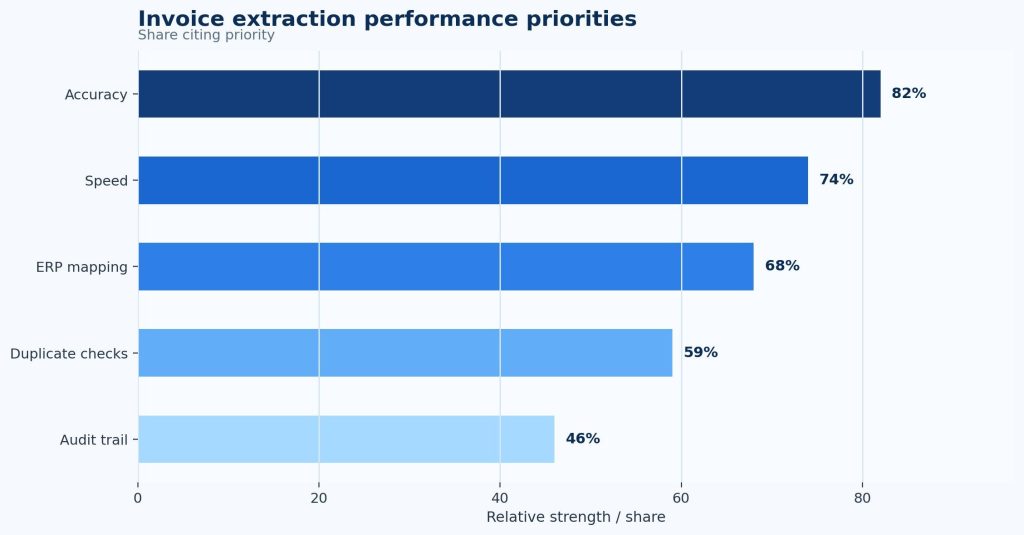
Figure 3. Invoice extraction scorecards should connect extraction accuracy, exception handling, AP controls, and compliance readiness instead of measuring OCR output alone.
Practical Scenario: What Poor Extraction Costs at Scale
Consider a company that receives 25,000 supplier invoices each month across several business units. Some arrive as PDF attachments, some through portals, some through scanned paper, and some through structured e-invoicing channels. The AP team has automation software, but many invoices still require review because fields are missing, PO numbers fail, tax totals do not validate, or suppliers use inconsistent layouts.
• At 25,000 invoices per month, a 15% exception rate creates 3,750 monthly exception cases.
• If each exception takes 12 minutes to review, the team spends 45,000 minutes, or 750 hours, on exception handling each month.
• At 20 minutes per exception, the same exception volume consumes 1,250 hours per month.
• If the average fully loaded handling cost is $35 per hour, 750 exception hours equal $26,250 of monthly labor capacity.
• If better extraction and validation reduce the exception rate from 15% to 9%, monthly exceptions fall from 3,750 to 2,250.
• That improvement removes 1,500 exception cases per month before supplier follow-up is counted.
• At 12 minutes per avoided exception, the team saves 300 hours each month.
• At $35 per hour, that equals $10,500 in monthly capacity value, or $126,000 annually.
• If invoice cycle time also falls by three days, finance gains earlier visibility into liabilities and supplier payment timing.
• If duplicate-payment detection prevents even a small number of high-value errors, the control benefit can exceed the labor savings.
This scenario is not meant to replace a company’s own baseline. It shows why invoice extraction quality compounds at scale. A few percentage points of exception reduction can free hundreds of AP hours when monthly invoice volume is high. The savings become larger when reduced rework also improves supplier communication, month-end reporting, compliance evidence, and payment accuracy.
How to Use These Invoice Extraction Statistics
Invoice extraction statistics are most useful when they help AP teams decide what to measure internally. Market forecasts show demand for better systems, but they do not prove that a specific company is ready for touchless AP. The internal baseline matters more: invoice volume, document mix, supplier concentration, exception reasons, field-level accuracy, and the current cost of manual correction.
• Use IDP, OCR, AP automation, and e-invoicing forecasts as directional signals because publishers define these categories differently.
• Benchmark extraction performance by invoice type, not only by overall accuracy.
• Separate extraction errors from PO mismatches, supplier master-data issues, approval delays, and compliance exceptions.
• Measure manual edits by field so the team can see whether supplier name, invoice number, tax, PO, line item, or total is causing the most rework.
• Compare touchless rate with duplicate-payment, tax, and fraud controls so automation does not remove useful review.
• Use regional e-invoicing statistics to plan supplier onboarding, Peppol readiness, tax fields, and ERP integration changes.
• Review exception reasons monthly; a shrinking exception queue is more meaningful than a software accuracy claim.
• Track supplier inquiries because they often reveal invisible process gaps before AP metrics do.
• Tie extraction KPIs to cash outcomes such as discount capture, late-payment exposure, and payment holds.
• Build the business case from internal invoice volume, exception time, cost per invoice, and cycle-time improvement, not vendor averages alone.
Planning readout
The most useful next step is a leakage review. Select one recent AP period, classify invoice sources, count exceptions by reason, measure manual correction time, and compare PO invoices with non-PO invoices. That exercise turns market statistics into a company-specific automation plan.
Implementation Questions Before Expanding Automation
Before expanding invoice extraction automation, AP teams should answer a short set of operating questions. These questions keep the project grounded in real process leakage rather than generic AI expectations.
| Question | Why it matters | What to inspect |
|---|---|---|
| Which invoice types create the most rework? | A blended exception rate hides whether the issue is PO invoices, non-PO invoices, freight, tax, credit memos, or scans. | Exception reports by invoice category and supplier group. |
| Which fields are corrected most often? | Field-level correction data shows whether the model, supplier layout, master data, or business rule is failing. | Manual edits by supplier name, invoice number, PO, tax, total, line item, and due date. |
| Which suppliers create the most exceptions? | Supplier behavior often determines automation performance more than the AP tool itself. | Top exception suppliers, layout changes, missing PO usage, and channel quality. |
| Which exceptions are actually control events? | Some items should not be forced into touchless processing because they protect payment accuracy or fraud controls. | Bank-detail changes, duplicate warnings, tax mismatches, and unusual totals. |
| Which countries require structured invoice readiness? | Regional mandates change data fields, reporting timing, and supplier onboarding requirements. | Mandate timeline, Peppol or clearance needs, local tax fields, and ERP mapping. |
| What is the current cost of rework? | The automation business case depends on actual correction time, not vendor averages. | Exception volume, minutes per exception, AP labor cost, supplier inquiry volume, and cycle-time delay. |
A focused implementation plan usually starts with a controlled sample rather than a full rollout. Pick one month of invoices, classify the document sources, rank exception reasons, identify the suppliers causing the largest manual burden, and calculate the time spent on correction. Then decide whether the first improvement should be supplier onboarding, PO discipline, field extraction, validation rules, e-invoicing setup, or approval routing. That sequence produces better results than buying automation and hoping it reveals the problem later.
Invoice Data Extraction FAQ
What is invoice data extraction?
Invoice data extraction is the process of capturing structured information from invoices, such as supplier name, invoice number, date, PO number, line items, tax, totals, and payment terms. In modern AP, extraction also includes validation, classification, exception routing, and ERP-ready data preparation.
Is invoice extraction the same as OCR?
No. OCR converts visual text into machine-readable text. Invoice extraction uses OCR as one input, but also needs field mapping, document classification, validation, supplier matching, line-item capture, and workflow rules. IDP goes further by using AI, machine learning, NLP, and computer vision to interpret document meaning.
Why does invoice extraction matter for AP automation?
AP automation depends on clean invoice data. If supplier identity, PO number, tax amount, due date, or line items are wrong, the invoice still needs manual review. Better extraction increases first-pass matching, reduces exceptions, improves audit evidence, and shortens the path from invoice receipt to approval and payment.
What is touchless invoice processing?
Touchless processing means an invoice can move through capture, validation, matching, approval, posting, and payment readiness without manual intervention. It does not mean removing controls. It means clean invoices pass faster while risky or incomplete invoices are routed to the right exception workflow.
How do e-invoicing mandates affect invoice extraction?
E-invoicing mandates shift the work from reading unstructured documents toward validating structured invoice data. AP teams still need extraction-like controls because invoice data must be mapped to ERP fields, checked against tax rules, matched to suppliers and POs, and preserved for audit.
Which invoice extraction KPIs matter most?
The strongest KPIs include field-level accuracy, touchless processing rate, exception rate, first-pass match rate, manual edit rate, cost per invoice, invoice cycle time, duplicate-detection rate, supplier inquiry volume, and e-invoicing acceptance rate.
Final Takeaway
Invoice data extraction statistics point to one practical conclusion: extraction is now the data-quality foundation of modern accounts payable. OCR and AI matter, but the real test is whether invoice data can move into AP workflows cleanly enough to support matching, approval, posting, tax compliance, audit evidence, and payment control.
The strongest AP teams will not evaluate invoice extraction solely by how quickly a document is processed. Instead, they focus on how many invoices can bypass manual corrections, how accurately essential fields are captured, how effectively exceptions are categorized, how well regional e-invoicing regulations are supported, and how seamlessly invoice data is converted into accurate ERP records. Even businesses using a free invoice generator can benefit from these advancements, as modern invoice extraction tools are designed to improve both efficiency and financial accuracy. This is where the real value of the statistics lies: they demonstrate why invoice extraction is evolving into a critical finance control layer rather than simply a document-conversion solution.


