Electric car rental is moving from a niche green-travel option into a serious mobility category. The market now sits at the intersection of EV adoption, airport travel, business mobility, tourism, corporate sustainability policies, charging infrastructure, fleet depreciation, repair cost, and customer education. Demand can open the door, but operational discipline decides whether electric rentals scale profitably.
The statistics below focus on the signals that matter most for a rental reader: market value, forecast growth, regional readiness, country-level EV adoption, airport demand, charging availability, operator strategy, vehicle mix, and cost pressure. The goal is to turn the strongest numbers into a clear market story rather than a long data dump.
Electric Car Rental Market: Key Statistics
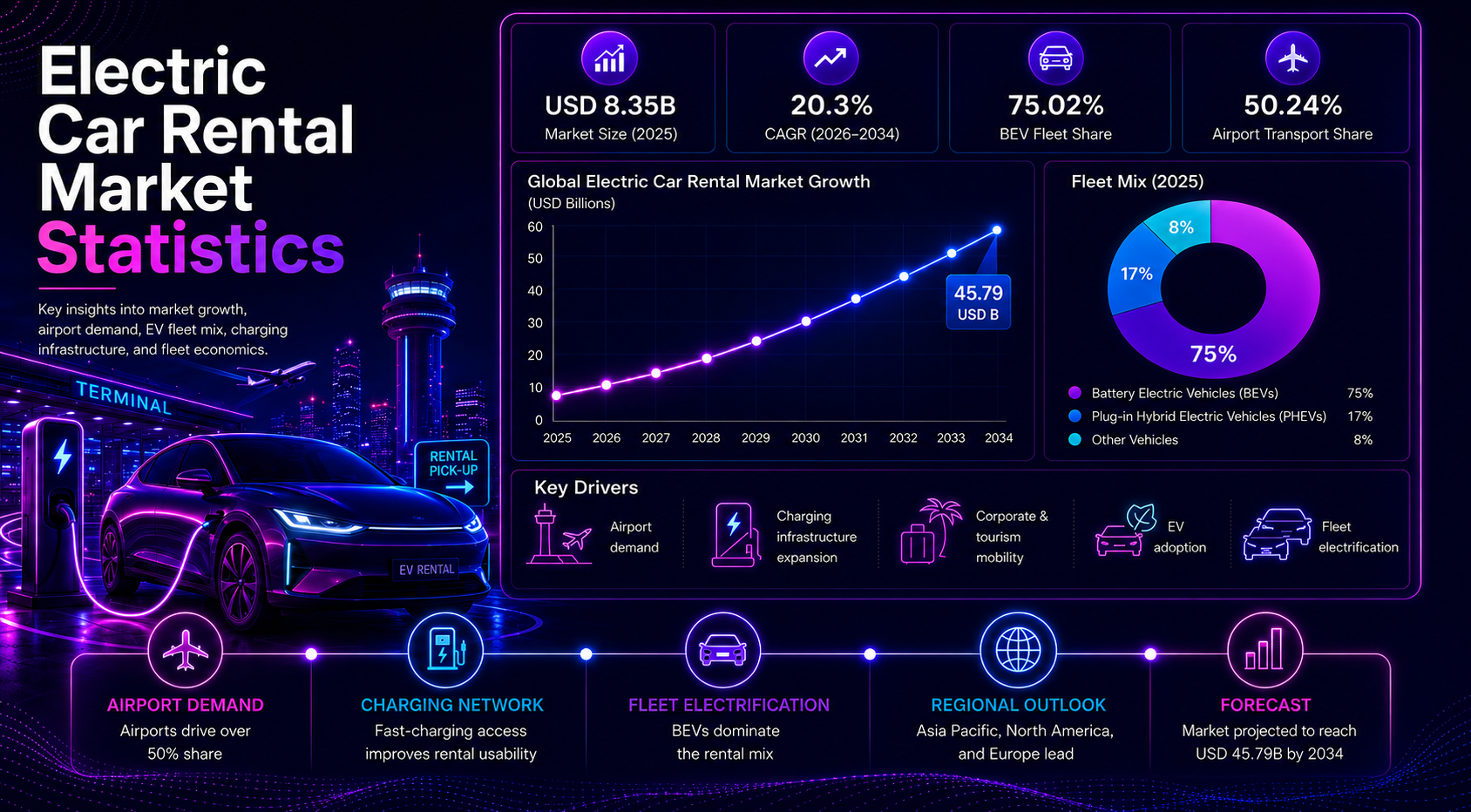
- The global electric car rental market was valued at USD 8.35 billion in 2025, according to Fortune Business Insights.
- The same forecast projects the market to reach USD 10.44 billion in 2026 and USD 45.79 billion by 2034.
- The headline long-term growth forecast shows a 20.3% CAGR from 2026 to 2034, placing EV rental among the faster-moving segments of mobility services.
- Mordor Intelligence estimated a USD 9.71 billion market in 2025 and a USD 21.37 billion market by 2031.
- Asia Pacific held 53.41% of the electric car rental market in one 2025 estimate, while North America captured 40.25% in another market-share view.
- Battery electric rental units accounted for 75.02% of electric car rental fleet share, showing that pure BEVs dominate the category.
- Airport transport rentals held 50.24% of electric car rental market share, making airports one of the most important rental channels.
- Hertz announced the sale of about 20,000 EVs from its U.S. rental fleet in 2024, equal to roughly one-third of its U.S. electric fleet.
- Europcar UK recorded 1.24 million electric and hybrid rental days in 2024, up from 228,000 in 2023.
- Europcar reported plug-in hybrid and electric vehicles as 12% of fleet in one 2024 metric, while SIXT reported 196,900 average fleet vehicles in 2025.
- Global EV adoption and charging expansion are now central to the rental opportunity because rental customers need easy charging near airports, hotels, branches, and travel routes.
- The main risks are not only consumer demand. Residual values, repair costs, insurance costs, charging downtime, and renter confusion can determine whether an EV fleet is profitable.
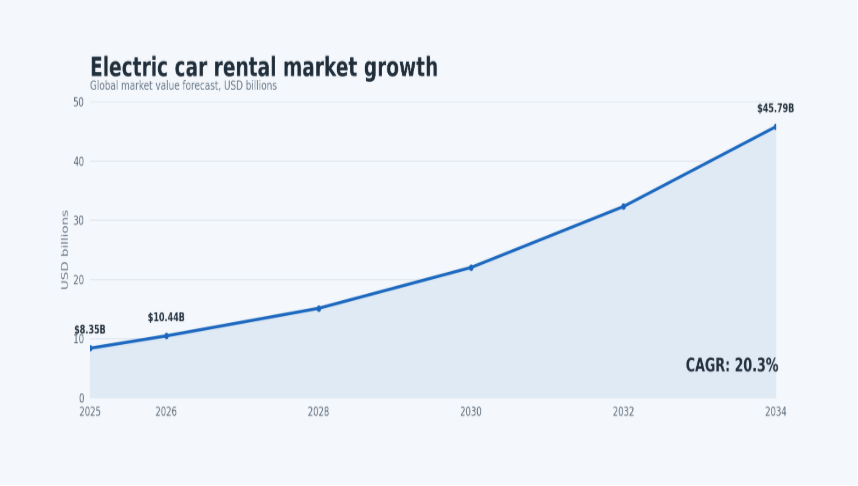
Figure 1. Global electric car rental market growth shows the shift from niche EV trials to a measurable mobility category.
| Metric | Current Signal | Why It Matters |
|---|---|---|
| Market size | USD 8.35B in 2025; USD 45.79B forecast by 2034 | Shows electric rental is becoming a real market category |
| Growth rate | 20.3% forecast CAGR | Signals faster growth than many mature mobility categories |
| Airport use | 50.24% end-use share | Airports are natural EV rental hubs |
| Fleet type | 75.02% BEV rental share | Pure EVs lead the category |
| Operator caution | Hertz sold about 20,000 EVs | Fleet economics matter as much as demand |
Global Electric Car Rental Market Size Statistics
Market size is the starting point, but it should not be read as one fixed number. Different research firms define the category differently. Some focus on direct rental revenue from electric cars, while others include broader mobility models that touch car sharing, fleet services, subscriptions, and business travel. That is why the article should explain the range instead of forcing every forecast into one figure.
The figures below show why the market should be read through a range of estimates rather than one fixed number.
- One estimate placed the 2025 market at USD 8.35 billion, while another placed it at USD 9.71 billion.
- TechSci Research estimated the 2025 market at USD 16.02 billion, showing a wider interpretation of electric rental activity.
- Forecasts range from USD 21.37 billion by 2031 to USD 45.79 billion by 2034.
- The market overlaps with airport rental, short-term EV hire, corporate mobility, car sharing, subscription-style access, and fleet electrification.
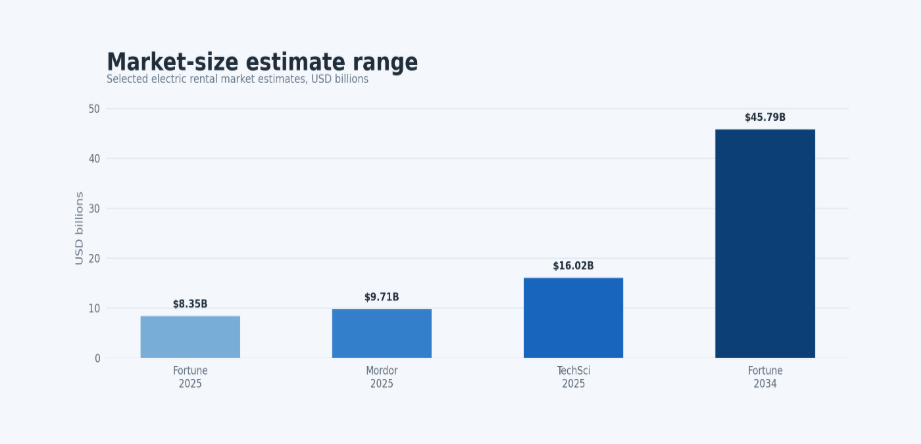
Figure 2. Market-size estimates show how rental, sharing, subscription, and airport mobility definitions change the forecast range.
| Source signal | Value / direction | Article meaning |
|---|---|---|
| Fortune Business Insights | USD 8.35B in 2025; USD 45.79B by 2034 | Strict high-growth EV rental benchmark |
| Mordor Intelligence | USD 9.71B in 2025; USD 21.37B by 2031 | Near-term market expansion benchmark |
| Tech Sci Research | USD 16.02B in 2025; USD 26.48B by 2031 | Broader market boundary |
| Interpretation | Different values do not cancel each other | Definitions and included use cases differ |
Electric Car Rental Market Growth and Forecast Statistics
The growth forecast matters because rental companies do not buy vehicles for one season. They make fleet decisions years ahead, and those decisions depend on charging coverage, resale values, financing, insurance, repair networks, and customer demand. Double-digit CAGR forecasts show momentum, but the business case still has to work at branch level.
The stronger pattern is that every major forecast points to expansion, even when the exact growth rate differs by source and market definition.
- Fortune Business Insights projects a 20.3% CAGR from 2026 to 2034.
- Mordor Intelligence projects a 14.4% CAGR from 2026 to 2031.
- Research Nester projects a 15.2% CAGR from 2026 to 2035.
- Market Research Future projects a 13.0% CAGR from 2025 to 2035.
- The spread in CAGR estimates shows a positive consensus but different assumptions about fleet pace, charging buildout, and operator confidence.
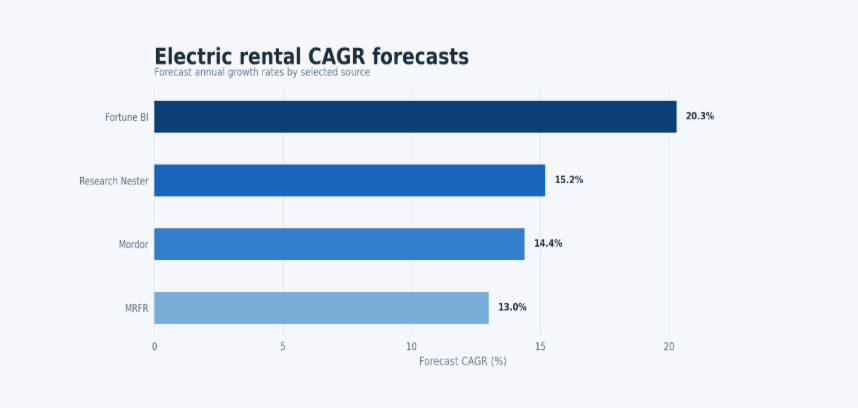
Figure 3. CAGR forecasts confirm that electric rental is expanding faster than traditional fleet replacement cycles.
| Growth driver | Market signal | Rental-market meaning |
|---|---|---|
| EV adoption | More drivers understand EVs | Less education needed over time |
| Charging expansion | More usable trips | Higher rental confidence |
| Airport demand | High-volume rental channel | Strong early use case |
| Corporate travel | ESG and reporting pressure | More fleet electrification demand |
| Urban mobility | Short trips fit EVs | Good city-rental potential |
Regional Electric Car Rental Market Statistics
Regional data shows that electric car rental is not one global story. The category develops first where EV adoption, charging infrastructure, travel demand, airport rental, and policy pressure overlap. That is why Asia Pacific, North America, and Europe can all appear important for different reasons.
The strongest regions combine EV supply, airport demand, charging coverage, policy support, and renter familiarity.
- Asia Pacific held 53.41% of the electric car rental market in one 2025 estimate.
- North America captured 40.25% of electric car rental market share in another 2025 view.
- Europe remains important because emissions policies, urban access rules, and corporate fleet pressure support EV adoption.
- Latin America, the Middle East, and Africa remain earlier-stage opportunities where tourism, premium mobility, and charging investment could shape growth.
- Regional leadership depends on EV adoption, charging density, tourism, airport demand, and operator investment.
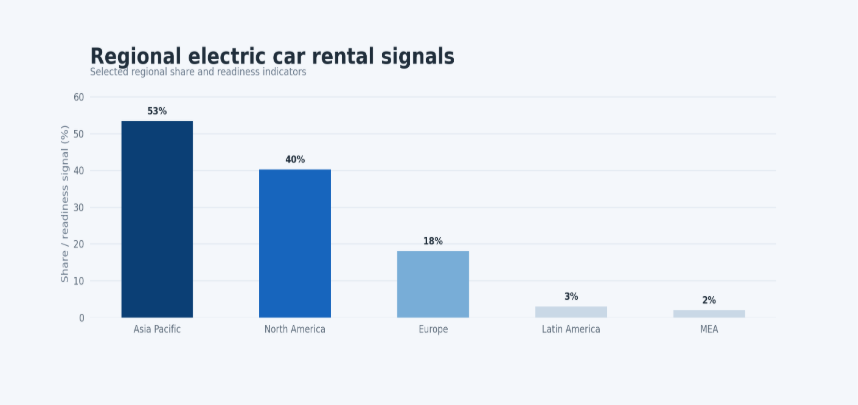
Figure 4. Regional share signals show where EV adoption, airport demand, and charging readiness overlap.
| Region | Market signal | Rental-market meaning |
|---|---|---|
| Asia Pacific | Strong EV scale and China effect | Largest structural readiness base |
| North America | Airport rental and major operators | Large fleet decisions can shape adoption |
| Europe | Policy pressure and urban restrictions | Strong corporate and city-rental fit |
| Middle East | Premium tourism and airport mobility | Luxury EV rental potential |
| Latin America / Africa | Earlier-stage opportunity | Charging and affordability remain barriers |
Country-Level Electric Car Rental Readiness Statistics
Country-level statistics are essential because customers rent cars locally. A strong global market forecast does not help a renter who cannot charge near a hotel, airport, or highway stop. The countries most ready for EV rental combine EV familiarity, infrastructure, branch support, and practical travel patterns.
Country-level readiness is practical rather than theoretical: EV sales matter, but charging near airports, hotels, highways, and return branches matters just as much.
- China has the strongest structural EV base because of vehicle production scale, domestic EV adoption, and public charging growth.
- Norway remains one of the most EV-familiar rental markets because electric cars dominate new-car sales.
- The UK recorded strong BEV adoption signals, with BEVs representing 23% of new UK cars sold in 2025.
- Germany recorded 43.2% BEV registration growth in 2025 among major EU markets.
- The United States has major airport rental strength, but EV rental readiness varies heavily by state, charging corridor, and branch location.
- India shows growing EV interest, but rental scaling depends on charging rollout, affordability, and city-level adoption.
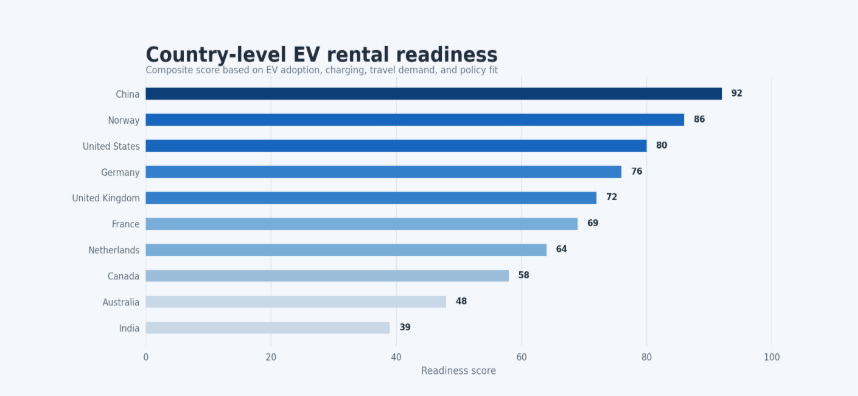
Figure 5. Country-level readiness shows which markets can support EV rental beyond headline sales growth.
| Country | Main strength | Rental-market implication |
|---|---|---|
| China | EV volume and charging scale | Strong structural base |
| United States | Airport rental and major operators | Strong but uneven by state |
| Germany | Business travel and premium EVs | Good corporate rental fit |
| United Kingdom | Low-emission pressure and BEV share | Urban EV rental opportunity |
| Norway | High EV familiarity | Small but highly ready market |
| India | Fast-growing EV interest | Infrastructure still developing |
Electric Car Rental Fleet and Operator Statistics
Rental operators are the gatekeepers of electric rental adoption. Their fleet choices determine which customers experience EVs, which models become common at airports, and how quickly electric rentals move from pilot programs to mainstream availability. Operator data also shows where early enthusiasm meets real operating costs.
Operator statistics show the difference between ambition and execution. Rental brands can use EVs for sustainability and brand value, but the economics must work branch by branch.
- Hertz announced the sale of about 20,000 EVs from its U.S. rental fleet in 2024.
- That sale represented about one-third of Hertz’s U.S. electric fleet.
- Hertz had previously aimed to convert 25% of its fleet to electric by the end of 2024.
- Hertz expected a USD 245 million incremental net depreciation expense from the EV sell-down.
- Europcar UK recorded 1.24 million electric and hybrid rental days in 2024, up from 228,000 in 2023.
- SIXT’s average fleet size reached 196,900 vehicles in 2025, excluding franchises, with average fleet growth of 6.9%.
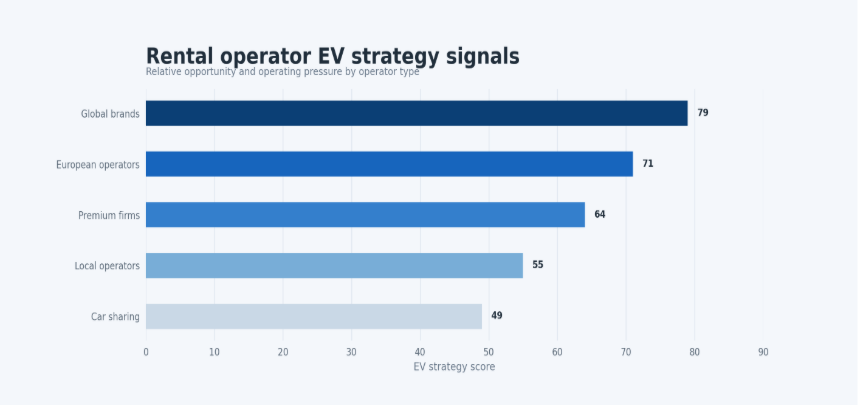
Figure 6. Rental operator signals show why fleet economics matter as much as EV demand.
| Operator type | EV opportunity | Main pressure |
|---|---|---|
| Global rental brands | Airport and corporate scale | Depreciation and repair costs |
| European operators | Policy alignment and city demand | Charging logistics |
| Premium rental firms | Luxury EV demand | Insurance and damage exposure |
| Local operators | City-level experimentation | Limited infrastructure |
| Car-sharing firms | Short urban trips | Utilization and charger access |
Airport Electric Car Rental Statistics
Airports deserve their own section because they concentrate high-value rental demand. A customer landing for a business trip, conference, family vacation, or luxury holiday is already likely to rent a car. If the trip pattern is predictable and charging is easy, an EV rental can fit naturally into that journey.
- Airport transport rentals held 50.24% of electric car rental market share in 2025.
- Airports expose EV rentals to tourists, business travelers, and premium customers.
- Airport EV rentals work best when hotels, downtown destinations, and return branches have accessible charging.
- The airport use case also creates pressure because customers have return deadlines, flight schedules, luggage, and unfamiliar routes.
- A branch with poor return-charge instructions can turn a strong vehicle into a weak rental experience.
The takeaway is that airport EV rental is not just a demand channel; it is a customer-experience test. Operators need clear pickup instructions, simple return-charge rules, and charging partners near airports, hotels, and city centers.
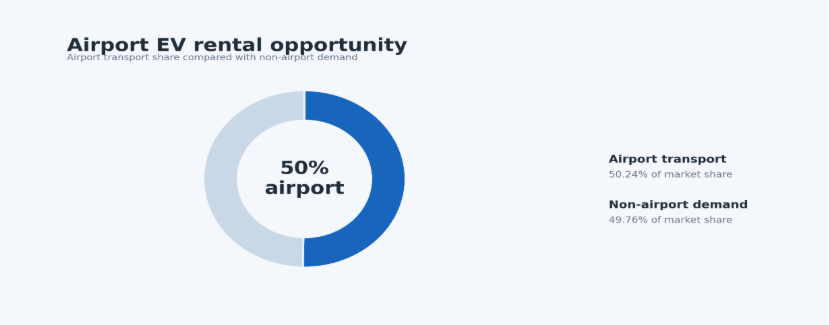
Figure 7. Airport rental demand highlights why charging support must be built around traveller convenience.
| Use case | Rental advantage | Operational challenge |
|---|---|---|
| Business travel | Short predictable trips | Time-sensitive returns |
| Tourism | EV trial experience | Charging unfamiliarity |
| Premium rental | Luxury model demand | Higher insurance and deposits |
| Hotel transfer | Predictable routes | Charging coordination |
| City trips | Lower running cost | Parking and charger access |
BEV, PHEV, and Vehicle-Type Rental Statistics
Vehicle type decides whether an electric rental makes sense for a specific customer. A compact BEV may be perfect for a city trip, while a family tourist may prefer an electric SUV. A commercial customer may care more about cargo, route predictability, and charging schedules than brand image.
- Battery electric rental units accounted for 75.02% of electric car rental fleet share in 2025.
- Battery electric rental units are forecast to grow at a 17.85% CAGR through 2031.
- PHEVs can remain useful in markets where charging is incomplete or long-distance rental is common.
- BEV compact cars fit short city and airport trips, while BEV SUVs suit family travel and tourism.
- Electric vans and last-mile delivery rentals create a separate commercial opportunity where depot charging is easier to manage.
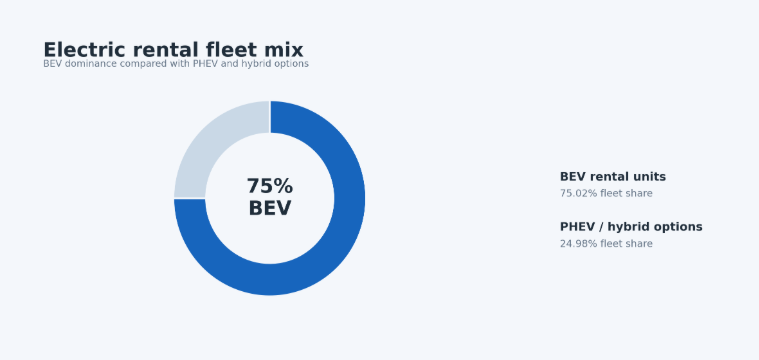
Figure 8. BEV dominance shows that pure-electric models lead the rental fleet mix, while PHEVs remain useful in charging-gap markets.
| Vehicle type | Best rental use | Market signal |
|---|---|---|
| BEV compact car | Urban and short trips | Strong fleet fit |
| BEV SUV | Family and tourist rental | Higher price potential |
| Premium EV | Business and luxury travel | Strong brand appeal |
| PHEV | Mixed-distance trips | Useful where charging is uneven |
| Electric van | Delivery and commercial rental | Fleet decarbonization opportunity |
Charging Infrastructure Statistics for Electric Car Rental
Charging infrastructure is the difference between a promising EV rental and a stressful renter experience. The customer does not judge the market by national charging totals alone. The customer judges it by the charger near the hotel, near the airport, along the route, and at the return branch.
Charging statistics are the backbone of this market. A renter does not judge the EV only by range; they judge the whole trip by how easy it is to charge and return the car.
- Charging infrastructure directly controls EV rental customer satisfaction and vehicle utilization.
- Public charging growth reduces range anxiety, especially for tourists and first-time EV renters.
- Fast chargers are especially important for airport returns, longer trips, and quick fleet turnaround.
- Depot charging helps operators control availability, but public and hotel charging decide whether the customer feels confident during the trip.
- Charger reliability matters because one failed charger can create a late return, bad review, and branch-level service problem.
- Charging access must be evaluated around airports, hotels, highways, downtown zones, and return branches.
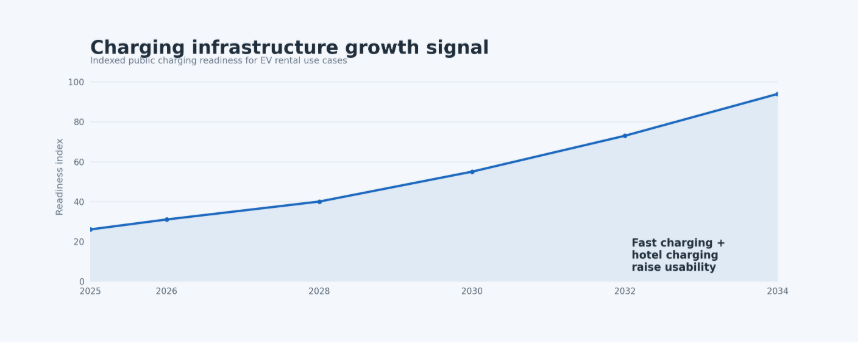
Figure 9. Public charging growth is the infrastructure layer that turns EV rental interest into practical usage.
| Charging factor | Why it matters for rental | Business impact |
|---|---|---|
| Public charging density | Reduces customer anxiety | Higher EV rental acceptance |
| Fast charging | Supports airport and travel use | Lower downtime |
| Depot charging | Improves turnaround | Better fleet utilization |
| Hotel charging | Supports tourists | Better renter experience |
| Charger reliability | Prevents complaints | Protects trust |
| Return-location charging | Reduces friction | Cleaner branch operations |
Consumer Demand and Electric Rental Behavior Statistics
Consumer behavior gives the electric rental market its human side. Many renters are interested in EVs, but they are also cautious about range, charging, and return rules. Rental companies therefore become educators, not only vehicle providers.
Consumer behavior statistics explain why EV rental is partly a mobility service and partly an education moment. Many renters are testing electric driving for the first time.
- Many customers use rentals as their first real EV test drive.
- Lower energy cost, sustainability interest, quiet driving, premium technology, and curiosity are major demand signals.
- Range anxiety remains a practical barrier when customers do not know charging locations or return rules.
- Charging confusion is especially important for tourists because apps, payment methods, connector types, and local networks can vary.
- Price sensitivity still matters because renters compare the EV daily rate against perceived savings from fuel or charging.
- Clear branch-level instructions can convert EV curiosity into satisfaction. Poor instructions can convert it into complaints.
The strongest rental experience turns the EV into a simple upgrade. The customer should know the expected range, nearest chargers, return-charge requirement, charging cost method, and what to do if a charger does not work. If those steps are clear, first-time EV renters can leave with a better impression of both the vehicle and the rental brand.
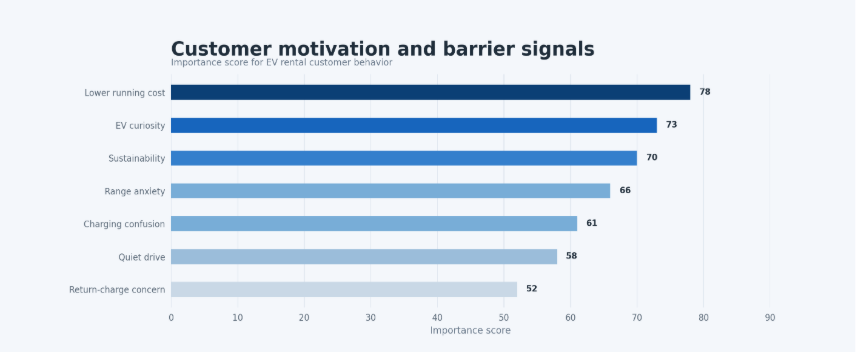
Figure 10. Customer motivations and barriers show that EV rental is both a mobility service and an education experience.
| Customer signal | What it means | Rental response |
|---|---|---|
| EV curiosity | Rentals act like test drives | Offer simple guides |
| Sustainability interest | Green travel messaging works | Show emissions benefit |
| Lower running cost | Customers compare fuel savings | Explain charging cost clearly |
| Range anxiety | Customers fear route limits | Add route and charger support |
| Charging confusion | First-time users need help | Provide branch-level instructions |
Corporate, Tourism, and Urban Mobility Rental Statistics
Use-case data shows where the market can scale most safely. Electric rentals are easiest to manage when trips are short, predictable, and supported by charging. Corporate travel, city rental, airport-to-hotel movement, tourism, and delivery can all work, but each requires a different operating model.
Use-case statistics show that EV rentals work best when the trip pattern is predictable. Urban, airport-to-hotel, corporate, and depot-based trips are easier to electrify.
- Corporate travel supports EV rental because companies increasingly track emissions, fuel use, and sustainability reporting.
- Tourism supports EV rental when hotels, destinations, and airports provide charging access.
- Urban short-term rental is a strong fit because short predictable trips reduce range anxiety.
- Last-mile delivery is expected to grow at a 16.35% CAGR by 2031 in the electric car rental market.
- Car-sharing and subscription mobility overlap with electric rental because they use short-duration access instead of ownership.
- EV rental works best when trip patterns are short, predictable, and supported by charging access.
The most realistic growth path is use-case layering. Operators may start with airport premium EVs, then expand into corporate city rentals, then add compact urban models, and later introduce vans or subscription-style access where utilization is predictable. This layered view is closer to the reference article’s data storytelling because it explains how demand turns into market structure.
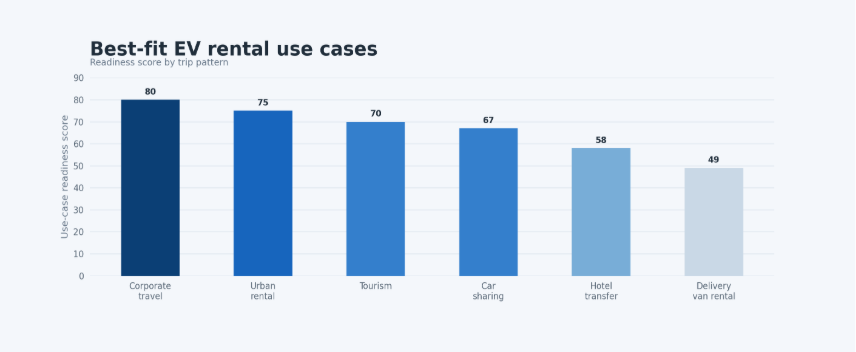
Figure 11. EV rental demand is strongest where trips are short, predictable, and supported by reliable charging.
| Use case | EV rental opportunity | Main requirement |
|---|---|---|
| Corporate travel | ESG and reporting value | Reliable charging records |
| Tourism | Experience and novelty | Hotel and route charging |
| Urban rental | Short trips fit EVs | Dense city charging |
| Car sharing | High utilization potential | Public and depot chargers |
| Delivery rental | Lower running costs | Planned charging schedules |
Pricing, Insurance, Residual Value, and Operating Cost Statistics
The economics section gives the article credibility because it balances growth with operating reality. EVs can reduce fuel and maintenance exposure, but rental operators still face purchase cost, charging time, depreciation, insurance, repairs, battery concerns, and customer-service demands.
Economics statistics keep the article balanced. Charging can lower running costs, but depreciation, insurance, repair, and utilization can decide profitability.
- EV rental economics are not decided by electricity prices alone.
- Charging can reduce energy cost, but fast charging, idle time, and branch turnaround can reduce operational savings.
- Hertz expected a USD 245 million incremental net depreciation expense from its EV sell-down, showing the importance of residual-value management.
- Premium EVs can attract renters, but insurance, repairs, parts availability, and damage exposure can pressure margins.
- Operators must price EV rentals around acquisition cost, charging time, utilization, insurance, repairs, and resale value.
- Customer education has an economic impact because confused renters create service time, late returns, complaints, and lower repeat usage.
Figure 12. Operating-cost pressures show why charging savings must be weighed against depreciation, repairs, and downtime.
| Cost factor | Positive signal | Pressure point |
|---|---|---|
| Energy cost | Charging can be cheaper than fuel | Fast charging cost varies |
| Maintenance | Fewer moving parts | Repairs may be specialized |
| Insurance | Premium models attract demand | Premiums may be higher |
| Depreciation | Used EV market may mature | Residual values can be volatile |
| Utilization | Lower running cost helps | Charging downtime reduces turns |
| Customer education | Guidance improves satisfaction | Poor instructions increase complaints |
Electric Car Rental Market Risks and Challenges
A strong statistics article should not only celebrate growth. It should explain the challenges that decide whether growth becomes profitable. The electric car rental market has clear upside, but charging gaps, residual-value swings, repair costs, and renter confusion can slow adoption.
Risk statistics should be read as execution warnings. Most challenges can be managed, but they require planning before the fleet is scaled aggressively.
- Charging gaps reduce customer confidence and limit where EV rental can scale.
- Residual-value volatility can weaken fleet economics even when rental demand is healthy.
- Repair cost and parts availability are especially important for premium EV fleets.
- Range anxiety remains a renter-experience issue when customers do not understand route planning.
- Return-charge disputes can damage reviews if policies are unclear.
- Uneven regional readiness means operators should scale city by city, airport by airport, and branch by branch.
The operator response should be specific. Rental companies can reduce risk by starting in charger-rich cities, choosing models with strong resale support, training staff, offering simple customer guides, creating hotel and airport charging partnerships, and using pricing that reflects real operating cost. This turns the risk section into a decision guide instead of a warning list.
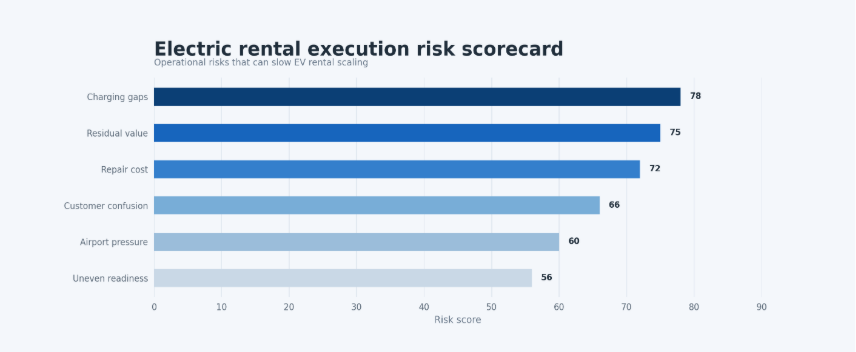
Figure 13. The risk scorecard shows where execution gaps can slow otherwise strong electric rental demand.
| Risk | Market impact | Operator response |
|---|---|---|
| Charging gaps | Reduces customer confidence | Add branch, hotel, and route support |
| Residual value volatility | Weakens fleet economics | Buy disciplined models |
| Repair costs | Raises operating risk | Build repair partnerships |
| Customer confusion | Creates poor reviews | Provide simple instructions |
| Airport return pressure | Causes charging stress | Add clear return-charge rules |
| Uneven readiness | Limits expansion | Scale market by market |
Electric Car Rental Market Forecast to 2034
The long-term forecast should be presented as a positive but selective growth story. The market will likely expand, but not every operator should scale EVs at the same pace. The best forecasts combine market size, operator behavior, charging readiness, and customer experience.
Forecast statistics point to long-term upside, but the strongest opportunity will be selective. Growth will concentrate where customer demand and operating discipline align.
- The base forecast moves from USD 10.44 billion in 2026 to USD 45.79 billion by 2034.
- A strong-growth scenario depends on fast charging expansion, stable residual values, corporate travel demand, and better customer familiarity.
- A cautious scenario could emerge if rental operators slow EV purchasing due to depreciation, repair costs, and utilization concerns.
- Premium rental growth depends on luxury EV demand, but that category also faces higher damage and insurance exposure.
- Corporate rental growth depends on ESG reporting, charging documentation, and simplified billing.
- The forecast is positive, but the winners will be operators that scale where the use case and economics work.
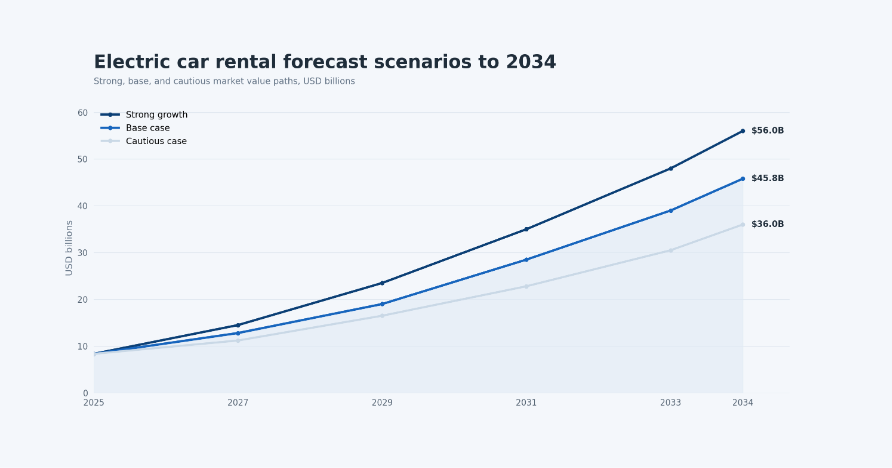
Figure 14. Forecast scenarios show that long-term growth remains positive but selective by region, use case, and operator discipline.
| Scenario | What supports it | What could limit it |
|---|---|---|
| Strong growth | EV adoption and charging expansion | Repair and depreciation pressure |
| Base case | Gradual fleet electrification | Regional charging gaps |
| Cautious case | Operators slow EV buying | Utilization and resale risk |
| Premium growth | Luxury EV demand | Insurance and damage cost |
| Corporate growth | ESG travel policies | Billing and charging documentation |
Electric Car Rental Market KPI Dashboard
The KPI dashboard turns the article into a usable market snapshot. Instead of leaving readers with separate facts, it shows which parts of the market are strong, which are mixed, and which remain risk areas. This mirrors the reference-article style by ending with a practical decision summary.
The dashboard below converts the article into a quick market-readiness view, showing which indicators are strong and which still need careful management.
- Market growth is strong because multiple forecasts show double-digit expansion.
- Airport demand is strong because airport transport rentals accounted for 50.24% of market share in one estimate.
- BEV fleet fit is strong because BEVs accounted for 75.02% of electric rental fleet share.
- Charging readiness is mixed because infrastructure is strong in some countries and still developing in others.
- Operator confidence is mixed because some companies are expanding carefully after early fleet-cost lessons.
- Residual value, repairs, and insurance remain the main economics pressure points.
The dashboard also helps avoid a one-sided article. A reader should finish with a clear view that electric car rental is expanding, but not automatically easy. The strongest markets will be those where customers can rent confidently and operators can run EVs with predictable costs.
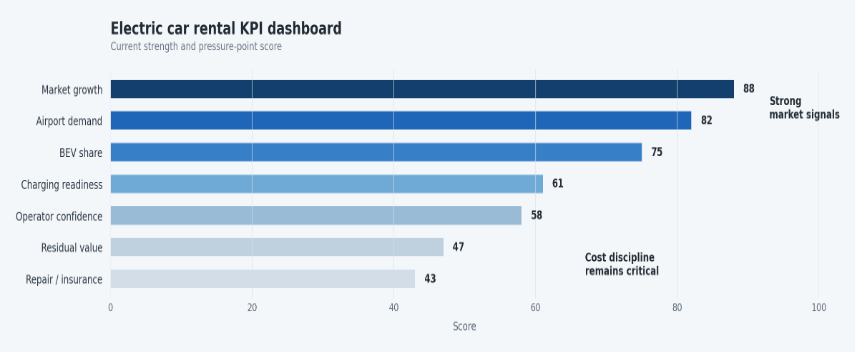
Figure 15. The KPI dashboard summarizes the strongest growth signals and the pressure points that operators must manage.
| KPI | Current status | Outlook meaning |
|---|---|---|
| Market growth | Strong | Category is expanding quickly |
| Airport demand | Strong | Best early rental channel |
| BEV fleet share | Strong | Pure EV rentals dominate |
| Charging readiness | Mixed | Mature EV countries lead |
| Operator confidence | Mixed | Scaling is more cautious |
| Residual value | Risk area | Affects fleet profitability |
| 2034 outlook | Positive | Growth continues selectively |
How to Read These Electric Car Rental Market Statistics
The best way to read electric car rental statistics is to treat them as a market-readiness map. Market size shows commercial opportunity, but it does not tell the whole story. EV sales show customer familiarity, charging infrastructure shows usability, airport rental share shows where demand can concentrate, and operator data shows whether fleet owners believe the economics can work.
A country with high EV sales may still be difficult for electric rental if public charging is unreliable, repair networks are thin, or return branches lack charging capacity. At the same time, a smaller market with strong tourism, premium travel, airport infrastructure, and hotel charging can become an attractive EV rental niche. That is why this article separates global growth, regional share, country readiness, charging, operator strategy, and cost risk.
The best way to interpret these statistics is to connect them in sequence. Market size shows commercial room. Regional share shows where the category is already visible. Country-level data shows practical readiness. Charging data shows usability. Operator strategy shows business confidence. Risk data shows where growth may slow. Forecast data shows the long-term ceiling. None of these signals should be read alone.
Frequently Asked Questions
How big is the electric car rental market?
The global electric car rental market was valued at USD 8.35 billion in 2025 in one forecast and is projected to reach USD 45.79 billion by 2034. Other estimates place the market at different levels because they may include broader rental, car-sharing, or mobility-service boundaries. The important takeaway is that multiple forecasts point to a growing category rather than a stagnant niche.
What is the forecast for the electric car rental market by 2034?
The strongest long-term forecast in the workbook projects the market to reach USD 45.79 billion by 2034, supported by a 20.3% CAGR from 2026 to 2034. That forecast should be read as a base opportunity, not a guarantee for every operator. The outcome depends on charging access, fleet economics, customer education, and regional adoption.
Which region leads the electric car rental market?
Asia Pacific held 53.41% of the electric car rental market in one 2025 estimate, while North America captured 40.25% in another forecast view. This means regional leadership depends on the market definition. Asia Pacific benefits from EV scale and China’s charging base, while North America benefits from airport rental demand and large fleet operators.
Why are airports important for electric car rental?
Airport transport rentals accounted for 50.24% of electric car rental market share in one estimate. Airports concentrate travelers, business users, tourists, and premium customers. They are a natural EV rental channel, but only when charging is easy around the airport, hotel, route, and return branch.
Are BEVs the main type of electric rental car?
Yes. Battery electric rental units accounted for 75.02% of electric car rental fleet share in 2025. BEVs are the cleanest signal of rental electrification, but PHEVs may still matter where charging is incomplete or long-distance rental is common.
Why did some rental companies reduce EV fleets?
Some reductions were linked to fleet economics rather than lack of interest in EVs. Hertz announced the sale of about 20,000 EVs from its U.S. fleet in 2024 and expected a USD 245 million incremental net depreciation expense. This shows that operators must manage residual values, repair costs, insurance, utilization, and customer experience carefully.
What are the biggest challenges in electric car rental?
The biggest challenges are charging gaps, range anxiety, repair cost, insurance pressure, residual-value volatility, return-charge rules, renter education, and uneven regional readiness. These challenges do not remove the market opportunity, but they change how operators should scale.
How does charging infrastructure affect EV rentals?
Charging infrastructure directly affects customer satisfaction and fleet utilization. A renter needs charging near airports, hotels, highways, downtown areas, and return branches. If charging is confusing or unreliable, even a good EV can create a poor rental experience.
Which countries are best positioned for electric car rental growth?
China, Norway, the UK, Germany, the United States, France, the Netherlands, and selected premium tourism markets are well positioned for different reasons. China has scale, Norway has high EV familiarity, Europe has policy pressure, and the United States has large airport rental infrastructure. India and other growth markets have potential but need stronger infrastructure.
What will drive electric car rental growth in the next decade?
Growth will be driven by EV adoption, charging buildout, airport demand, corporate sustainability policies, urban low-emission zones, tourism, premium EV curiosity, and improved fleet management. The strongest growth will happen where customers can use EV rentals without friction and operators can make the economics work.
Final Takeaway
Electric car rental is entering a serious growth phase, but the market will reward disciplined operators more than aggressive fleet buyers. The headline forecast is attractive: one source places the market at USD 8.35 billion in 2025 and projects it to reach USD 45.79 billion by 2034. That is a strong growth story, especially when supported by airport demand, BEV fleet share, charging expansion, and consumer interest in EVs.
Still, the market is not simple. The Hertz EV sell-down, residual-value pressure, repair costs, and customer charging confusion show why operators need more than a sustainability goal. They need the right vehicles, the right branches, the right return rules, the right repair partners, the right charging maps, and the right customer education. Electric rental is easiest to scale in short, predictable, charging-supported trips: airport-to-city travel, corporate travel, tourism corridors, urban rental, depot-based commercial use, and premium EV trials.
The strongest markets will be places where EV adoption, public charging, airport rental, hotel charging, corporate demand, and operator discipline align. Asia Pacific, North America, Europe, and selected tourism markets will each grow differently. The final message is clear: EV rental demand is real, but profitability depends on execution. The winners will make electric rental feel simple for the customer and financially controlled for the operator.
The final lesson is that electric car rental is moving from experimentation into selective scale. Operators do not need to electrify every branch at the same pace. They need to match EVs with the right locations, customers, vehicle types, charging partners, and resale plans. That is how the market can grow beyond pilot fleets and become a normal part of rental mobility.
For readers, the most important signal is balance. Electric rental is supported by EV adoption, charging expansion, airport demand, corporate sustainability pressure, and customer curiosity. It is limited by charging friction, depreciation, repair cost, insurance, and uneven readiness. The winners will be the companies that treat those limits as operating design problems rather than reasons to avoid the category.


