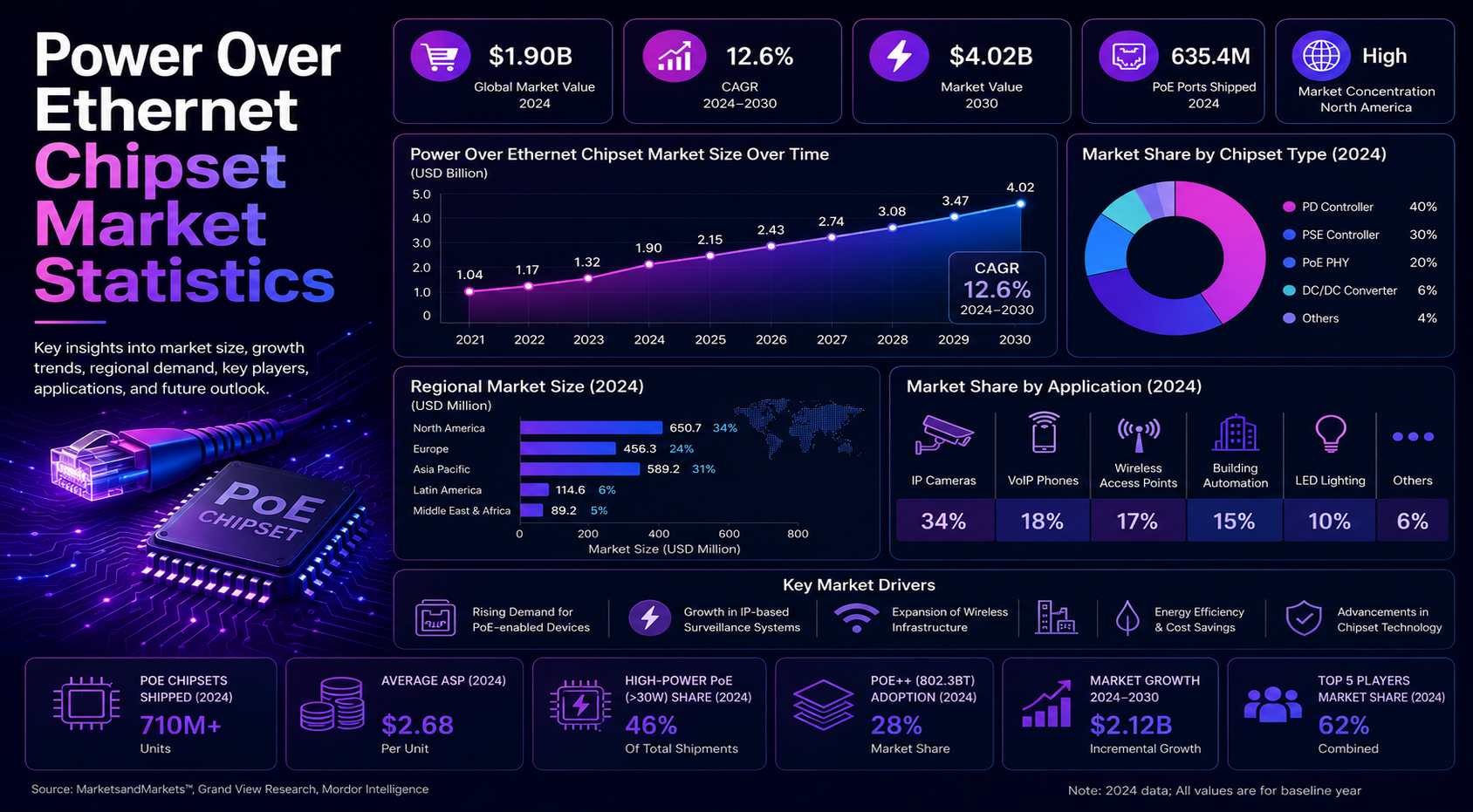
Power over Ethernet chipsets are the quiet semiconductor layer behind a growing share of enterprise networks, smart buildings, IP surveillance systems, wireless access points, VoIP devices, access control readers, industrial sensors, and edge infrastructure. They allow power and data to move through the same Ethernet cable, reducing the need for separate electrical wiring and giving network teams more control over device placement, monitoring, and power delivery.
The strongest statistics show why the category deserves a dedicated scorecard. Mordor Intelligence places the global Power over Ethernet chipset market at USD 690.15 million in 2025, USD 756.21 million in 2026, and USD 983.70 million by 2030. Persistence Market Research uses a similar chipset boundary and forecasts USD 732.0 million in 2026 and USD 1.40 billion by 2033. Broader PoE solution forecasts are larger because they include switches, injectors, power sourcing equipment, lighting systems, and adjacent hardware.
This article separates the market into the signals that explain demand: PSE chipsets, PD chipsets, power standards, high-power PoE, endpoint applications, smart building drivers, regional demand, country hotspots, supplier strategy, risks, and the metrics analysts should track. Each section uses benchmark statistics, compact tables, charts, and readout boxes so the article remains a useful market scorecard rather than a raw list of numbers.
Executive Power Over Ethernet Chipset Benchmarks
These are the statistics that frame the PoE chipset market. They show the size of the semiconductor opportunity, the difference between chipset and solution forecasts, and the role of endpoint growth, standards, applications, and regional investment.
The numbers that define the PoE chipset market
• Mordor Intelligence values the Power over Ethernet chipset market at USD 690.15 million in 2025, USD 756.21 million in 2026, and USD 983.70 million by 2030.
• Mordor lists a 7.35% CAGR for 2026-2030, supported by smart buildings, industrial automation, and IoT demand.
• Persistence Market Research places the market at USD 732.0 million in 2026 and USD 1,399.5 million by 2033.
• TechSci Research uses a broader scope and forecasts USD 1.34 billion in 2025 and USD 3.12 billion by 2031.
• Research & Markets reports USD 610.01 million in 2023 with a 10.43% CAGR during 2025-2030.
• Precedence Research forecasts the broader PoE market at USD 1.64 billion in 2025 and USD 4.87 billion by 2035.
• Grand View Research reports India PoE chipset revenue of USD 42.2 million in 2023 and USD 129.3 million by 2030.
• Grand View Research reports China PoE chipset revenue of USD 63.7 million in 2023 and USD 171.0 million by 2030.
• IEEE 802.3bt expands powered-device capability by using all four twisted pairs for higher-power four-pair delivery.
• PD chipsets scale with cameras, access points, phones, sensors, and lighting nodes, while PSE chipsets track switch and injector capacity.
Editorial readout
PoE chipset statistics point to a market shaped by connected endpoints rather than only switch shipments. Demand rises when more devices need power, data, remote control, standards compliance, and easier installation through one Ethernet cable.
Why Power Over Ethernet Chipsets Carry Market Weight
PoE chipsets matter because they turn Ethernet cabling into a power-and-data platform. A powered device can be placed where the network is needed instead of where a wall outlet already exists. For buildings with cameras, access points, phones, sensors, lighting, access readers, and control devices, that difference can reduce installation complexity and make upgrades faster.
The market also has two sides. Power sourcing equipment, usually called PSE, supplies power from switches, injectors, gateways, and controllers. Powered devices, usually called PDs, receive that power and negotiate how much is required. A complete PoE deployment needs both sides to work safely and predictably, which makes chipset quality, standards compliance, power management, and thermal design commercially important.
• PSE chipsets sit inside PoE switches, injectors, routers, gateways, and power sourcing equipment.
• PD chipsets sit inside endpoint devices such as IP cameras, Wi-Fi access points, VoIP phones, sensors, and lighting nodes.
• Controller ICs help with detection, classification, power negotiation, current limiting, protection, and monitoring.
• Higher-power PoE expands the market from basic phones and cameras into lighting, signage, kiosks, edge devices, and advanced access points.
• PoE lowers wiring complexity in locations where separate electrical work is expensive, slow, or difficult to manage.
• Enterprise networks, smart buildings, factories, warehouses, hospitals, campuses, hotels, and smart city projects all create endpoint density.
| Chipset role | Common location | Market meaning |
|---|---|---|
| PSE chipset | Switches, injectors, gateways | Network-side power capacity |
| PD chipset | Cameras, APs, phones, sensors | Endpoint-side growth |
| Controller IC | Power negotiation and control | Compliance and protection |
| High-power chipset | 802.3bt equipment | Broader applications |
| Industrial PoE IC | Rugged network devices | Harsh environment demand |
Market context readout
PoE chipsets should be reviewed by endpoint density, power class, port count, and application mix. A building with hundreds of powered endpoints creates a different market signal from a simple Ethernet switch replacement cycle.
Global Power Over Ethernet Chipset Market Size and Forecast
Market-size forecasts are useful, but the PoE chipset category needs careful reading. Some sources measure chipsets only, while others include broader PoE equipment, solutions, switches, lighting infrastructure, power sourcing equipment, and adjacent hardware. The best approach is to compare direction, scope, CAGR, and demand logic instead of forcing every forecast into one blended number.
Narrow chipset forecasts show a market moving from hundreds of millions of dollars toward the billion-dollar range. Broader PoE solution forecasts are larger because the value chain includes switches, controllers, power supplies, injectors, cabling, lighting systems, and service integration. Both perspectives matter: chipset revenue shows semiconductor demand, while solution revenue shows the deployment environment that pulls chipsets into networks.
• Mordor Intelligence reports USD 690.15 million in 2025 and USD 756.21 million in 2026.
• Mordor forecasts USD 983.70 million by 2030, with a 7.35% CAGR for 2026-2030.
• Persistence Market Research reports USD 732.0 million in 2026 and USD 1.40 billion by 2033.
• TechSci Research forecasts a wider PoE chipset market from USD 1.34 billion in 2025 to USD 3.12 billion by 2031.
• Research & Markets reported USD 610.01 million in 2023 and a 10.43% CAGR during 2025-2030.
• Broader PoE market forecasts can exceed chipset-only forecasts because they include switches, power sourcing equipment, injectors, and system-level revenue.
| Source | Base year | Base value | Forecast year | Forecast value | CAGR |
|---|---|---|---|---|---|
| Mordor Intelligence | 2025 | USD 690.15M | 2030 | USD 983.70M | 7.35% |
| Persistence Market Research | 2026 | USD 732.0M | 2033 | USD 1.40B | 9.7% |
| TechSci Research | 2025 | USD 1.34B | 2031 | USD 3.12B | 15.13% |
| Research & Markets | 2023 | USD 610.01M | 2030 | Not disclosed in snippet | 10.43% |
| Precedence Research | 2025 | USD 1.64B | 2035 | USD 4.87B | 11.50% |
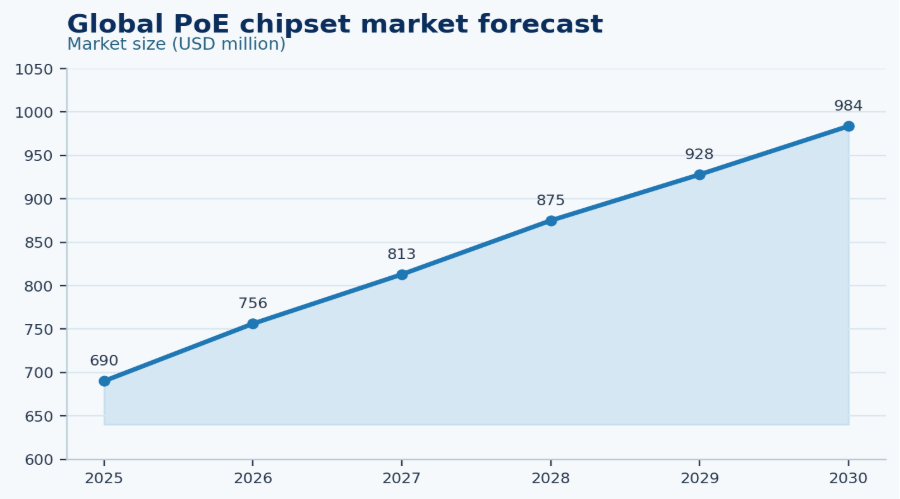
Figure 1. Global PoE chipset market forecasts should be read by source scope because chipset-only and solution-level estimates use different boundaries.
Forecast readout
The consistent signal is growth, not one perfect number. PoE chipset demand is supported by endpoint expansion, higher-power standards, smart buildings, surveillance, industrial IoT, and enterprise wireless upgrades.
Chipset Type Statistics: PSE and PD Demand
The PSE and PD split is one of the most important ways to understand the market. PSE chipsets are tied to the network infrastructure that supplies power. PD chipsets are tied to the powered endpoints that consume it. A city, campus, factory, or commercial building can grow both sides at once when it adds more PoE ports and more powered devices.
PSE demand is strongest when organizations upgrade switches, add PoE port density, deploy higher-power standards, or build networks that need centralized power control. PD demand is strongest when cameras, wireless access points, phones, access readers, lighting nodes, and sensors are installed at scale. Because endpoint deployments can multiply across every floor and facility, PD growth often tells a clearer story about installed device density.
PSE and PD chipset benchmarks
• PSE chipsets are used in switches, injectors, routers, gateways, and power-sourcing equipment.
• PD chipsets are used in endpoint devices that receive power over Ethernet cabling.
• Powered-device chipsets scale with IP cameras, Wi-Fi access points, phones, sensors, and lighting.
• Power-sourcing-equipment chipsets scale with port density, switch refresh cycles, and higher-power network upgrades.
• High-power PSE chipsets become more important as networks support 802.3bt devices.
• High-power PD chipsets support advanced cameras, signage, lighting, kiosks, and edge devices that need more wattage.
• India country data from Grand View Research identifies PoE powered-device chipsets as the largest revenue-generating type in 2023.
• China country data also identifies PoE powered-device chipsets as the largest revenue-generating type in 2023.
| Type | Where used | Demand signal |
|---|---|---|
| PSE chipset | PoE switches and injectors | Port upgrades |
| PD chipset | Cameras, APs, phones | Endpoint expansion |
| High-power PSE | 802.3bt switches | Higher wattage ports |
| High-power PD | Lighting and advanced devices | New applications |
| Integrated controller | Switch and device boards | Lower BOM complexity |
Type readout
PSE chipsets show how much power the network can deliver. PD chipsets show how many endpoints are being connected. The strongest market view tracks both sides together because one without the other limits deployment.
Power Standard Statistics: 802.3af, 802.3at, and 802.3bt
PoE standards define how much power a device can receive, how many cable pairs are used, and which endpoint categories chipsets must support. Earlier PoE standards still support phones, cameras, and access points, while 802.3bt expands the market toward higher-power smart-building, lighting, signage, wireless, and industrial edge devices.
• IEEE 802.3af remains the mature lower-power PoE base for simpler endpoints.
• IEEE 802.3at supports PoE+ devices such as enterprise access points and cameras.
• IEEE 802.3bt uses all four cable pairs to support higher powered-device levels.
• Type 3 and Type 4 PoE expand demand across APs, cameras, lighting, signage, and edge devices.
• Higher-power PoE raises chipset requirements for thermal design, power budgeting, cable quality, and standards compliance.
| Standard | Common name | Typical role | Market implication |
|---|---|---|---|
| IEEE 802.3af | PoE | Lower-power endpoints | Mature installed base |
| IEEE 802.3at | PoE+ | Cameras and APs | Broad enterprise use |
| IEEE 802.3bt Type 3 | PoE++ | Higher-power devices | Application expansion |
| IEEE 802.3bt Type 4 | High-power PoE | Lighting and signage | Premium chipset demand |
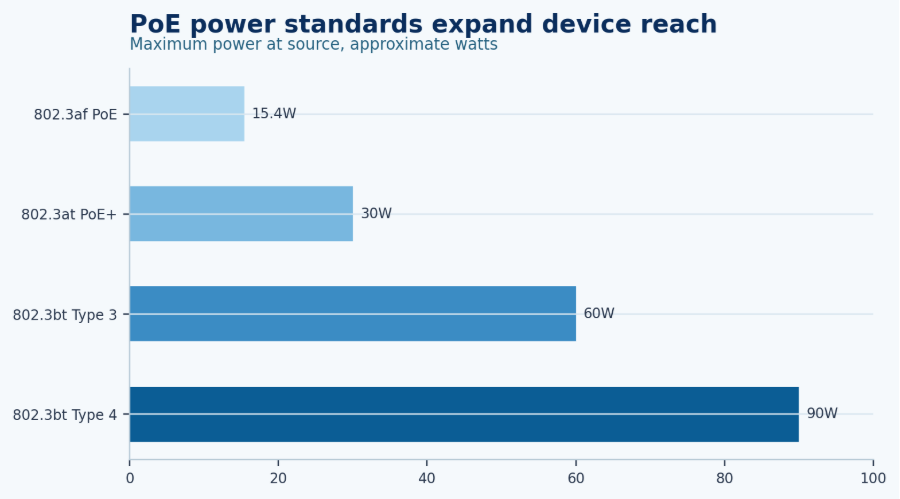
Figure 2. PoE standards expand the addressable device base by increasing available power and improving power management.
Standards readout
PoE standards matter because they expand what Ethernet-powered devices can do. Earlier standards support mature endpoint categories, while 802.3bt opens higher-power demand across access points, cameras, lighting, signage, smart buildings, and industrial edge devices.
Application-Level PoE Chipset Demand
Application-level analysis keeps the market practical. A chipset sold into a surveillance camera follows a different demand pattern from a chipset sold into a PoE switch, access point, access-control reader, lighting controller, or industrial sensor. The strongest view separates endpoint categories because each application has its own replacement cycle, power requirement, and regional adoption pattern.
IP cameras and wireless access points are among the clearest demand signals because they often use PoE to reduce installation work and support centralized power. VoIP phones represent a mature enterprise base. Access control, occupancy sensors, lighting nodes, and building-management devices show why smart buildings are important. Industrial IoT and edge devices add another layer because they require reliability, ruggedization, and sometimes higher power classes.
Application benchmarks
• IP cameras create strong PD chipset demand because surveillance systems often place endpoints across buildings, campuses, warehouses, and cities.
• Wireless access points support PD chipset growth as enterprises upgrade Wi-Fi coverage, capacity, and access-point density.
• VoIP phones remain a mature PoE category because office networks can power phones centrally through switches.
• Access control systems use PoE for readers, door controllers, intercoms, and security endpoints.
• Smart lighting creates high-power PoE opportunity when building owners want centralized control and data-linked fixtures.
• Industrial IoT expands demand for ruggedized PoE devices in factories, logistics sites, utilities, and transportation infrastructure.
• Digital signage and kiosks can require higher-power PoE, creating a stronger role for 802.3bt-capable chipsets.
• Edge AI cameras raise power and thermal requirements because they combine imaging, compute, networking, and remote management.
| Application | Main chipset demand | Why it matters |
|---|---|---|
| IP cameras | PD chipsets | Surveillance density |
| Wi-Fi access points | PD + high-power support | Enterprise refresh |
| VoIP phones | Mature PD demand | Stable installed base |
| Access control | PD chipsets | Security systems |
| Smart lighting | High-power PSE/PD | Smart buildings |
| Industrial IoT | Rugged PoE ICs | Factory edge networks |
| Digital signage | Higher-power PoE | Wider power needs |
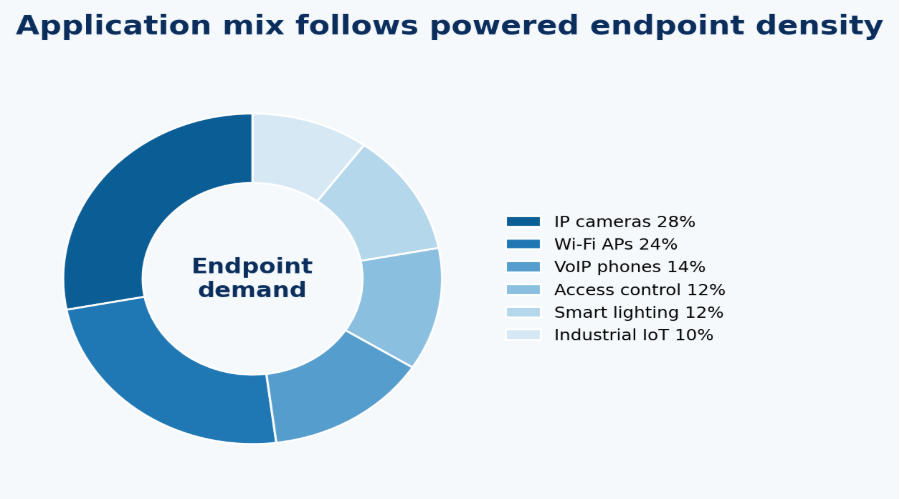
Figure 3. Application-level PoE chipset demand follows powered endpoint density across cameras, access points, phones, controls, lighting, and industrial devices.
Application readout
The application mix shows why PoE chipset growth is not only a networking story. It is also a security, building automation, wireless infrastructure, and industrial edge story.
Smart Buildings, IoT, and Enterprise Network Drivers
The main demand driver behind PoE chipsets is not one device category. It is the steady increase in powered endpoints across buildings and networks. Smart buildings need sensors, cameras, access readers, lighting nodes, controllers, gateways, and wireless access points. PoE supports those deployments because it simplifies power delivery and lets facilities use network infrastructure to monitor and manage endpoint availability.
Enterprise network refresh cycles also matter. Wi-Fi upgrades can increase access-point density and raise power demand per access point. Security modernization can add more cameras and access-control endpoints. Industrial Ethernet can expand PoE into equipment rooms, warehouses, manufacturing lines, transportation hubs, and utility environments. When these trends overlap, chipset demand moves beyond standard office phones and into a larger edge-infrastructure market.
• Smart buildings increase endpoint density through cameras, sensors, access control, lighting, and building-management devices.
• IoT growth increases demand for simplified power and data connections at the network edge.
• Enterprise Wi-Fi upgrades support higher-power access points and more PoE switch capacity.
• Security camera growth increases demand for powered-device chipsets and higher-reliability power negotiation.
• Industrial Ethernet adoption expands the addressable market for ruggedized PoE chipsets.
• Edge AI devices raise power requirements because endpoints now combine sensing, compute, storage, and networking.
• PoE helps reduce installation complexity where adding electrical outlets would slow a deployment.
• Centralized power management can improve uptime, troubleshooting, and remote restart capability for deployed endpoints.
| Driver | What changes | Chipset implication |
|---|---|---|
| Smart buildings | More endpoints | More PD chipsets |
| Wi-Fi upgrades | Higher AP density | More power per port |
| Surveillance | More cameras | Strong PD demand |
| Industrial IoT | Rugged endpoints | Industrial-grade ICs |
| LED lighting | Higher wattage | 802.3bt opportunity |
| Edge devices | More compute | Higher power classes |
Driver readout
Endpoint density is the common thread. PoE chipsets benefit when buildings, campuses, factories, and public infrastructure add more networked devices that need both power and data.
Regional Power Over Ethernet Chipset Market Statistics
Regional PoE chipset demand does not move evenly. It follows enterprise networking maturity, smart building investment, surveillance deployment, industrial automation, telecom infrastructure, and public-sector digitization. Global averages can hide the difference between North America’s large installed base, Asia-Pacific’s manufacturing and smart-city scale, Europe’s building modernization, the Middle East’s project-led smart infrastructure, and Latin America’s security and enterprise-network opportunity.
North America
• North America remains one of the largest PoE chipset demand regions because enterprise networks, smart buildings, security systems, and Wi-Fi upgrades are already well established.
• Grand View Research regional outlook data has projected North America PoE chipset revenue at USD 500.9 million by 2030.
• The United States is the regional anchor because commercial buildings, campuses, hospitals, schools, hotels, data-heavy enterprises, and public facilities use large numbers of powered endpoints.
• Canada adds demand through commercial buildings, transportation, education, healthcare, industrial sites, and surveillance networks.
Europe
• Europe is shaped by building modernization, energy efficiency, security upgrades, smart offices, and industrial Ethernet adoption.
• Germany is important because industrial automation and manufacturing networks can support ruggedized and standards-compliant PoE deployments.
• The United Kingdom, France, Italy, Spain, and Nordic markets add demand through commercial buildings, security, hospitality, and public infrastructure.
• Europe also has retrofit opportunity because PoE can simplify endpoint additions in existing buildings without heavy electrical work.
Asia-Pacific
• Asia-Pacific is one of the strongest growth zones because smart cities, manufacturing, telecom infrastructure, surveillance, and enterprise network upgrades overlap.
• Grand View Research reports China PoE chipset revenue of USD 63.7 million in 2023 and USD 171.0 million by 2030.
• Grand View Research reports India revenue of USD 42.2 million in 2023 and USD 129.3 million by 2030.
• Japan and South Korea add mature enterprise, telecom, industrial, and smart-building demand.
• Southeast Asian markets add opportunity through urban development, security systems, hospitality, logistics, and commercial construction.
Middle East and Africa
• Middle East demand is project-led, with smart cities, airports, hospitality, security, government buildings, and commercial districts supporting PoE use.
• Saudi Arabia and the UAE are important because large real estate, smart-city, and infrastructure programs can create high-density endpoint environments.
• GCC countries often require integrated security, access control, surveillance, Wi-Fi, and building automation systems in new developments.
• Africa adds selective demand through commercial networks, public safety, telecom infrastructure, campuses, and urban security upgrades.
Latin America
• Latin America is more selective but still important for surveillance, enterprise networking, smart buildings, and public infrastructure upgrades.
• Brazil is the largest country-level opportunity in the region because of enterprise scale, security demand, logistics, retail, and commercial buildings.
• Mexico adds demand through manufacturing, industrial parks, hotels, commercial property, and security systems.
• Chile, Colombia, Argentina, and Peru create smaller but useful demand pockets through enterprise and public-sector network modernization.
| Region | Main demand theme | Strategic implication |
|---|---|---|
| North America | Enterprise and security | Large installed base |
| Europe | Building modernization | Retrofit opportunity |
| Asia-Pacific | Smart cities and manufacturing | Fast growth potential |
| Middle East & Africa | Smart infrastructure | Project-led demand |
| Latin America | Security and enterprise | Selective growth |
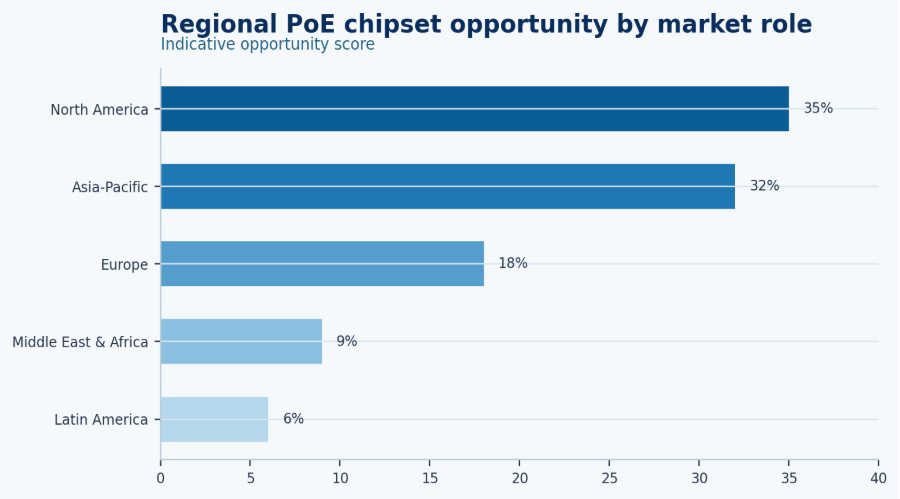
Figure 4. Regional PoE chipset demand should be reviewed by endpoint density, infrastructure maturity, and project-led smart building investment.
Regional readout
North America is installed-base heavy, Asia-Pacific is growth-heavy, Europe is modernization-heavy, the Middle East is project-heavy, and Latin America is selective but security-led.
Country-Level PoE Chipset Market Hotspots
Country-level analysis adds practical value because PoE deployments are local. Purchasing decisions often come from enterprise IT teams, system integrators, smart-building contractors, security vendors, public-sector projects, telecom operators, and industrial automation teams. A country with strong endpoint density can be more attractive than a country with large population but limited enterprise or smart-building investment.
The strongest country scores usually appear where multiple signals overlap: enterprise network refresh, security camera deployment, Wi-Fi density, smart city projects, commercial building activity, industrial Ethernet adoption, and standards-based infrastructure. That is why the United States, China, India, Germany, Japan, South Korea, the UK, Saudi Arabia, UAE, Brazil, and Mexico deserve dedicated attention.
• The United States combines enterprise networks, smart buildings, surveillance, education, healthcare, hospitality, and public-sector infrastructure.
• China combines smart city activity, manufacturing scale, surveillance infrastructure, and commercial construction.
• India is a high-growth market because enterprise modernization, smart infrastructure, offices, campuses, and security systems are expanding.
• Japan and South Korea have mature technology environments where enterprise, telecom, industrial, and smart-building demand overlap.
• Germany is important for industrial Ethernet and automation-led PoE applications.
• The United Kingdom is linked to commercial retrofits, security, office networks, and public infrastructure.
• Saudi Arabia and the UAE are project-led markets because smart cities, airports, hotels, campuses, and commercial districts require high endpoint density.
• Brazil and Mexico anchor Latin America through enterprise networks, retail, manufacturing, logistics, surveillance, and public-sector demand.
| Country | Main demand signal | Market meaning |
|---|---|---|
| United States | Enterprise, security, smart buildings | Largest North America base |
| China | Smart cities and manufacturing | Large APAC opportunity |
| India | Smart infrastructure and offices | Fast growth |
| Japan | Enterprise and industrial Ethernet | Mature technology base |
| South Korea | Telecom and smart buildings | High-connectivity demand |
| Germany | Industrial automation | Rugged PoE use |
| United Kingdom | Commercial retrofit and security | Modernization demand |
| Saudi Arabia | Smart city projects | Project-led growth |
| UAE | Hospitality and commercial districts | Smart building demand |
| Brazil | Security and enterprise networks | Latin America base |
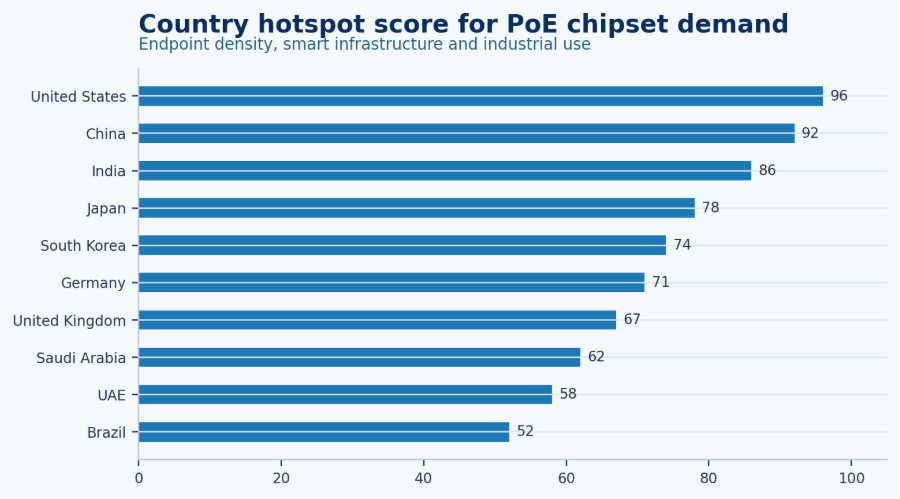
Figure 5. Country opportunity rises where endpoint density, smart infrastructure, security demand, and industrial networking overlap.
Country readout
Country demand should not be ranked by population alone. PoE chipset opportunity is stronger where smart buildings, enterprise networks, public security, Wi-Fi upgrades, and industrial Ethernet are expanding at the same time.
Competitive and Semiconductor Supply Chain Landscape
The competitive landscape is shaped by standards compliance, power efficiency, integration, thermal performance, port density, qualification support, and ecosystem relationships. PoE chipsets are not purchased as isolated components; they are designed into switches, powered devices, controllers, gateways, industrial equipment, cameras, access points, and modules. That makes design-in cycles and vendor support important.
Suppliers compete through analog and power-management expertise, Ethernet ecosystem support, reference designs, protection features, and compatibility with IEEE standards. High-power PoE increases the importance of thermal management, current control, cable loss awareness, and board design. Industrial PoE adds additional requirements around temperature range, surge protection, electromagnetic noise, reliability, and long product life cycles.
• PoE chipset suppliers must support standards-based detection, classification, power negotiation, and protection.
• PSE designs need port density, power budget control, telemetry, current limiting, and thermal planning.
• PD designs need efficient power conversion, startup reliability, protection, and compatibility across switch environments.
• High-power PoE raises design complexity because heat, cable loss, and power budgeting become more important.
• System integrators and OEMs value vendor reference designs because they shorten design cycles and reduce compliance risk.
• Industrial customers often require rugged temperature ranges, long availability, and stronger protection from electrical noise or surges.
| Competitive factor | Why it matters |
|---|---|
| Standards compliance | Supports interoperability |
| Power efficiency | Reduces heat |
| Integration level | Lowers board complexity |
| Port density | Supports larger switches |
| Thermal design | Important for high power |
| Industrial rating | Enables harsh environments |
| Vendor ecosystem | Supports design-in |
Competitive readout
Vendors compete on more than wattage. The strongest designs combine compliance, efficiency, integration, protection, thermal control, and the support needed to help OEMs qualify products quickly.
Risks and Bottlenecks
The PoE chipset market has strong drivers, but several risks can affect adoption speed. Higher-power PoE increases thermal pressure, switch cost, power-budget complexity, and cable-quality requirements. Enterprise capex cycles can delay network refreshes. Standards mismatch or poor installation quality can also create support problems that slow confidence in deployment.
The most useful risk view separates technical constraints from purchasing constraints. Technical risks include heat, cable loss, endpoint compatibility, power budgeting, and cybersecurity exposure from connected devices. Purchasing risks include higher switch cost, delayed building projects, semiconductor supply cycles, and slow enterprise IT spending. The market remains attractive, but suppliers and integrators need to manage these bottlenecks carefully.
• Higher-power PoE can create heat and power-loss challenges that require careful chipset and board design.
• PoE switches can cost more than non-PoE switches, which can affect adoption timing in cost-sensitive deployments.
• Cable quality and installation practices affect reliability, especially in older buildings or longer cable runs.
• Standards mismatch can create device compatibility issues between older PSE equipment and newer powered devices.
• Cybersecurity risk rises when more powered endpoints are connected to the network edge.
• Semiconductor supply cycles can affect lead times for power-management ICs and Ethernet-related components.
• Enterprise capex delays can slow switch refresh cycles even when endpoint demand remains strong.
• Power-budget mistakes can limit usable ports or reduce reliability in dense device deployments.
| Risk | What it affects | Market response |
|---|---|---|
| Heat and power loss | High-power devices | Better efficiency |
| Switch cost | Adoption timing | Cost optimization |
| Cable quality | Reliability | Installation standards |
| Standards mismatch | Compatibility | Compliance testing |
| Cybersecurity | Endpoint exposure | Network controls |
| Supply cycles | Lead times | Vendor planning |
| Capex delays | Refresh timing | Installed-base focus |
Risk interpretation
The main risk is not whether PoE has use cases. The risk is whether deployments are specified, powered, secured, and supported correctly enough to avoid performance problems, cost overruns, or delayed refresh cycles.
Power Over Ethernet Chipset Opportunity Diagnostic
The diagnostic view keeps the article from becoming a stat dump. Every PoE chipset statistic should answer a business question: where are powered endpoints growing, which standard is needed, which region is adding dense deployments, and which devices require higher power or better reliability?
| Opportunity area | Core signals to measure | Why it matters |
|---|---|---|
| IP surveillance | Camera deployments, smart cities | Strong PD demand |
| Wi-Fi access | AP refresh and density | Higher-power ports |
| Smart buildings | Sensors, lighting, controls | Endpoint growth |
| Industrial IoT | Factory Ethernet, rugged devices | Reliability need |
| PSE infrastructure | Switch upgrades, port density | Network-side demand |
| Regional projects | Campuses, airports, districts | Project-led growth |
| Standards shift | 802.3bt adoption | Premium chipsets |
Diagnostic readout
The best PoE chipset opportunity appears where endpoint density, power requirements, network refresh cycles, and smart-building investment overlap. That combination turns a simple networking component into an infrastructure growth signal.
90-Day Power Over Ethernet Chipset Market Benchmark Plan
Statistics become useful when they are translated into a repeatable review process. A 90-day benchmark plan helps analysts separate market-size claims from practical demand signals such as endpoint deployments, regional projects, standards adoption, supplier readiness, and design-in activity.
| Timing | What to do | Output |
|---|---|---|
| Days 1-30 | Build baseline by source, type, application, standard, and region | Market map |
| Days 31-60 | Compare endpoint demand, country signals, smart buildings, Wi-Fi, and security adoption | Country list |
| Days 61-90 | Review suppliers, standards, design cycles, power classes, and risks | Practical scorecard |
Planning principle
Do not judge PoE chipset demand by CAGR alone. Compare forecasts with endpoint growth, switch upgrades, power standards, regional projects, and application-level adoption.
Metrics Industry Leaders Should Track
A mature PoE chipset scorecard should be detailed enough to locate demand without becoming a vanity dashboard. Market value and CAGR are useful starting points, but the practical metrics are endpoint density, standards adoption, port capacity, regional projects, country opportunity, and supplier design wins.
| Metric | Why it matters |
|---|---|
| Total PoE chipset value | Shows market direction |
| CAGR by source | Compares assumptions |
| PSE chipset share | Tracks infrastructure demand |
| PD chipset share | Tracks endpoint demand |
| 802.3bt adoption | Shows high-power opportunity |
| IP camera deployments | Signals surveillance demand |
| Wi-Fi AP upgrades | Tracks enterprise refresh |
| Smart building projects | Shows endpoint density |
| Industrial Ethernet adoption | Signals rugged demand |
| Regional market share | Shows demand concentration |
| Country opportunity score | Prioritizes markets |
| Supplier design wins | Indicates future revenue |
Scorecard readout
The strongest metrics connect semiconductor demand to real deployments. Chipsets win when devices are installed, ports are powered, standards are supported, and endpoints remain reliable across the network lifecycle.
How Buyers Should Read PoE Chipset Statistics
Buyers should read PoE chipset statistics through deployment logic. A market forecast shows commercial direction, but endpoint density shows practical demand. A smart campus with cameras, access points, access readers, sensors, and lighting nodes can require a deeper PoE ecosystem than a simple office network. The more a deployment depends on centralized control, remote power cycling, uptime, and standards compliance, the more chipset quality matters.
• A high endpoint count supports PD chipset demand.
• A high PoE port count supports PSE chipset demand.
• Advanced cameras, access points, lighting, and signage increase the need for higher-power standards.
• Industrial and outdoor deployments raise reliability, protection, and temperature requirements.
• Smart buildings create stronger PoE demand when lighting, access control, sensors, and security are integrated.
• Country-level demand is strongest where enterprise networks, smart infrastructure, and security upgrades overlap.
For suppliers, the strongest opportunities appear in markets where deployment density is real and reachable. That means tracking building projects, security upgrades, Wi-Fi refreshes, switch port density, standards adoption, and OEM design cycles. For operators, the main question is not only whether a PoE device will power on. It is whether the entire network can power, monitor, protect, and manage hundreds or thousands of endpoints reliably.
Deployment Economics and Power-Budget Statistics
PoE deployment economics matter because the value of a chipset is tied to the whole installation model. A PoE device may cost more at the component or switch level, but it can reduce the need for separate electrical work, support faster moves and adds, simplify endpoint placement, and make device power easier to monitor centrally. That is why many organizations evaluate PoE through total deployment cost rather than only the price of a switch port or endpoint module.
Power budgeting is the practical discipline behind PoE adoption. A switch with many powered ports does not always have enough available power to run every device at maximum wattage at the same time. Network teams must compare the available power budget, device class, cable distance, thermal conditions, and redundancy needs before large deployments. This creates demand for smarter PSE chipsets, telemetry, classification features, protection circuits, and software-managed power allocation.
• Power budget planning becomes more important as networks add higher-power endpoints such as access points, cameras, signage, and lighting.
• PSE chipsets with better monitoring help network teams understand port-level power draw and available headroom.
• PD chipsets with efficient conversion can reduce waste heat and improve endpoint reliability.
• Centralized power can simplify troubleshooting because network teams can remotely reset or monitor connected devices.
• Installation savings are strongest when PoE avoids expensive electrical work in ceilings, corridors, warehouses, campuses, and outdoor locations.
• PoE economics become more attractive when the deployment includes many endpoints instead of one or two isolated devices.
• Power budgeting errors can create field problems even when the chipset and endpoint are technically standards-compliant.
• High-power PoE increases the importance of cable quality, switch power capacity, and thermal planning across the network.
| Economic factor | What it changes | Chipset implication |
|---|---|---|
| Electrical work | Separate power runs | Higher PoE value |
| Power budget | Usable powered ports | Smarter PSE control |
| Endpoint efficiency | Heat and uptime | Better PD conversion |
| Remote reset | Support workload | Power telemetry |
| Dense deployment | Device count per site | Higher IC volume |
| High-power devices | Thermal load | 802.3bt design focus |
Deployment readout
PoE chipset value is easier to understand when deployment cost, port power budget, endpoint density, and support workload are reviewed together. The chipset is small, but it influences whether a powered network scales cleanly.
Device Lifecycle and Installed-Base Demand
Installed-base demand is an important part of the PoE chipset story. A new smart building can create a large one-time pull for switches and powered devices, but the installed base creates recurring demand through replacements, standards migration, endpoint upgrades, and network refresh cycles. A camera fleet may be upgraded for better resolution or analytics. Access points may be replaced for higher Wi-Fi performance. Building sensors and access-control devices may be expanded over time. Each cycle can create new PD demand while also pressuring PSE infrastructure to support more ports and higher wattage.
This lifecycle view helps explain why PoE chipset demand can remain active even when new construction slows. Existing buildings still add cameras, wireless access points, occupancy sensors, visitor-management systems, intercoms, and lighting controls. Enterprise IT teams also replace older switches when power budget, port density, or management features become limiting. The installed base therefore creates a market floor that is different from project-led new construction.
• Camera upgrades can increase PD demand when organizations move to higher-resolution, AI-enabled, or multi-sensor cameras.
• Wi-Fi access point refresh cycles can increase power requirements as radio density and performance needs rise.
• Older PoE switches may be replaced when they cannot support enough powered ports or newer standards.
• Smart building expansions often add endpoints gradually, creating follow-on demand after the original deployment.
• Industrial networks require longer lifecycle support because factory and infrastructure equipment is not replaced as quickly as office devices.
• Access-control systems can expand building by building, door by door, and campus by campus.
• Service and maintenance teams value standardized PoE because endpoint replacement can be faster when power and data use the same cable path.
• Lifecycle demand is strongest where device fleets are large, distributed, and managed by central IT or facilities teams.
| Lifecycle signal | What it indicates | Market meaning |
|---|---|---|
| Camera refresh | Better video and analytics | New PD demand |
| AP upgrade | Higher Wi-Fi density | More power per endpoint |
| Switch replacement | Port and wattage limits | PSE refresh |
| Building expansion | More sensors and controls | Endpoint growth |
| Industrial lifecycle | Long support needs | Ruggedized demand |
| Access control rollout | More doors and readers | Distributed PD demand |
Lifecycle readout
The market should not be judged only by new smart-building projects. Existing networks create steady chipset demand when endpoints are upgraded, power budgets tighten, and older PSE equipment is replaced.
Supplier and Buyer Implications
PoE chipset suppliers, switch vendors, device manufacturers, system integrators, and building owners do not all read the market in the same way. Semiconductor suppliers focus on design wins, standards migration, efficiency, integration, and lifecycle support. Switch vendors focus on port density, power budget, software management, and enterprise refresh. Device manufacturers focus on efficient PD design, thermal behavior, protection, and compatibility across a wide range of switches. Buyers focus on deployment cost, reliability, device placement, and long-term support.
A strong supplier strategy should distinguish between product capability and actual market access. While a chipset may meet the required wattage and technical standards, its commercial success also depends on the availability of design tools, reference boards, technical documentation, validation support, and a reliable supply chain. In high-volume applications such as IP cameras and access points, securing a design win can generate revenue across multiple generations of devices. For industrial and smart-building applications, however, long product lifecycles, dependable performance, and reliability may be more important than achieving the lowest component cost. Clear documentation for unrelated business transactions, such as a donation receipt, can also help maintain organized financial records.
| Market participant | What to watch | Why it matters |
|---|---|---|
| Chipset suppliers | Design wins and standards | Future IC revenue |
| Switch vendors | Port density and budget | PSE demand |
| Device OEMs | Efficiency and compatibility | PD adoption |
| System integrators | Installation simplicity | Project execution |
| Building owners | Total deployment cost | Adoption timing |
| Industrial buyers | Reliability and lifecycle | Long-term support |
Buyer readout
The market is strongest when technical capability, design support, and deployment economics line up. PoE succeeds when the device works reliably, the switch has enough power, and the installation model saves time or complexity.
Power Over Ethernet Chipset Market Statistics FAQ
Common questions
What is the Power over Ethernet chipset market?
It is the market for semiconductor devices that enable power and data delivery through Ethernet cabling. It includes PSE chipsets in switches and injectors and PD chipsets in powered devices such as cameras, access points, phones, sensors, and lighting nodes.
How large is the PoE chipset market?
Mordor Intelligence values the market at USD 690.15 million in 2025 and forecasts USD 983.70 million by 2030. Persistence Market Research forecasts USD 1.40 billion by 2033 under a similar chipset-market lens.
What is the difference between PSE and PD chipsets?
PSE chipsets supply power from switches, injectors, gateways, or other power sourcing equipment. PD chipsets receive and manage power inside endpoint devices such as IP cameras, Wi-Fi access points, VoIP phones, sensors, and lighting systems.
Which applications use PoE chipsets most?
The most important applications include IP surveillance cameras, wireless access points, VoIP phones, access control, building sensors, smart lighting, industrial IoT devices, digital signage, and edge infrastructure.
Why does 802.3bt matter?
IEEE 802.3bt expands PoE power delivery by using all four cable pairs. That makes PoE more practical for higher-power endpoints such as advanced wireless access points, lighting, signage, kiosks, and edge devices.
Which region has strong PoE chipset demand?
North America has a large enterprise and security installed base, while Asia-Pacific has strong growth from China, India, manufacturing, smart cities, and infrastructure modernization. Europe, the Middle East, and Latin America add additional smart-building and security demand.
What drives PoE chipset market growth?
Growth is driven by powered endpoint density, smart buildings, IP cameras, Wi-Fi upgrades, access control, industrial Ethernet, high-power standards, and the need to simplify power and data installation.
What risks should analysts watch?
Key risks include heat in high-power devices, switch cost, cable quality, standards mismatch, endpoint security, semiconductor lead times, and delayed enterprise capex cycles.
What metrics matter most?
Track market value, CAGR by source, PSE and PD chipset share, 802.3bt adoption, camera deployments, Wi-Fi access point upgrades, smart building projects, industrial Ethernet use, regional demand, and country opportunity scores.
Final Takeaway
Power Over Ethernet chipset market statistics point to one clear conclusion: PoE is becoming a broader edge-infrastructure platform, not only a convenience feature for phones and basic cameras. The market grows when buildings, campuses, factories, hotels, hospitals, schools, airports, warehouses, retail sites, and smart-city systems add more powered endpoints that need both connectivity and centralized power control.
The best analysis separates PSE demand from PD demand. PSE chipsets show how much power the network can supply through switches, injectors, and gateways. PD chipsets show how many devices are being installed at the edge. Both sides become more valuable as 802.3bt and higher-power applications expand the addressable device base. Advanced cameras, Wi-Fi access points, lighting, signage, access control, and industrial IoT devices all make the chipset market more diverse than a simple switch-replacement story.
For suppliers, the strongest opportunities are markets where endpoint density, smart-building investment, network refresh cycles, and higher-power requirements overlap. For buyers and analysts, the practical goal is to connect market forecasts with real deployment signals: port density, device count, power class, regional infrastructure, country demand, standards compliance, and supplier design wins. That is where PoE chipset statistics become commercially useful.


