Solar control window films are moving from a simple tinting product into a practical efficiency and comfort upgrade. They are applied to existing glass to reduce solar heat gain, glare, infrared transmission, and ultraviolet exposure without the cost or disruption of replacing the window system. That makes the category useful for homes, offices, retail stores, hotels, schools, vehicles, and public buildings that need better thermal comfort quickly.
The market is benefiting from several forces at once. Cooling demand is rising in hot and urban climates, commercial buildings are under pressure to improve energy performance, homeowners are looking for lower-cost upgrades, and vehicle owners continue to value cabin comfort and UV protection. At the same time, ceramic, spectrally selective, low-e, and high-performance films are helping suppliers sell performance rather than only shade or appearance.
Executive Solar Control Window Films Benchmarks
These headline statistics frame the article. They show market scale, forecast range, performance value, regional momentum, and the difference between selling window film as a tinting product and selling it as an efficiency solution.
The numbers that define the market
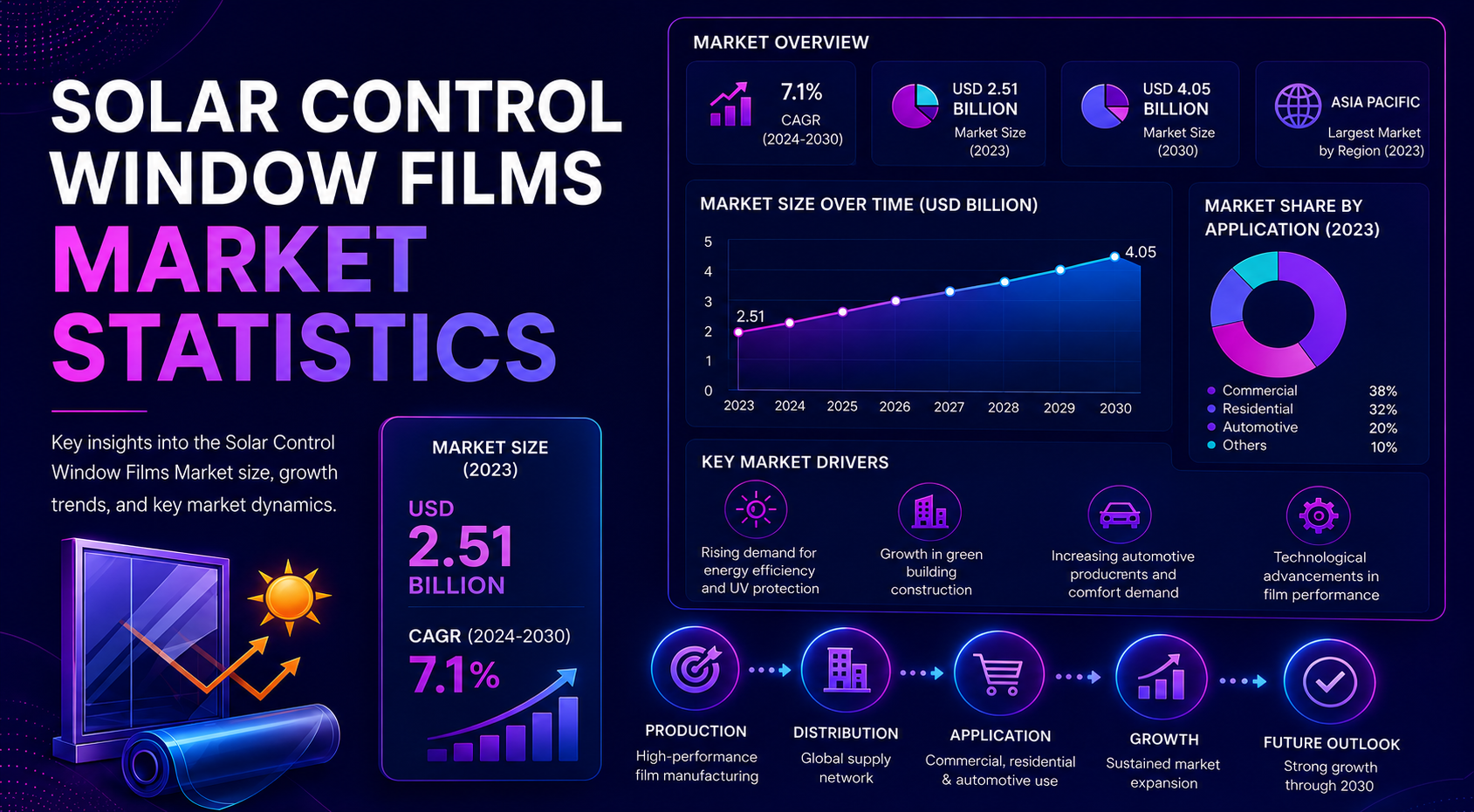
- Grand View Research estimated the solar control window film market at USD 763.81 million in 2022 and projected it to reach USD 1,271.9 million by 2030.
- Future Market Insights placed the market at USD 1.7 billion in 2025 and projected it to reach USD 4.4 billion by 2035, implying a 9.9% CAGR.
- Strategic Market Research estimated a broader solar control window films market at USD 4.2 billion in 2024 and forecast USD 7.4 billion by 2030.
- Market Research Future used a broader market definition and projected growth from USD 4.20 billion in 2024 to USD 11.52 billion by 2035.
- The U.S. solar control window film market rose from USD 213.8 million in 2022 to USD 265.7 million in 2024.
- North America represented more than 24% of the solar control window films market in one 2024 estimate, while broader window-film data placed North America at 32.1% revenue share.
- Asia-Pacific appears repeatedly as the dominant or fastest-growing region, with broader window-film data giving the region a 42% share signal.
- China is listed as the largest Asia-Pacific solar control window film market, while India is identified as one of the fastest-growing markets in the region.
- Country-level growth benchmarks show China at 13.4% CAGR, India at 12.4%, Germany at 11.4%, and the United Kingdom at 9.4%.
- 3M performance data shows selected window films can reject up to 97% infrared radiation and block about 99% to 99.9% of ultraviolet radiation.
- Building energy context matters because windows can account for about 33% of cooling expense related to solar heat gain in some estimates.
- Space-cooling demand is increasing globally, with one benchmark showing annual growth near 4%.
- The market is shaped by residential retrofits, commercial building upgrades, automotive aftermarket demand, and high-performance film technologies.
Editorial readout
Solar control film statistics point to three overlapping markets: energy efficiency, comfort, and retrofit economics. The product is not only decorative and not only automotive. It helps buildings reduce cooling pressure, improves occupant comfort, protects interiors from ultraviolet exposure, and gives property owners a lower-disruption alternative to glazing replacement. The best opportunities appear where hot climates, high cooling costs, large glass surfaces, and active renovation spending overlap.
Why Solar Control Window Films Are Becoming an Efficiency Upgrade
Solar control films are gaining attention because they solve a practical building problem. Many buildings already have large areas of glass, but replacing the glazing system is expensive, disruptive, and often difficult for occupied properties. Film installation gives owners a faster path to reduce heat gain, glare, fading, and comfort complaints.
Market-size and energy-efficiency benchmarks
- The market is projected to grow under multiple forecast models, from conservative estimates near USD 1.27 billion by 2030 to broader category forecasts above USD 7 billion by the same year.
- U.S. solar control window film revenue increased by about USD 51.9 million between 2022 and 2024, showing steady demand in a mature market.
- The window film category is not limited to buildings: automotive, marine, transportation, decorative, security, and specialty films create adjacent demand channels.
- Heat rejection and UV protection remain central product claims because buyers often want comfort, reduced fading, and energy savings from one installation.
- High-performance product data showing up to 97% infrared rejection helps explain why premium ceramic and spectrally selective films are gaining attention.
- Cooling demand growth creates a wider market context because window films can reduce solar-driven cooling pressure before air-conditioning equipment has to respond.
- The retrofit channel matters because existing building stock is much larger than annual new construction, making upgrade-friendly solutions commercially important.
- Hot-climate regions, glass-heavy buildings, and electricity-price pressure create the strongest case for film adoption.
The numbers show why the product is increasingly framed as an efficiency upgrade. Solar control films do not replace all building-envelope improvements, but they can reduce the load that windows place on cooling systems. That makes them useful in offices, homes, retail locations, schools, and hotels where comfort problems are visible and installation disruption must stay low.
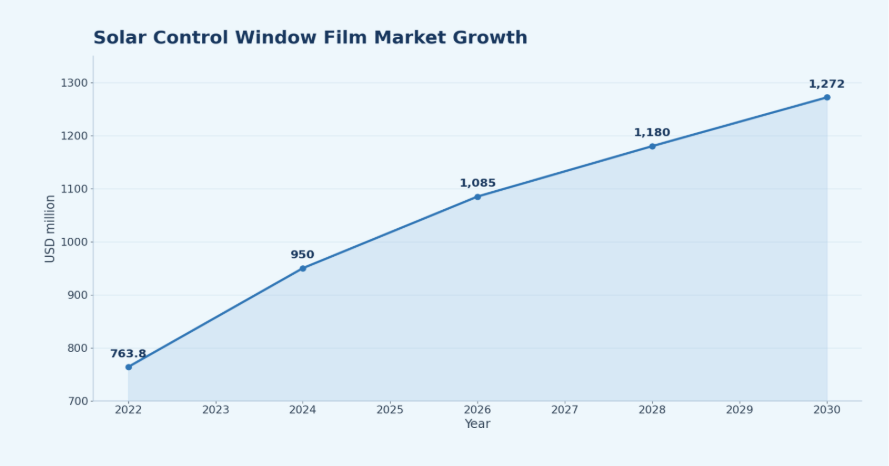
Figure 1. Solar control window film market growth should be viewed beside cooling demand because the product’s value depends on comfort, energy savings, and retrofit economics.
Market Size and Growth Outlook
Market-size estimates vary because research firms define the category differently. Some track solar control films narrowly, while others include wider window-film categories or adjacent performance films. The useful signal is not one isolated estimate; it is the consistent direction of growth across sources.
Market growth benchmarks
- Grand View Research estimated USD 763.81 million in 2022, USD 812.4 million in 2023, and USD 1,271.9 million by 2030 for the solar control window film market.
- Future Market Insights estimated USD 1.7 billion in 2025 and USD 4.4 billion by 2035, with a 9.9% CAGR.
- Strategic Market Research estimated USD 4.2 billion in 2024 and USD 7.4 billion by 2030 under a broader definition.
- Market Research Future estimated USD 4.20 billion in 2024 and forecast USD 11.52 billion by 2035.
- Straits Research projected broader growth from USD 8.17 billion in 2025 to USD 14.03 billion by 2034.
- Spherical Insights estimated USD 934.2 million in 2025 and USD 1,737.8 million by 2035 for a narrower solar control film scope.
A stronger market-size section should also explain how buyers interpret the spread between narrow and broad estimates. A narrow solar-control-film forecast is useful for product planning because it isolates heat, glare, UV, and cooling-performance demand. A broader window-film estimate is useful for channel planning because installers often sell solar control, decorative, safety, privacy, and automotive films through the same local networks. For manufacturers, the practical lesson is to separate the revenue pool from the selling motion: the product category may be defined by film type, but conversion is shaped by installers, glass compatibility, warranty confidence, and the buyer’s ability to connect the film to a measurable comfort or energy problem.
The forecast range in context instead of treating one number as the whole market. A building owner deciding between blinds, low-e glass, exterior shading, HVAC adjustment, or solar film is not comparing research definitions; the buyer is comparing disruption, cost, appearance, comfort, and payback. The market story becomes closer to the reference style when the statistics are used to explain this decision path. Solar control films win when they look less like an optional accessory and more like a low-disruption retrofit that can be specified, installed, measured, and justified within an energy-efficiency or comfort budget.
| Market signal | What it confirms | Why it matters |
|---|---|---|
| Rising market value | Demand is expanding beyond niche use | Supports manufacturer and installer growth |
| Forecast variation | Definitions differ across reports | Readers should compare scope before quoting size |
| Retrofit demand | Existing buildings need low-disruption upgrades | Films compete with glazing replacement |
| Hot-climate adoption | Demand rises with cooling pressure | Regional strategy matters |
| Performance selling | Buyers compare heat, glare, UV, and comfort | Sales teams need benefit-led positioning |
Market-size interpretation
The forecast spread is wide, but it does not weaken the market story. Instead, it shows that solar control films sit inside a larger window-film ecosystem. The most reliable way to use the numbers is to separate narrow solar control film estimates from broader window-film estimates and then connect both to real demand drivers such as cooling load, retrofit budgets, vehicle comfort, and building energy performance.
Heat, Glare, and UV Control: The Metrics That Drive Adoption
The product-performance section is where the market becomes easier to understand. Buyers are not only purchasing square footage of film; they are purchasing better interior conditions. The strongest value is usually a bundle of benefits: less heat, lower glare, UV protection, better comfort, and reduced strain on cooling systems.
Performance benchmarks
- Selected 3M window film data shows infrared rejection up to 97%, giving installers a clear premium-performance selling point.
- UV rejection data reaches about 99% to 99.9% for selected window-film products, which supports interior-protection claims.
- A building-cooling benchmark links roughly 33% of cooling expense to solar heat gain through windows, showing why glazing performance matters.
- Technical coating research shows near-infrared reflectance above 80% and mid-infrared emissivity above 90% in advanced cooling-window applications.
- Visible light transmission remains important because commercial and residential buyers often want heat rejection without making interiors too dark.
- Glare reduction matters in offices, schools, retail stores, and homes because comfort complaints can create pressure even when energy savings are not formally measured.
- Interior fading protection strengthens the value story for furniture, flooring, fabrics, retail merchandise, and vehicle interiors.
- Premium product categories such as ceramic and spectrally selective films allow suppliers to sell performance with clarity instead of selling only darker tint.
| Buyer type | Main need | Why films are useful |
|---|---|---|
| Homeowners | Heat, glare, fading control | Improves comfort without replacing windows |
| Offices | Cooling and glare reduction | Supports comfort and productivity |
| Retail buildings | UV and interior protection | Protects merchandise and reduces hot spots |
| Automotive users | Cabin heat and UV protection | Improves comfort and interior durability |
| Public buildings | Low-disruption efficiency | Supports retrofit goals without major construction |
Performance readout
The strongest product story is not one metric. A homeowner may care about lower heat and fading, while an office owner may care about glare, cooling complaints, and occupant comfort. A vehicle owner may value cabin heat rejection and UV protection. This is why performance films should be compared through heat rejection, UV rejection, visible light transmission, warranty, appearance, and installation quality together.
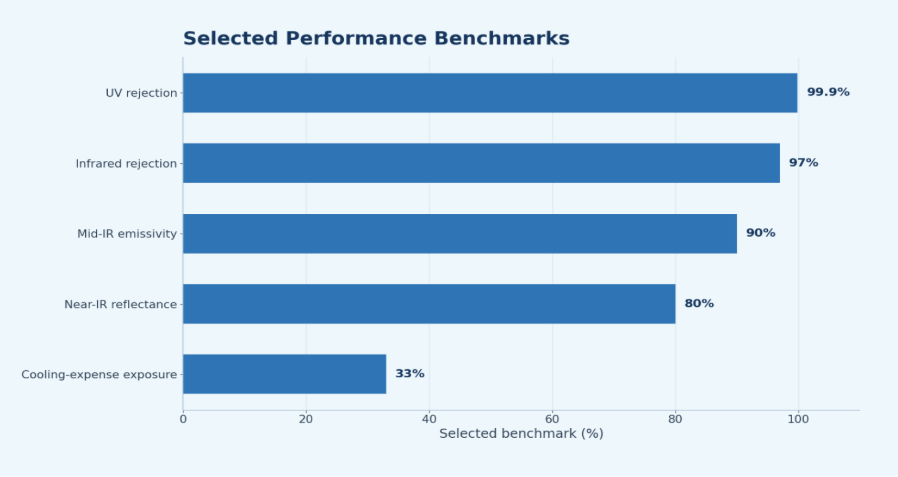
Figure 2. Performance demand is strongest when heat rejection, UV protection, glare control, and cooling-pressure reduction are positioned as one buyer-value package.
Residential Demand: Comfort, Cooling Bills, and Retrofit Value
Residential demand is highly practical. Homeowners usually do not start by comparing market forecasts. They notice hot rooms, glare on screens, fading furniture, or summer cooling bills. Solar control films can be positioned as a lower-disruption upgrade for these everyday comfort problems.
• Residential adoption is strongest where hot summers, high solar exposure, large glass areas, and rising electricity costs appear together.
• The U.S. market moved from USD 213.8 million in 2022 to USD 265.7 million in 2024, showing that mature residential and commercial channels still have room to grow.
• UV rejection near 99% to 99.9% turns interior protection into a measurable selling point for furniture, flooring, fabrics, and vehicle interiors.
• Solar heat gain through windows can make home comfort an energy issue, especially in rooms exposed to strong afternoon sun.
• Residential films can be bundled with renovation, smart thermostats, cooling-system upgrades, and broader home-efficiency projects.
• Clear payback and comfort messaging matters because films compete with blinds, curtains, shade systems, low-e upgrades, and full glass replacement.
Residential buyers respond best when the statistics are translated into lived benefits. Instead of selling only a percentage of heat rejection, installers can explain how films reduce hot spots, protect interiors, lower glare, and make rooms more usable during the warmest parts of the day.
| Residential driver | Market implication |
|---|---|
| Higher cooling bills | Homeowners look for lower-cost efficiency upgrades |
| Large windows | Films reduce heat gain without construction |
| UV exposure | Furniture and flooring protection becomes a selling point |
| Renovation spending | Films can be bundled with comfort upgrades |
Commercial Demand: Glass Buildings, HVAC Load, and Occupant Comfort
Commercial buildings are one of the most important demand channels because they often combine large glass areas, high occupancy, long operating hours, and measurable energy costs. A film project can be justified through occupant comfort, cooling-load reduction, glare control, and protection of interior assets.
- Commercial buildings with glass-heavy envelopes are more exposed to solar heat gain, especially on west- and south-facing façades.
- Solar control films can reduce cooling pressure without requiring a full window replacement project, which helps occupied offices, hotels, schools, and public buildings.
- Office demand is driven by glare on screens, localized hot spots, and HVAC complaints as much as by formal energy-payback calculations.
- Retail buildings use UV and heat-control films to protect merchandise, reduce fading, and improve comfort near display windows.
- Schools and government buildings are attractive retrofit targets because they often need practical upgrades with limited disruption.
- Green building and energy-efficiency goals can support specification of performance films when savings, comfort, and payback are documented.
- Commercial film projects are easier to scale when installers can provide performance data, product warranties, and clear before/after measurement.
| Building type | Film value | Metric to track |
|---|---|---|
| Offices | Glare and cooling control | Energy use, comfort complaints |
| Retail | UV and fading protection | Merchandise damage, cooling load |
| Hotels | Comfort and privacy | Guest comfort, HVAC pressure |
| Schools | Heat and glare reduction | Cooling bills, classroom comfort |
| Government buildings | Retrofit efficiency | Energy targets, payback period |
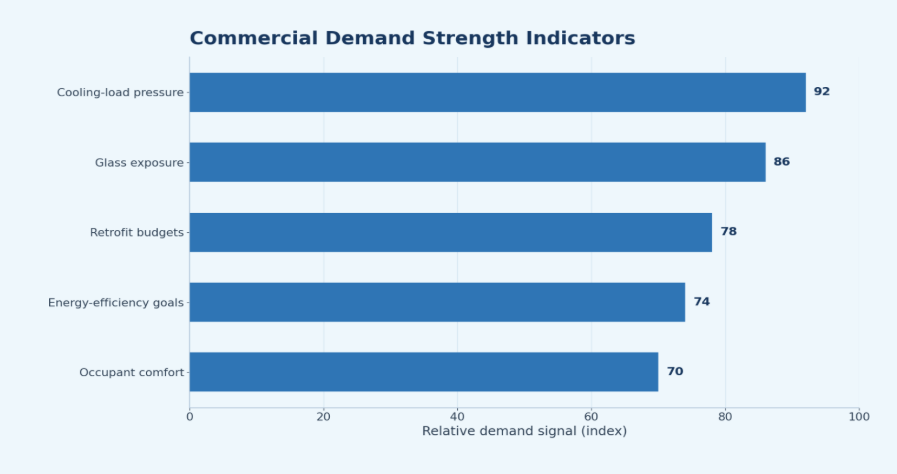
Figure 3. Commercial solar control film demand is strongest where cooling loads, glass exposure, retrofit budgets, and energy-efficiency goals overlap.
Commercial retrofit readout
Commercial buyers usually need more than a product claim. They need a clear project case: where the sun hits, how occupants are affected, what the cooling system is carrying, and how the building owner will measure results. The more clearly installers connect heat rejection to comfort, cooling load, and business disruption avoided, the easier it is to justify installation.
Automotive Demand: Cabin Heat, UV Protection, and Aftermarket Growth
Automotive films remain one of the most visible parts of the market. In vehicles, the value story is easy for consumers to understand: less cabin heat, better privacy, reduced glare, UV protection, and improved interior durability. Premium films add a performance angle by separating heat rejection from simply making glass darker.
- Automotive window-film demand is shaped by passenger-vehicle ownership, aftermarket installer networks, regional heat exposure, and consumer tint preferences.
- High infrared rejection is especially relevant for cabin comfort because it targets the heat that drivers and passengers feel most directly.
- UV rejection near 99% to 99.9% helps support claims related to skin protection and interior durability.
- Electric vehicles add a useful demand angle because cabin cooling can influence energy use and driving range, especially in hot climates.
- Visible light transmission rules shape automotive film demand because tint legality varies by jurisdiction and window position.
- Ceramic and high-performance automotive films are positioned as premium options when drivers want heat rejection without overly dark glass.
Automotive film rule
Automotive demand is driven by comfort, appearance, heat rejection, and UV protection, but it is also regulated. A strong aftermarket strategy should combine product performance with local tinting rules, installer quality, and warranty clarity. In premium channels, ceramic and spectrally selective products can help separate performance from simple dark tint.
Film Technology: Dyed, Metalized, Ceramic, Carbon, and Spectrally Selective Films
Technology segmentation matters because customers do not all buy the same performance level. Entry-level buyers may prioritize affordability and appearance, while commercial, premium residential, and automotive customers may pay more for clarity, infrared rejection, durability, and warranty support.
- Dyed films remain important where cost and appearance are the primary purchase factors.
- Metalized films provide strong reflective heat control, but signal-interference concerns can limit use in some automotive and connected environments.
- Ceramic films are positioned as premium products because they combine high heat rejection with better clarity and fewer signal concerns.
- Carbon films often sit between entry-level and premium options by offering durable appearance and improved heat control.
- Spectrally selective films are attractive in buildings because they can reject heat while preserving more visible light.
- Low-e and insulating films connect the category to year-round building-envelope performance rather than only summer heat rejection.
| Film type | Main advantage | Market limitation |
|---|---|---|
| Dyed film | Low cost and appearance | Lower heat rejection |
| Metalized film | Strong heat rejection | Signal interference risk |
| Ceramic film | Heat rejection with clarity | Higher price point |
| Carbon film | Durable look and heat control | Mid-premium positioning |
| Spectrally selective film | Heat control with visible light | Needs performance-led selling |
| Low-e film | Insulation support | More specialized building use |
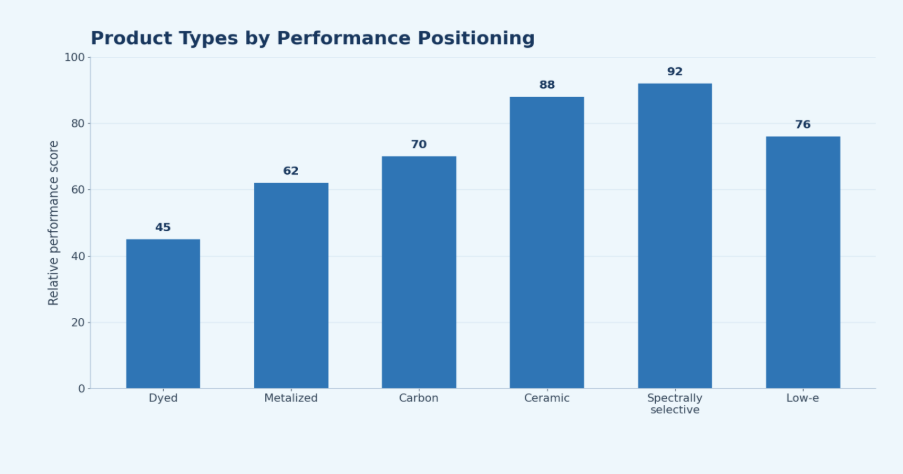
Figure 4. Product types differ by price, clarity, heat rejection, signal compatibility, and building-performance use case.
Technology readout
The market is moving away from a simple tinting conversation and toward a performance conversation. Buyers increasingly compare heat rejection, visible light transmission, UV protection, reflectivity, durability, warranty, and installation quality. That gives premium suppliers room to differentiate, but it also requires clearer product education.
Regional Solar Control Window Films Market Intelligence
Regional data is one of the most useful parts of a solar control window film statistics article because demand is not driven by market size alone. Climate, construction activity, vehicle ownership, cooling costs, glass-heavy buildings, regulations, and installer networks all shape adoption.
North America
North America is a mature market with strong residential, commercial, and automotive channels. The U.S. has visible market scale, while Canada and Mexico add retrofit, automotive, and climate-driven demand in different ways.
- The U.S. solar control window film market reached USD 265.7 million in 2024 after rising from USD 213.8 million in 2022.
- North America represented more than 24% of solar control window film market share in one 2024 estimate.
- Broader window-film data gives North America a 32.1% revenue-share signal.
- Canada’s broader window-film CAGR benchmark is 7.8%, showing continued regional growth potential.
The regional opportunity is strongest where installers can connect film performance to comfort, cooling bills, glare reduction, and automotive heat rejection rather than treating the product as a simple cosmetic add-on.
Europe
Europe is increasingly relevant because building renovation, energy-performance expectations, and summer overheating are becoming stronger concerns. Demand is not limited to traditionally hot countries; office comfort and energy efficiency also matter in cooler markets.
- Germany’s solar control window film CAGR benchmark is 11.4%, one of the strongest country-level growth signals in the workbook.
- The United Kingdom’s benchmark is 9.4%, supported by retrofit demand and overheating concerns.
- France, Italy, and Spain appear in the country coverage set, showing the need for a multi-country European view.
- European demand is shaped by building-envelope efficiency, renovation activity, and the need to improve existing glass without major construction.
Asia-Pacific
Asia-Pacific is the strongest long-term opportunity zone because it combines urban growth, glass-heavy construction, hot climates, vehicle demand, and rising cooling electricity use.
- Asia-Pacific is identified as the dominant or fastest-growing region across multiple market sources.
- Broader window-film data gives Asia-Pacific a 42% regional share signal.
- China is identified as the largest Asia-Pacific solar control window film market.
- India is identified as one of the fastest-growing Asia-Pacific markets, with a 12.4% CAGR benchmark.
Latin America
Latin America has demand potential in automotive films, commercial buildings, and residential comfort upgrades. The opportunity is strongest in urban and hot-climate markets, but affordability and installer coverage influence adoption speed.
- Brazil appears as a key country in the regional-country dataset because of heat exposure, vehicles, and commercial building demand.
- Mexico is included in the regional breakdown and benefits from both automotive and construction-linked demand.
- Country-level planning scores in the workbook show that Latin American demand depends heavily on affordability and channel development.
Middle East and Africa
The Middle East has some of the strongest climate-based demand conditions for solar control films. Africa’s opportunity is longer term and linked to urbanization, cooling access, and affordable efficiency upgrades.
- Regional driver scoring gives the Middle East and Africa a high extreme-heat exposure signal.
- Saudi Arabia and the UAE appear as important country opportunities because of high solar exposure, cooling loads, and glass-heavy commercial buildings.
- South Africa is included as a retrofit and building-comfort opportunity within the regional-country dataset.
The regional story should therefore be read as an opportunity map, not only as a ranking. North America benefits from mature installer networks, automotive aftermarket demand, and commercial retrofit awareness. Europe benefits from renovation policy and building-performance pressure, even though the cooling case is more climate-specific. Asia-Pacific benefits from urban growth, hot-weather exposure, vehicle ownership, and rising cooling demand. Latin America and the Middle East show strong climate logic, but adoption depends on affordability, product availability, and installer trust. This framing makes the section more useful than a simple regional-share table because it explains why the same film can be sold differently across markets.
| Region | Main demand signal | Planning implication |
|---|---|---|
| North America | Retrofit, cooling, automotive demand | Sell comfort and savings together |
| Europe | Renovation and efficiency rules | Connect films to energy performance |
| Asia-Pacific | Urban growth and cooling demand | Scale installer networks |
| Latin America | Automotive and building comfort | Balance affordability with performance |
| Middle East & Africa | Heat exposure and cooling load | Position films as low-disruption efficiency upgrades |
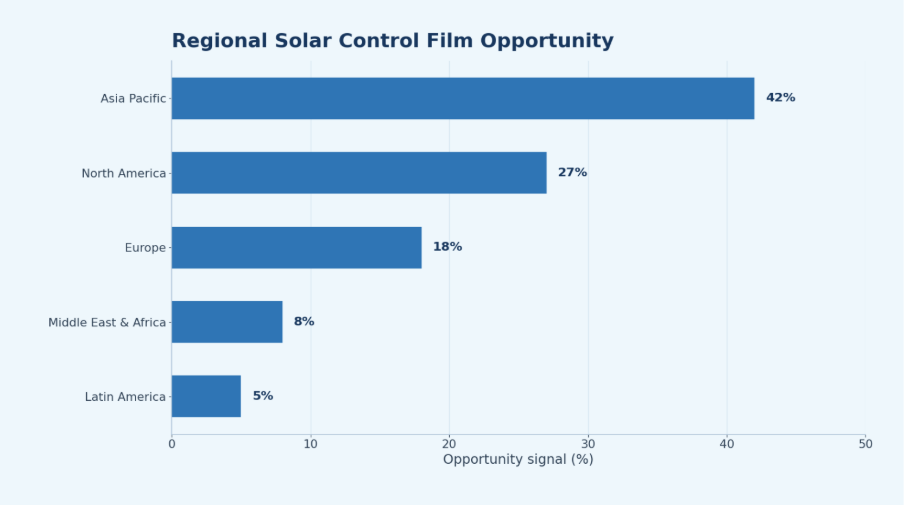
Figure 5. Regional solar control film demand depends on climate, glass-heavy building stock, vehicle ownership, electricity prices, and retrofit activity rather than market size alone.
Regional market rule
The best regional opportunities are not always the largest economies. They appear where heat exposure, cooling costs, building glass area, vehicle use, and installer availability overlap. Asia-Pacific offers scale and growth, North America offers mature channels, Europe offers renovation pressure, the Middle East offers climate intensity, and Latin America offers a mixed opportunity across automotive and building comfort.
Country-Level Solar Control Window Film Statistics
Country-level statistics help prevent global averages from hiding local market logic. A country with strong construction activity may need a different sales strategy from one driven by retrofit payback or automotive tinting demand.
- The United States is the clearest mature-market benchmark, with solar control window film revenue reaching USD 265.7 million in 2024.
- China has a 13.4% solar control window film CAGR benchmark and is identified as the largest Asia-Pacific market.
- China’s broader window-film market data shows USD 1,762.8 million and a forecast of USD 3,229.2 million, with sun control identified as the largest product segment.
- India has a 12.4% country CAGR benchmark and is identified as one of the fastest-growing Asia-Pacific markets.
- Germany has an 11.4% CAGR benchmark, supported by renovation and energy-efficiency pressure.
- The United Kingdom has a 9.4% CAGR benchmark, with retrofit and overheating concerns supporting demand.
- Brazil, Saudi Arabia, the UAE, and South Africa appear in the country opportunity set because heat exposure and building comfort are important demand signals.
| Country | Demand strength | Main constraint |
|---|---|---|
| United States | Mature retrofit and automotive demand | Price sensitivity and installer competition |
| China | Construction scale and vehicle demand | Market fragmentation |
| India | Cooling growth and urbanization | Affordability and awareness |
| Germany | Renovation and efficiency pressure | Cooler-climate payback perception |
| U.K. | Retrofit and overheating concerns | Weather variability |
| Brazil | Heat, vehicles, commercial buildings | Cost sensitivity |
| UAE/Saudi Arabia | High solar exposure and cooling load | Premium product positioning |
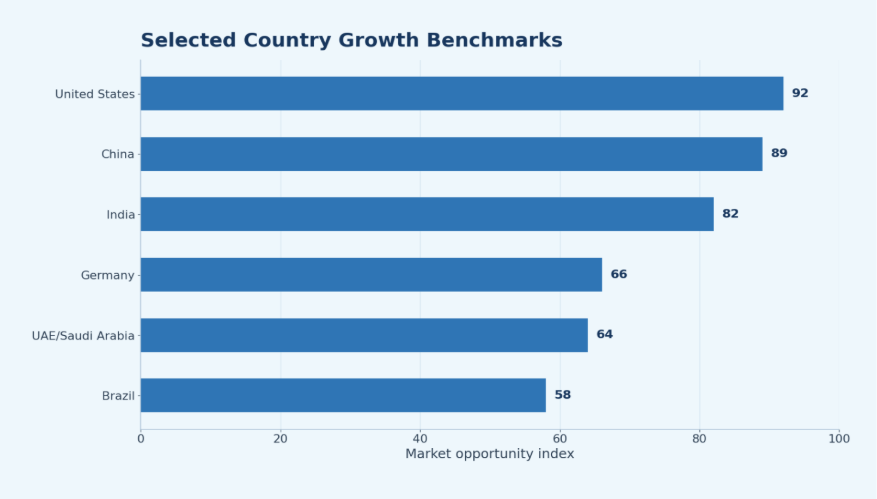
Figure 6. Country-level growth benchmarks show why solar control film planning should separate mature markets from high-growth, hot-climate, and retrofit-heavy markets.
Where Window Films Reduce Cooling Pressure
The energy case for solar control films becomes strongest when cooling load, peak demand, and solar heat gain are reviewed together. A film does not replace a full HVAC upgrade, but it can reduce the solar-driven load that cooling systems need to manage.
- Space-cooling demand shows a growth benchmark near 4% annually, creating a wider market context for heat-rejection products.
- Windows can contribute about 33% of cooling expense related to solar heat gain in some building contexts.
- High-performance films with up to 97% infrared rejection directly target the heat component that drives comfort complaints.
- UV rejection near 99% to 99.9% adds value beyond energy savings by protecting interiors and occupants.
- Near-infrared reflectance above 80% in advanced cooling-window research shows why the product category is linked to heat-management innovation.
- Commercial buildings can benefit from films when afternoon sun creates hot zones, high cooling demand, or glare-related productivity issues.
- The strongest payback story appears when owners measure energy use, comfort complaints, façade exposure, and installed cost together.
The cooling-pressure section should also make clear that energy savings are rarely judged in isolation. A facility manager may approve film because it lowers cooling load, but the same project can also reduce glare, protect interiors, improve occupant comfort, and make west-facing rooms easier to use. This bundled value is important because pure payback calculations can vary by climate, electricity tariff, glass type, building orientation, and installed cost. The most persuasive projects usually document several outcomes at once: room temperature, cooling complaints, visible light levels, UV protection, and occupant feedback before and after installation.
| Energy signal | What to measure | Why it matters |
|---|---|---|
| Cooling load | HVAC use before and after installation | Shows direct energy impact |
| Peak demand | Afternoon cooling peaks | Films reduce solar-driven load |
| Glare complaints | Occupant comfort feedback | Supports workplace comfort |
| Interior fading | UV exposure and asset damage | Adds non-energy value |
| Payback period | Installed cost versus savings | Helps justify retrofit spending |
Energy-savings readout
The energy case is strongest when film is not oversold as a standalone fix. It should be positioned as a load-reduction and comfort tool that works alongside HVAC tuning, shading, building controls, and envelope upgrades. The more specific the measurement is to façade orientation, glass area, operating hours, and cooling costs, the stronger the retrofit case becomes.
Construction, Retrofit, and Green Building Demand
Construction activity supports the market, but retrofit demand is often more important. Existing buildings have long operating lives and many were built before today’s energy-efficiency and comfort expectations. Solar films give owners a way to improve performance without removing the entire glazing system.
- Commercial retrofits are attractive because offices, schools, hotels, retail stores, and government buildings often need lower-disruption upgrades.
- Glass-heavy high-rises and commercial façades create a larger addressable surface for performance films.
- Residential remodeling supports film installation when homeowners combine comfort, privacy, glare, and interior-protection upgrades.
- Green building and energy-efficiency programs create a context where performance data, warranty, and payback become more important than appearance alone.
- Installer networks are critical because the product’s final performance depends on correct specification, glass compatibility, and installation quality.
The retrofit channel also changes how the market should be measured. Square footage installed, number of trained installers, warranty claims, customer satisfaction, and performance verification can be more useful than revenue alone.
Competitive Landscape and Leading Companies
The competitive landscape includes global diversified manufacturers, specialist film brands, regional suppliers, and installer networks. Brand trust matters, but installation quality and local availability are also decisive because film performance can be undermined by poor application.
- Leading companies and brands referenced in the workbook include 3M, Eastman/LLumar, Saint-Gobain, Avery Dennison, Madico, Solar Gard, Johnson Window Films, Garware Hi-Tech Films, Hanita Coatings, and Reflectiv.
- Global manufacturers compete through product performance, R&D, warranty, distribution, and specification power.
- Specialist film brands compete through installer relationships, product depth, and proven performance claims.
- Regional suppliers can win on availability and price, especially in cost-sensitive markets.
- Installer networks influence conversion because buyers often depend on contractors to explain performance, legality, and payback.
| Company type | Market role | Competitive factor |
|---|---|---|
| Global manufacturers | Scale, R&D, distribution | Brand trust and specification power |
| Specialist brands | Product depth and installer networks | Performance and warranty |
| Regional suppliers | Local pricing and availability | Cost competitiveness |
| Installer networks | Customer acquisition and service | Installation quality |
Market Risks and Constraints
The market has strong demand drivers, but it is not frictionless. Buyers may be price-sensitive, product quality can vary, installers may overpromise performance, and automotive tint rules can limit what is legal in specific markets.
- Price sensitivity is a barrier in residential and emerging markets because buyers compare films with blinds, curtains, and cheaper tint products.
- Installation defects such as bubbling, peeling, scratching, and poor edge work can damage trust even when the film itself is high quality.
- Automotive visible light transmission rules shape product selection and can vary by country, state, and window position.
- Warranty clarity matters because customers need to understand product lifespan, glass compatibility, installation coverage, and maintenance requirements.
- Competing options include low-e glass, exterior shading, blinds, coatings, smart glass, HVAC upgrades, and façade retrofits.
- Product awareness remains a constraint when buyers do not understand the difference between low-cost tint and performance-oriented solar control film.
| Risk area | Core signal to measure | Why it matters |
|---|---|---|
| Price sensitivity | Installed cost and buyer payback | Affects residential conversion |
| Installation quality | Defects and warranty claims | Impacts trust |
| Regulation | Tint and visible light rules | Shapes automotive demand |
| Product awareness | Search and installer inquiries | Affects education |
| Competing solutions | Glass, blinds, coatings, smart glass | Defines positioning |
Risk interpretation
The market can grow faster only if buyers understand the difference between low-cost tint and performance film. Poor installation, unclear warranties, and weak product education can damage trust. For manufacturers and installers, the best risk-control strategy is clear specification, legal compliance, training, warranty support, and realistic savings messaging.
Solar Control Window Film Opportunity Diagnostic
A useful statistics article should help readers decide where to look next. For solar control films, the best opportunity is not defined by market size alone. It appears where cooling pain, glass exposure, retrofit budget, and installer capacity come together.
It connects each statistic to a practical decision: where to sell, which product to specify, what benefit to emphasize, and what proof point buyers need before committing.
| Opportunity area | What to measure | Useful benchmark |
|---|---|---|
| Residential retrofits | Cooling bills and heat complaints | Energy-savings potential |
| Commercial buildings | HVAC load and glass exposure | Retrofit payback |
| Automotive aftermarket | Vehicle sales and tint demand | Heat and UV protection |
| Hot-climate regions | Cooling degree days and solar radiation | Adoption potential |
| Green buildings | Efficiency targets and retrofit budgets | Specification opportunity |
90-Day Market Planning Framework
Statistics become useful when they are converted into a short planning cycle. A 90-day review gives suppliers, distributors, and installers a practical way to move from market size to local demand action.
| Timing | What to do | Output |
|---|---|---|
| Days 1-30 | Map demand by climate zone, building type, and segment | Priority market list |
| Days 31-60 | Match products to residential, commercial, and automotive uses | Segment-specific sales message |
| Days 61-90 | Build installer, warranty, and performance proof points | Market-ready conversion plan |
Planning principle
Solar control film planning should start with local heat exposure, electricity prices, building type, glass area, and buyer pain points, not with one global market-size number. That keeps product selection, installer strategy, and sales messaging tied to the reasons customers actually buy.
Metrics Solar Control Window Film Leaders Should Track
The final scorecard should combine market, product, installation, and performance metrics. Revenue alone will not show whether growth is profitable, durable, or supported by installation quality. Leaders should review those metrics together. A film that performs well on paper still needs correct installation, clear warranty support, and a buyer message that connects performance ratings to comfort, savings, and risk reduction.
| Metric | Why it matters |
|---|---|
| Market value | Shows category size |
| CAGR | Shows expected growth speed |
| Installed square footage | Tracks real adoption |
| Heat rejection rating | Shows performance value |
| UV rejection | Supports protection claims |
| Visible light transmission | Balances comfort and appearance |
| Cooling-load reduction | Connects films to energy savings |
| Payback period | Supports retrofit economics |
| Installer coverage | Shows market accessibility |
| Warranty claims | Tracks quality and trust |
Buyer Decision Logic and Installation Economics
Buyer decisions in this market usually begin with a practical problem: hot rooms, glare, fading interiors, uncomfortable vehicle cabins, or cooling bills that feel too high. The strongest sales message connects performance ratings with a visible outcome buyers can understand.
This section should therefore work like a reference-style diagnostic rather than a long text block. It explains who compares window films with other options, what slows approval, and how installers convert interest into repeat demand.
| Buyer signal | What it confirms | Why it matters |
|---|---|---|
| Home comfort complaints | Heat, glare, fading, and privacy often start the search. | Residential messaging should connect comfort with cost. |
| Commercial retrofit pressure | Owners compare films with glazing, HVAC upgrades, and controls. | Payback and low-disruption installation matter. |
| Automotive heat exposure | Cabin comfort, legal tint limits, and UV protection shape choice. | Installer guidance affects product selection. |
| Warranty and installation risk | Poor application can damage trust even when the film is strong. | Training and after-sales support protect demand. |
Installation economics readout
The best opportunities are not always the highest-performance films. They are the projects where film performance, buyer pain, installation cost, and payback can be explained together. Buildings with strong afternoon sun, repeated comfort complaints, and high cooling demand usually justify films faster than sites with limited glass exposure.
Solar Control Window Films Market Statistics FAQ
What are solar control window films?
Solar control window films are thin films applied to glass to reduce solar heat gain, glare, and ultraviolet exposure. They are used in homes, commercial buildings, vehicles, and other glass-heavy environments.
How large is the solar control window films market?
Market estimates vary by definition. Narrower estimates place the market below USD 2 billion in the near term, while broader window-film and solar-control categories reach several billion dollars in forecast models.
What is the expected CAGR for the market?
Forecasts commonly show mid-single to high-single-digit growth. Grand View Research uses 6.6%, Future Market Insights uses 9.9%, and Strategic Market Research uses 7.5% under its broader market definition.
Which region leads the market?
Asia-Pacific is repeatedly identified as the dominant or fastest-growing region, while North America remains a mature market with strong residential, commercial, and automotive demand.
How much energy can solar control films save?
Savings depend on glass area, climate, orientation, HVAC use, film type, and electricity prices. The clearest energy case appears when films reduce solar heat gain during high cooling-load periods.
Which sectors use these films?
Key sectors include residential buildings, offices, retail, hotels, schools, government buildings, vehicles, marine applications, and transportation settings.
Are solar control window films used in cars?
Yes. Automotive films are used for heat rejection, UV protection, glare control, privacy, and appearance. However, legal tint limits vary by location and window position.
What metrics matter most in this market?
The most useful metrics include market value, CAGR, installed area, heat rejection, UV rejection, visible light transmission, cooling-load reduction, payback, installer coverage, and warranty claims.
Final Takeaway
Solar control window films are becoming more important because they solve several problems at once: heat gain, cooling load, glare, UV exposure, comfort, and retrofit cost. The market is not defined only by decorative tinting or automotive demand. It is increasingly connected to building efficiency, interior protection, and practical retrofit economics.
The strongest statistics show why the category is expanding. Forecasts point to steady growth, the U.S. market continues to rise, Asia-Pacific shows strong regional momentum, and country-level benchmarks in China, India, Germany, and the United Kingdom show where growth can be faster than global averages. Product-performance data also supports the value story, especially where infrared rejection, UV blocking, and visible light control can be clearly explained.
For manufacturers, installers, building owners, and energy-efficiency planners, the useful takeaway is not only that the market is expanding. The more important signal is that solar control films are becoming a measurable retrofit option. The strongest strategies will connect product performance to local heat exposure, glass area, cooling cost, installation quality, warranty confidence, and the buyer’s need for a low-disruption upgrade.
The market will be strongest where cooling demand, glass-heavy buildings, retrofit budgets, vehicle use, and product education move together. Buyers should compare heat rejection, visible light transmission, UV protection, warranty, installation quality, and payback before choosing a solution. That is what turns solar control window film from a surface product into a measurable efficiency and comfort upgrade.