Dog food has become a recurring consumer-staple market rather than a simple pet-care purchase. The category is shaped by how many households own dogs, how much owners spend per dog, which formats they trust, and whether shoppers treat food as a basic feeding product or as part of daily health management. That makes dog food a market built around population, loyalty, nutrition, retail access, and premium positioning.
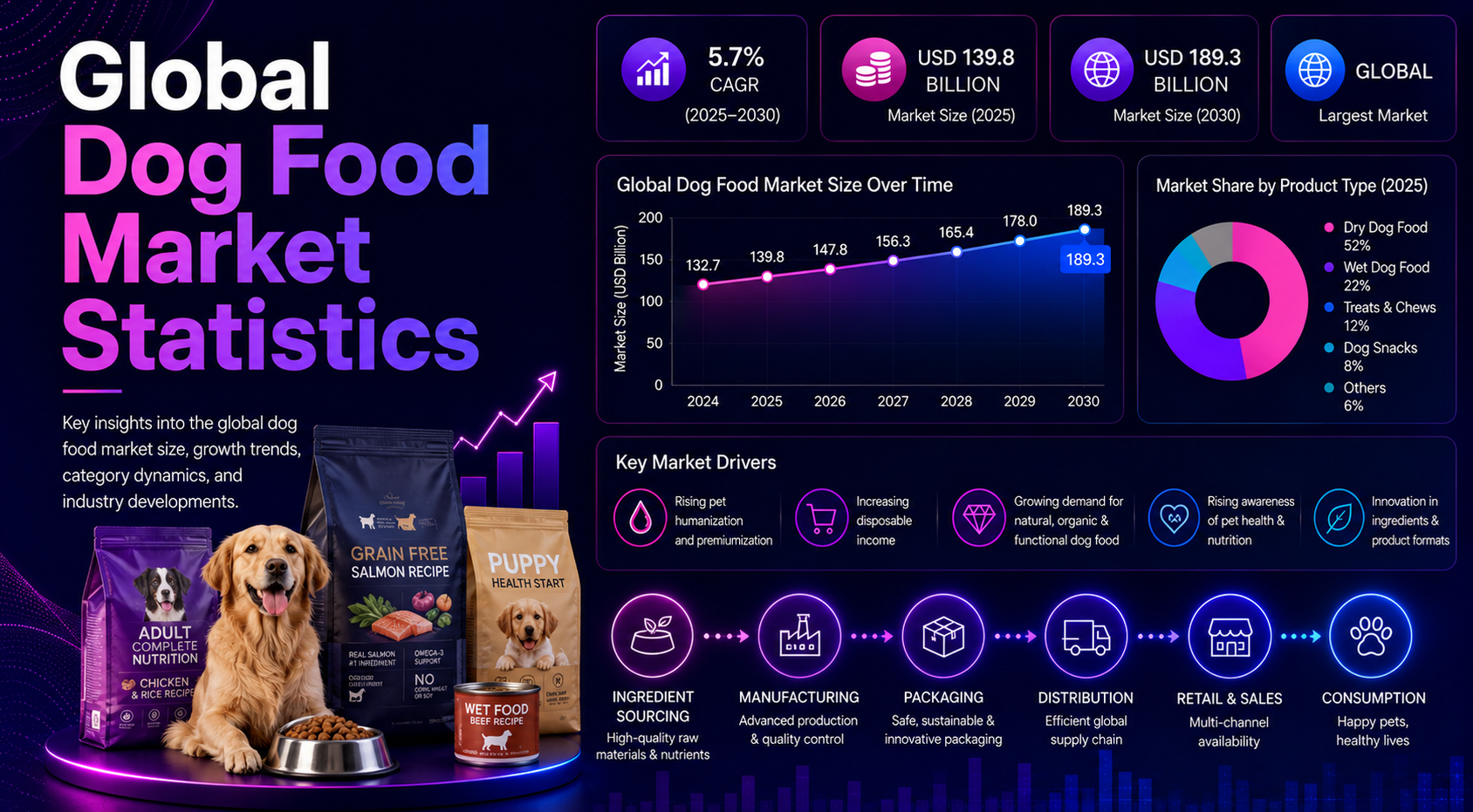
The strongest statistics show why the market needs its own scorecard. Fortune Business Insights valued the global dog food market at USD 77.17 billion in 2025 and projected it to reach about USD 117.22 billion by 2034. North America accounted for 46.21% of the 2025 market, while Asia-Pacific carried one of the fastest growth rates at 7.28% CAGR through the forecast period. FEDIAF data also shows Europe with about 89.6 million dogs, creating a large mature feeding base.
Executive Dog Food Benchmarks
These are the statistics that frame the article. They show the size of the dog food opportunity, the importance of North America, the country-level demand base in Europe, and the shift toward premium, functional, ecommerce, and regionally localized products.
The numbers that define the dog food market
• The global dog food market was valued at USD 77.17 billion in 2025, according to Fortune Business Insights.
• The market is projected to reach USD 117.22 billion by 2034, showing that dog food remains a long-run recurring-purchase growth category.
• The global forecast implies a 4.84% CAGR from 2026 to 2034.
• North America accounted for 46.21% of global dog food market value in 2025, making it the highest-value regional benchmark.
• The North American dog food market was estimated at USD 35.66 billion in 2025.
• The U.S. dog food market alone was estimated at USD 27.76 billion in 2025.
• Europe’s dog food market was estimated at USD 15.43 billion in 2025 and was forecast at a 4.9% CAGR.
• Asia-Pacific dog food value was estimated at USD 11.60 billion in 2025, with a 7.28% CAGR benchmark that makes it the clearest growth-region story.
• Japan’s dog food market was estimated at USD 2.84 billion in 2025, but its aging dog population creates a different growth mix than China or India.
• Canada dog food retail sales reached CAD 4.465 billion in 2024 according to Agriculture and Agri-Food Canada data.
• China pet food production reached about 1.6 million tones in 2024 in USDA FAS market reporting.
• FEDIAF data places the European dog population near 89.6 million, with the United Kingdom, Germany, Spain, Italy, Poland, and France forming the largest country-level dog bases.
• Brazil remains the largest Latin American pet food benchmark market in the market benchmarks and combines a large pet population with a growing premium retail opportunity.
• Australia’s pet economy is heavily dog-led, with national survey data showing strong spending on food, health, and pet care services.
• Across mature markets, dry food still anchors volume, while wet food, treats, fresh food, veterinary diets, and functional nutrition support value growth.
Editorial readout
The headline data points to five connected demand signals: dog ownership, spend per dog, product mix, retail channel, and regional maturity. A country with a large dog population is not automatically the highest-value dog food market if average spend is low. Likewise, a mature region can still grow when owners trade up to premium, fresh, functional, or veterinary diets.
Why Dog Food Now Carries Global Consumer-Staple Scale
Market-size figures do not tell a brand exactly which formula to launch or which retailer to prioritize, but they show why small shifts in household penetration, price tier, ecommerce retention, and product mix can become material. Dog food is purchased repeatedly, stored in larger pack sizes, and tied to routine feeding behavior. That makes revenue less occasional than many discretionary pet categories.
The global market is also becoming more specialized. Owners are no longer choosing only between dry and wet food. They are comparing puppy, adult, senior, small-breed, large-breed, grain-free, limited-ingredient, high-protein, digestive-health, joint-support, skin-and-coat, weight-control, veterinary, fresh, frozen, and subscription products. Each additional segmentation layer can lift value per dog, but it also requires sharper retail and regional planning.
Market-size and forecast benchmarks
• Global dog food market value stood at USD 77.17 billion in 2025.
• The 2026 benchmark moves to USD 80.34 billion, which creates a higher base for the rest of the forecast period.
• The forecast path reaches USD 84.23 billion in 2027, USD 88.31 billion in 2028, and USD 92.58 billion in 2029.
• By 2030, the global dog food market is expected to approach USD 97.06 billion.
• The forecast continues to USD 101.76 billion in 2031, USD 106.68 billion in 2032, USD 111.85 billion in 2033, and USD 117.22 billion in 2034.
• North America’s USD 35.66 billion 2025 market value means the region represents almost half of the measured global dog food market.
• Europe’s USD 15.43 billion benchmark shows a mature market with a large dog population, strong premium retail, and strict consumer expectations around quality and labeling.
• Asia-Pacific’s USD 11.60 billion 2025 value is smaller than North America and Europe, but the forecast CAGR of 7.28% gives it a stronger growth profile.
• South America’s USD 3.09 billion benchmark shows that Brazil and neighboring markets should be studied as volume-plus-premium opportunities rather than ignored as emerging markets.
• The U.S. estimate of USD 27.76 billion makes it the clearest single-country anchor for dog food market benchmarking.
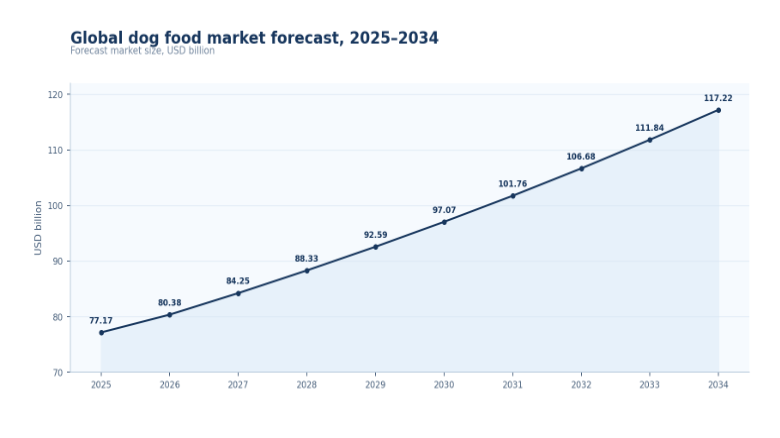
Figure 1. Global dog food market size and forecast values should be reviewed together because even modest annual growth becomes significant in a recurring-purchase category.
Dog Ownership: The Demand Base Behind the Market
Dog food demand begins with the number of dogs, but revenue depends on what owners buy for those dogs. Population creates the addressable feeding base. Household ownership shows how mainstream dog care has become. Spend per dog reveals premiumization. Product mix indicates whether growth is coming from basic volume or higher-value nutrition. Channel mix shows how often owners buy through grocery, pet specialty, veterinary clinics, ecommerce, and subscriptions.
This is why dog population statistics must be interpreted carefully. A market with millions of dogs can still underperform if owners rely on homemade food, low-price bulk products, or informal retail. A smaller market can generate high value if owners use commercial dog food consistently, buy premium products, adopt veterinary diets, and subscribe to recurring ecommerce delivery.
Dog population and household ownership benchmarks
• FEDIAF data places Europe’s dog population near 89.6 million dogs, making Europe one of the world’s largest mature commercial pet food regions.
• The United Kingdom has about 11.7 million dogs in the European country table, which makes it one of the region’s largest dog populations.
• Germany has about 10.5 million dogs, supporting one of Europe’s most important premium pet food markets.
• Spain has about 9.46 million dogs, giving Southern Europe a major dog food demand base.
• Italy has about 8.77 million dogs, which supports both mainstream and premium dog food sales.
• Poland has about 8.44 million dogs, making it a large Central and Eastern Europe opportunity.
• France has about 7.6 million dogs, which keeps it in the top tier of European dog food markets.
• Ukraine, Romania, Portugal, and Hungary also appear in the European top-ten dog population group, showing that dog food demand is not limited to Western Europe.
• Australia survey data shows dogs remain a central part of national pet ownership and spending behavior.
• China’s dog and cat care market is increasingly linked to urban pet ownership, ecommerce retailing, and domestic pet food manufacturing capacity.
| Demand driver | What it measures | Why it matters |
|---|---|---|
| Dog population | Number of dogs in a country or region | Sets the addressable feeding base for commercial food demand. |
| Dog-owning households | Share or number of homes with dogs | Shows whether dog ownership is mainstream or niche. |
| Spend per dog | Annual food and pet care spend per animal | Separates volume markets from high-value premium markets. |
| Product mix | Dry, wet, treats, fresh, functional, and veterinary products | whether growth is coming from basic feeding or higher-margin nutrition. |
| Channel mix | Grocery, pet specialty, veterinary, ecommerce, and subscription | how brands reach owners and how often they can retain repeat purchases. |
Ownership interpretation
Dog population is a starting metric, not the whole diagnosis. A useful dog food dashboard combines population, household penetration, commercial food usage, average spend, and product tier. That prevents teams from overvaluing a large low-spend market or undervaluing a smaller high-premium market.
Product Type: Dry, Wet, Treats, Fresh, and Specialized Diets
Dog food market value is shaped by product format. Dry food remains central because it is convenient, shelf-stable, easy to store, and cost-efficient for daily feeding. Wet food adds palatability and is often used by owners of smaller, older, or selective dogs. Treats increase basket size and buying frequency. Fresh, frozen, and lightly cooked foods convert nutrition into a premium lifestyle promise. Veterinary and functional diets attach food to health management.
The product-type story matters because volume and value do not always move together. Dry food can dominate tonnage, while fresh and veterinary products may account for a smaller feeding base but a higher price per meal. A brand that reads only market volume may miss the products that expand margin. A brand that reads only premium growth may miss the base formats that keep distribution and household penetration strong.
Format and product-mix benchmarks
• Dry dog food should be treated as the anchor format because it supports large pack sizes, repeat buying, mainstream retail distribution, and daily feeding routines.
• Wet dog food performs as a palatability and premiumization product, especially where owners want texture variety, portion control, or easier eating for older dogs.
• Treats function as both a reward product and a training product, which makes them more impulse-driven than core food but highly useful for basket expansion.
• Fresh and frozen dog food remain smaller than dry food in broad market volume, but they have high value-per-meal positioning because they borrow from human food language such as fresh, gently cooked, real ingredients, and customized plans.
• Veterinary diets are often linked to health conditions such as weight, digestion, kidney health, skin sensitivity, urinary health, and mobility support.
• Puppy, adult, and senior life-stage formulas help brands segment the same dog-owning household across the pet lifecycle.
• Small-breed and large-breed formulas create size-based segmentation because kibble size, calorie density, joint support, and feeding patterns can differ by dog size.
• Limited-ingredient and grain-free claims show how ingredient positioning can turn basic dog food into a premium or sensitivity-focused purchase.
• Functional claims such as digestive health, joint support, skin and coat, immune health, and weight management are useful because they connect food to a clear owner concern.
• Product mix should be measured by value, volume, margin, frequency, and retention rather than by revenue alone.
| Product type | Main market role | Article interpretation |
|---|---|---|
| Dry dog food | Volume and daily feeding base | Still the format that anchors broad household penetration and large-pack retail. |
| Wet dog food | Palatability and premium feeding | Useful for senior dogs, small dogs, picky eaters, and owners seeking variety. |
| Treats | Basket expansion and frequency | Supports rewards, training, dental care, and impulse purchases. |
| Fresh/frozen food | Premium lifestyle positioning | Raises value per meal and supports subscription-led customer relationships. |
| Veterinary diets | Health-condition management | Creates trust-led repeat demand through veterinary recommendation and specialized nutrition. |
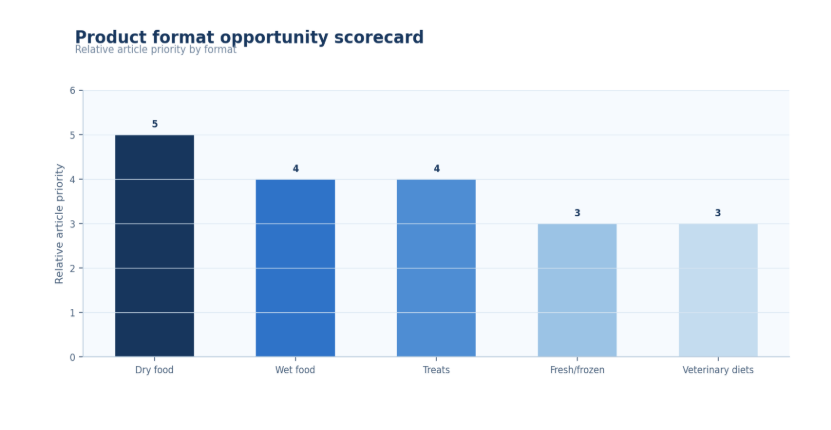
Figure 2. Product format trends show how dry food anchors volume while fresh, functional, and veterinary diets support higher-value growth stories.
Product mix readout
The most useful product question is not which format is largest. The better question is which format increases profitable repeat demand in a specific country, channel, price tier, and dog segment. Dry food builds scale; wet, fresh, functional, and veterinary products lift value when owners believe the benefit is specific and credible.
Premiumization and Pet Humanization
Pet humanization is the strongest language behind dog food premiumization. Owners increasingly describe dogs as family members, and that changes how they evaluate food. Instead of choosing only the cheapest daily meal, many owners look for ingredient transparency, cleaner labels, health support, digestibility, freshness, brand trust, sustainability, and convenience. This does not mean every owner buys premium food, but it does mean premium language has moved into mainstream shelf competition.
Premiumization also changes the competitive field. A brand selling high-protein dry food competes with wet food, fresh food, toppers, supplements, veterinary diets, and treats because owners may combine formats. A dog may eat dry food daily, wet food occasionally, a joint-support treat, and a veterinary diet after diagnosis. In this environment, brands must understand meal occasions rather than only SKU categories.
Premium and health-positioning benchmarks
• Human-grade positioning increases price perception because it borrows quality cues from human food, even when owners still evaluate convenience and feeding cost.
• Fresh and lightly cooked formats often depend on subscription economics because they require more predictable purchase frequency and stronger cold-chain or delivery logic.
• Functional dog food can target digestive health, joint support, immunity, oral care, skin and coat, calmness, weight management, and age-related needs.
• Veterinary diets remain important because a professional recommendation can reduce owner uncertainty and increase repeat purchase commitment.
• Natural, organic, clean-label, limited-ingredient, and grain-free claims can create premium differentiation, but they must be supported by credible formulation and transparent labeling.
• Breed-size positioning allows brands to address kibble size, calorie density, joint support, and feeding instructions for small, medium, and large dogs.
• Senior dog nutrition becomes more important in aging pet markets such as Japan, where dog population trends favor older animals and smaller breeds.
• Puppy nutrition remains a customer-acquisition opportunity because owners often establish brand loyalty early in the dog lifecycle.
• Premium packaging, resealable bags, portioned packs, and subscription bundles can support convenience, freshness, and higher repeat rates.
• The premiumization story should be tested by repeat purchase, not only by first-order sales, because dog food must work as a long-term feeding routine.
| Premium trend | What owners are buying | Market implication |
|---|---|---|
| Human-grade and fresh | Recognizable ingredients, lightly cooked meals, refrigerated or frozen packs | Raises price per meal and often depends on subscription retention. |
| Functional nutrition | Digestive, joint, skin, coat, immune, calm, and weight products | Connects dog food to owner concerns and health outcomes. |
| Breed and size targeting | Small-breed, large-breed, puppy, adult, and senior formulas | Improves segmentation and retail shelf clarity. |
| Veterinary diets | Prescription or condition-specific products | Supports high trust, professional recommendation, and repeat buying. |
| Clean label and natural | Fewer artificial ingredients, clear protein sources, transparent packaging | Helps premium brands justify price and build trust. |
Premiumization rule
Premium dog food should be measured through willingness to repeat, not only willingness to try. A higher price point is durable only when owners believe the product improves feeding convenience, digestion, visible wellness, veterinary outcomes, or daily quality of life.
Distribution Channels: Grocery, Pet Specialty, Vet, Ecommerce, and Subscription
Dog food is a channel-sensitive market. Grocery and mass retail are important because owners buy food as part of routine household shopping. Pet specialty stores matter because they offer assortment depth, premium discovery, staff advice, and category credibility. Veterinary clinics matter because medical recommendation can change product choice. Ecommerce matters because dog food is heavy, repetitive, and suitable for autos hip. Direct-to-consumer models matter when brands can use personalization, bundles, and subscription retention to offset fulfillment complexity.
The rise of ecommerce does not eliminate store-based retail. Instead, it changes the role of stores. Many owners still discover products in store, ask for advice, or buy emergency replacements offline. They may then reorder online or subscribe. A mature channel strategy should measure first purchase, repeat purchase, pack size, margin, delivery cost, returns, customer support, and loyalty behavior by channel.
Channel and retail benchmarks
• Grocery and mass retail remain important for mainstream dry food because shoppers can add pet food to regular household trips.
• Pet specialty stores remain valuable for premium products because they provide larger assortments and advice-led category browsing.
• Veterinary channels support trust-heavy products, especially prescription diets, therapeutic formulas, and condition-specific nutrition.
• Ecommerce is structurally suited to dog food because food is purchased repeatedly and owners benefit from home delivery of heavy packs.
• Subscription and autos hip models can stabilize demand, but they must manage price sensitivity, delivery reliability, stockouts, and product switching.
• Marketplace sales can expand reach quickly but may increase price comparison pressure and weaken brand control.
• Direct-to-consumer fresh dog food can build strong loyalty when personalization, portioning, and delivery experience are consistent.
• Retailers should separate first-order conversion from repeat-order profitability because customer acquisition costs can be high in premium ecommerce.
• Country-level channel behavior matters: China’s pet food retailing is strongly influenced by ecommerce and digital platforms, while many European markets remain heavily store and specialty led.
• The best channel metric is not only sales value. It is profitable retained feeding relationships by format, pack size, dog size, and customer segment.
| Channel | Best fit | What to measure |
|---|---|---|
| Grocery/mass retail | Mainstream dry food, value packs, routine household buying | Velocity, shelf share, promotion lift, pack-size mix, repeat purchase. |
| Pet specialty | Premium, functional, breed-specific, treats, wet food | Advice-led conversion, margin, loyalty, category switching. |
| Veterinary | Prescription diets, therapeutic nutrition, health-linked formulas | Recommendation conversion, refill rate, clinical need, owner compliance. |
| Ecommerce marketplace | Large assortment, convenience, price comparison, heavy-pack delivery | Search rank, conversion, ratings, fulfillment, price pressure. |
| DTC/subscription | Fresh, personalized, recurring nutrition plans | Acquisition cost, retention, churn, delivery reliability, margin after fulfillment. |
Channel readout
Dog food is a repeat-purchase category, so the channel question is not only where the first bag sells. The stronger question is which channel keeps the dog fed on the same brand profitably over time. Auto ship, loyalty programs, vet recommendations, and pet specialty advice can all become retention tools when they reduce switching risk.
Regional Dog Food Market Intelligence
Regional analysis is one of the most important parts of a dog food statistics article because global averages hide very different market conditions. North America is high-value and premium-led. Europe is mature, quality-sensitive, and country-fragmented. Asia-Pacific combines mature markets such as Japan and Australia with faster-scaling markets such as China, India, South Korea, and Southeast Asia. Latin America combines large dog populations with affordability and premiumization tension. Middle East and Africa remains smaller but has urban premium pockets.
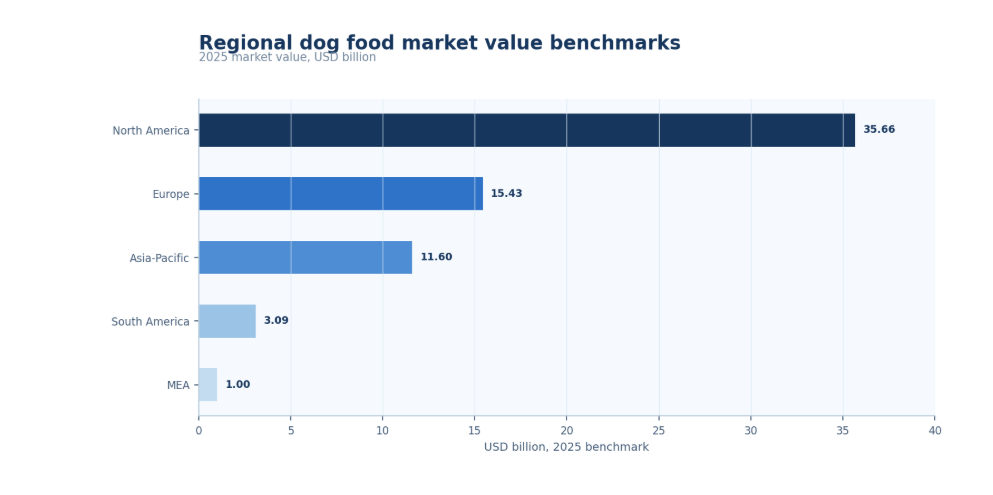
Figure 3. Regional dog food differences show why brands should localize product format, price tier, channel strategy, and claims rather than applying one global dog food playbook.
North America
North America is the central value benchmark for dog food. The region’s 2025 dog food value of USD 35.66 billion and 46.21% global share show that it carries the strongest revenue base. The U.S. alone was estimated at USD 27.76 billion in 2025, making it the most important country reference point for premiumization, fresh food, subscription, functional diets, and pet specialty retail. Canada adds a mature retail market where dog food sales exceeded CAD 4.465 billion in 2024.
• North America represented 46.21% of global dog food market value in 2025.
• The regional market was valued at USD 35.66 billion in 2025.
• The U.S. dog food market was estimated at USD 27.76 billion in 2025.
• Canada dog food retail sales reached CAD 4.465 billion in 2024.
• North American dog food growth is closely tied to premium dry food, wet food, treats, fresh food, veterinary diets, and ecommerce autos hip.
• The U.S. should be treated as a product innovation hub because premium and specialized dog food formats often scale there before moving into other regions.
• Canada should be treated as a mature but useful comparison market because retail sales data allows category, channel, and growth analysis over time.
Europe
Europe is a large and mature dog food region, but it should not be analyzed as one market. Country-level dog populations vary widely, retail structures differ, and owner expectations around ingredients, sustainability, quality, and labeling can be strict. FEDIAF’s country-level data makes Europe especially useful for regional analysis because it helps connect dog population to market opportunity by country.
• Europe’s dog food market was estimated at USD 15.43 billion in 2025.
• The region’s forecast CAGR benchmark is 4.9% from 2026 to 2034.
• Europe has about 89.6 million dogs in the FEDIAF data used for these market benchmarks.
• The United Kingdom has about 11.7 million dogs, making it one of Europe’s largest dog populations.
• Germany has about 10.5 million dogs and a 2025 dog food market estimate of USD 2.38 billion.
• Spain has about 9.46 million dogs, Italy has about 8.77 million, Poland has about 8.44 million, and France has about 7.6 million.
• European growth should be interpreted through premiumization, health positioning, sustainability expectations, pet specialty strength, and country-specific feeding habits.
• Central and Eastern Europe should not be ignored because Poland, Romania, Hungary, and Ukraine create meaningful dog population bases.
| European country | Dog population benchmark | Market implication |
|---|---|---|
| United Kingdom | 11.7 million dogs | Large dog base with strong premium, ecommerce, and specialty retail potential. |
| Germany | 10.5 million dogs | High-value mature market with quality and formulation expectations. |
| Spain | 9.46 million dogs | Large Southern European demand base for mainstream and premium dog food. |
| Italy | 8.77 million dogs | Mature pet care culture with opportunity in premium and wet formats. |
| Poland | 8.44 million dogs | Large Central/Eastern Europe opportunity with scale potential. |
| France | 7.6 million dogs | Important Western European market for premium, vet, and specialty positioning. |
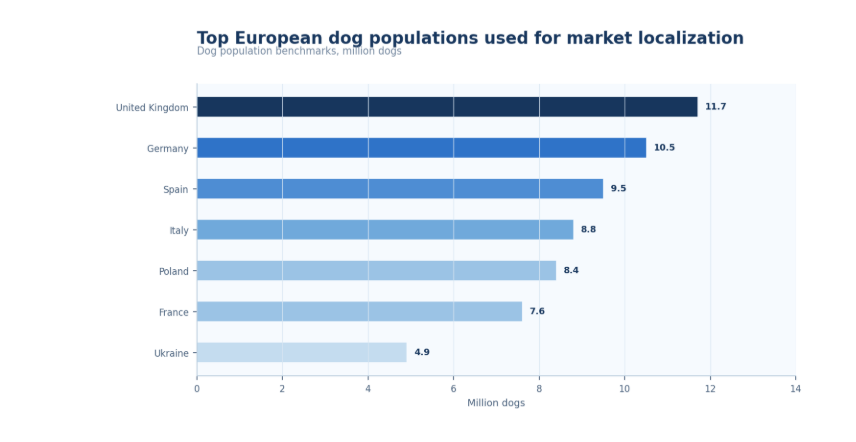
Figure 4. Top European dog populations show why country-level demand should be separated from broad regional averages.
Asia-Pacific
Asia-Pacific is the growth-region story, but it is also the region where market structure differs most by country. China’s market is shaped by urban pet ownership, domestic pet food production, digital platforms, and imported-brand trust. Japan is mature and affected by aging pets, smaller dog sizes, and high quality expectations. Australia is high-spend and dog-led. India and Southeast Asia are earlier-stage growth markets where urbanization, ecommerce, and middle-class pet ownership can expand commercial food usage.
• Asia-Pacific dog food market value was estimated at USD 11.60 billion in 2025.
• The region’s forecast CAGR benchmark is 7.28%, making it the fastest-growth regional story in the market benchmarks.
• Japan’s dog food market was estimated at USD 2.84 billion in 2025.
• China pet food production reached about 1.6 million tones in 2024, according to USDA FAS reporting.
• China’s pet food market should be measured through production capacity, ecommerce retail, imported brand positioning, and urban pet ownership.
• Japan should be measured through senior dog formulas, small-dog feeding, premium quality, and specialty diets rather than only population growth.
• Australia’s national pet survey data shows strong dog ownership and spending behavior, making it a high-value market relative to its population size.
• India and Southeast Asian markets need separate analysis because commercial food usage, household income, breed mix, and retail access vary sharply by city and country.
Latin America
Latin America combines large pet populations with price sensitivity, local production, import dynamics, and premium growth in major cities. Brazil is the key anchor market because it has one of the largest pet food industries in the region. Mexico, Argentina, Chile, Colombia, and Peru add market depth, but brands must manage affordability, retail fragmentation, and product education.
• South America’s dog food value benchmark was estimated at USD 3.09 billion in 2025.
• Brazil is the clearest Latin American pet food anchor market in the market benchmarks.
• Brazil combines a large dog population with local pet food production, tax considerations, and a growing premium segment.
• Mexico, Argentina, Chile, Colombia, and Peru should be analyzed separately because retail infrastructure, imports, local manufacturing, and income levels differ.
• Dry food remains central in many Latin American markets because it balances affordability, storage, and feeding efficiency.
• Premiumization in Latin America often starts in urban areas, pet specialty shops, veterinary channels, and ecommerce rather than across the whole market at once.
Middle East and Africa
Middle East and Africa is smaller in the global dog food market, but it should not be dismissed. Urban pet ownership, imported premium brands, veterinary access, and ecommerce availability are building pockets of demand in higher-income cities. South Africa and GCC countries are especially useful reference points for premium imported food, vet-led nutrition, and specialty retail.
• Middle East and Africa remains a smaller regional dog food base than North America, Europe, and Asia-Pacific.
• Urban income, pet-friendly housing, veterinary access, and imported brand availability shape demand more strongly than broad population size.
• Premium dog food in GCC markets often depends on import distribution, pet specialty stores, and veterinary recommendation.
• South Africa can be used as a regional benchmark for more developed pet food retail in Africa.
• The region is best analyzed as premium urban pockets rather than as one uniform mass market.
| Region | Core opportunity | Planning implication |
|---|---|---|
| North America | High value, premium products, ecommerce, fresh food, subscriptions | Keep premium innovation strong while measuring retention and margin. |
| Europe | Large dog base, mature retail, country fragmentation | Localize by country, claims, packaging, and channel. |
| Asia-Pacific | Fast growth, China scale, Japan maturity, Australia high spend | Separate mature premium markets from emerging urban growth markets. |
| Latin America | Large dog populations, affordability plus premium expansion | Balance dry-food value offers with urban premium and vet channels. |
| Middle East & Africa | Smaller base with premium urban pockets | Focus on import distribution, vet trust, and ecommerce availability. |
Regional interpretation
Regional dog food strategy should not copy one global template. North America answers the premium scale question. Europe answers the country-localization question. Asia-Pacific answers the growth and digital-channel question. Latin America answers the affordability-plus-upgrade question. Middle East and Africa answers the premium urban-pocket question.
Country-Level Dog Food Market Notes
Country-level notes help convert broad market data into article-ready insight. Each country should be included when it changes the story: large dog population, high spending, fast growth, manufacturing strength, distinctive retail channels, or a clear product need such as senior nutrition, premium dry food, veterinary diets, or ecommerce delivery.
The country section works best as a compact intelligence layer rather than a long encyclopedia. The strongest country notes explain how each market behaves: the U.S. anchors premium value, China shows production and ecommerce scale, Europe adds country-level localization, Japan highlights aging-pet needs, Canada provides mature retail signals, and Brazil anchors Latin America.
| Country/market | Key statistic | Article interpretation |
|---|---|---|
| United States | USD 27.76 billion dog food market estimate in 2025 | Largest single-country benchmark for premiumization, ecommerce, and subscription testing. |
| China | About 1.6 million tones of pet food production in 2024 | Scale market shaped by domestic production, ecommerce platforms, and imported-brand trust. |
| Germany | About 10.5 million dogs and USD 2.38 billion market estimate in 2025 | Mature European quality market where labeling, premium dry food, and veterinary nutrition matter. |
| United Kingdom | About 11.7 million dogs | Large European dog base with strong premium, ecommerce, and pet specialty potential. |
| Japan | USD 2.84 billion dog food estimate in 2025 | Mature market shaped by senior dogs, small breeds, and specialized diets. |
| Canada | CAD 4.465 billion dog food retail sales in 2024 | Useful benchmark for retail sales, pack formats, and category trend analysis. |
| Brazil | South America benchmark of USD 3.09 billion in 2025 | Latin American anchor where dog ownership, dry food volume, and premium growth intersect. |
Country-level rule
A useful country section should not only rank markets. It should explain why each country matters: market value, dog population, spend per dog, product needs, channel behavior, and premiumization stage. That keeps the article practical for brands and retailers.
Manufacturing, Ingredients, and Supply Chain
Dog food demand is consumer-facing, but margins are built inside manufacturing and supply chains. Ingredient costs, protein sourcing, grains, oils, vitamin-mineral premixes, packaging, energy, freight, retailer terms, and quality testing all affect profitability. A product can win at shelf because of nutrition and trust, but it must survive the operational realities of production, logistics, and retailer margin expectations.
Supply-chain analysis is especially important in a market where premium claims are common. Human-grade, single-protein, grain-free, fresh, organic, sustainable, and veterinary products all create different sourcing and compliance requirements. The stronger the claim, the more important the evidence becomes. That includes ingredient traceability, food safety, labeling, nutrient completeness, shelf stability, cold-chain management, and recall readiness.
Production and supply-chain benchmarks
• China pet food production of about 1.6 million tones in 2024 shows how country-level manufacturing capacity can become a market signal.
• Large dry food formats depend on stable access to proteins, grains, oils, vitamins, minerals, packaging, and extrusion capacity.
• Wet food requires different canning, pouching, sterilization, and logistics economics than dry kibble.
• Fresh and frozen food can create premium pricing but also requires cold-chain planning, shorter shelf life, and tighter fulfillment management.
• Veterinary and therapeutic diets require strong formulation controls and higher trust because owners may buy them for medical conditions.
• Private label can expand retailer participation in dog food, especially where shoppers are price-sensitive or where retailers want margin control.
• Import-heavy markets are exposed to currency, freight, customs, shelf registration, and distribution constraints.
• Sustainability claims are increasingly relevant, but they must be weighed against ingredient availability, packaging cost, and owner willingness to pay.
• Inflation can push some shoppers toward value packs, private label, or promotional channels, even while premium owners continue to trade up.
• Supply-chain resilience should be tracked alongside market growth because stockouts can break feeding routines and trigger brand switching.
Supply-chain readout
Dog food brands compete through nutrition, trust, palatability, price, and convenience, but their margins depend on inputs and operations. Premium products can protect value, but only when formulation, sourcing, production, packaging, and delivery support the promise without creating unreliable availability or excessive cost.
Dog Food Market Diagnostic
The dog food market is broad enough that one number cannot diagnose opportunity. A market may grow because there are more dogs, because owners spend more per dog, because ecommerce improves repeat purchase, because premium products lift value, or because new countries move from homemade feeding to commercial food. The diagnostic table below connects problem areas to useful measures.
Each metric belongs to a business question: is growth coming from more dogs, more spend per dog, better product targeting, stronger retail channels, regional expansion, or supply-chain capacity?
| Problem area | Core signals to measure | Useful benchmark from this report |
|---|---|---|
| Market scale | Market value, CAGR, forecast value | Global market moves from USD 77.17 billion in 2025 to USD 117.22 billion by 2034. |
| Ownership demand | Dog population, dog-owning households, commercial food usage | Europe has about 89.6 million dogs, but country-level demand varies sharply. |
| Premiumization | Spend per dog, premium share, fresh/functional/vet diet growth | Value growth comes from owners paying for health, convenience, and specialized nutrition. |
| Channel shift | Ecommerce share, subscription adoption, pet specialty performance | Dog food is suitable for auto ship because it is heavy and repeatedly purchased. |
| Regional mix | Country market value, dog population, retail behavior | North America leads value while Asia-Pacific has the clearest growth benchmark. |
| Product mix | Dry, wet, treats, fresh, functional, and veterinary products | Dry food anchors scale; wet, fresh, and specialized diets lift value per dog. |
| Supply chain | Ingredient cost, manufacturing capacity, packaging, logistics, imports | China production and Brazil market data show why manufacturing matters alongside demand. |
90-Day Dog Food Market Benchmark Plan
Statistics become useful when they are translated into a measurement plan. A practical dog food review can be organized into a 90-day cycle rather than a vague market scan. The same approach can guide brand planning, category strategy, content production, investor research, or market-entry work.
| Timing | What to do | Output |
|---|---|---|
| Days 1-30 | Capture baseline data by global value, region, country, dog population, product format, and channel. | A clean map of where demand and value are concentrated. |
| Days 31-60 | Compare premiumization, ecommerce, veterinary diets, fresh food, and retail-channel signals by country. | A prioritized list of product and market opportunities. |
| Days 61-90 | Review pricing, margins, supply chain, pack formats, and repeat-purchase economics before finalizing market strategy. | A repeatable scorecard for profitable dog food growth. |
Planning principle
The best dog food market teams do not chase every statistic. They compare external benchmarks against their own portfolio, then prioritize markets and products with clear demand, repeat purchase, supply-chain feasibility, and measurable margin impact.
Metrics Dog Food Market Leaders Should Track
The final scorecard should be detailed enough to locate opportunity without becoming a vanity dashboard. These metrics form the minimum useful set for a mature dog food market review.
| Metric | Why it matters |
|---|---|
| Global dog food market value | total revenue opportunity and establishes the category scale. |
| Forecast CAGR | the pace of expected expansion and helps compare mature and growth markets. |
| Regional market share | Separates high-value regions from faster-growing regions. |
| Country market value | Identifies single-country revenue anchors such as the United States, Germany, Japan, Canada, China, and Brazil. |
| Dog population | Defines the addressable feeding base. |
| Dog-owning households | whether dog ownership is mainstream and how far commercial food can penetrate. |
| Spend per dog | Measures premiumization and ability to support higher-value products. |
| Product format mix | Separates dry, wet, treats, fresh, functional, and veterinary diets. |
| Channel mix | the role of grocery, mass, pet specialty, veterinary, ecommerce, and subscription. |
| Repeat purchase and retention | whether a brand becomes part of the dog’s normal feeding routine. |
| Average selling price | Tracks premiumization, inflation, pack-size changes, and promotion pressure. |
| Supply-chain reliability | Protects brand loyalty because stockouts can force owners to switch foods. |
Global Dog Food Market Statistics FAQ
Common questions
• How big is the global dog food market?
The global dog food market was valued at USD 77.17 billion in 2025 in the Fortune Business Insights benchmark used in the market benchmark.
• What is the expected CAGR of the dog food market?
The global dog food market is projected to grow at a 4.84% CAGR from 2026 to 2034.
• What will the global dog food market be worth by 2034?
The market is projected to reach about USD 117.22 billion by 2034.
• Which region leads the dog food market?
North America leads the market by value, accounting for 46.21% of global dog food value in 2025 and an estimated USD 35.66 billion market size.
• Why is the United States important in dog food sales?
The U.S. dog food market was estimated at USD 27.76 billion in 2025, making it the largest single-country benchmark in these market benchmarks.
• How large is Europe’s dog population?
FEDIAF data places Europe’s dog population near 89.6 million dogs.
• Which European countries have the largest dog populations?
The largest European dog population benchmarks in the market benchmarks include the United Kingdom at about 11.7 million, Germany at 10.5 million, Spain at 9.46 million, Italy at 8.77 million, Poland at 8.44 million, and France at 7.6 million dogs.
• Why is premium dog food growing?
Premium dog food grows because owners increasingly connect food with health, digestion, breed needs, senior care, ingredient quality, freshness, convenience, and veterinary outcomes.
• How is ecommerce changing dog food sales?
Ecommerce supports dog food because the product is heavy, repeatedly purchased, and suitable for auto ship. It is especially important for subscriptions, fresh food, large pack delivery, and marketplace discovery.
• Which trends will shape dog food through 2034?
The most important trends are pet humanization, premium and functional nutrition, ecommerce subscriptions, fresh and veterinary diets, country-level localization, and supply-chain resilience.
Final Takeaway
Global dog food performance depends on five systems working together: the ownership base, recurring feeding demand, premiumization, regional localization, and channel execution. The statistics show that growth can come from any one of those areas, so dog food should not be managed only as a single blended market forecast.
The most useful market analysis finds the actual driver. If a country has millions of dogs but lower commercial food spend, the issue may be affordability, retail access, or feeding habits. If a mature market grows despite stable population, the driver may be premiumization, fresh food, veterinary diets, or ecommerce retention. If a brand has strong first-order sales but weak repeat purchase, the issue may be palatability, price, subscription experience, pack size, or trust.
For pet food leaders, the practical goal is a dog food system that is trusted, repeatable, localized, nutritionally credible, and financially controlled. That means understanding where dogs are, how owners spend, which formats they buy, which channels keep them loyal, and which claims they believe. The global market is large enough for broad growth, but the strongest opportunities will come from precise segmentation by country, dog size, life stage, product format, channel, and owner need.