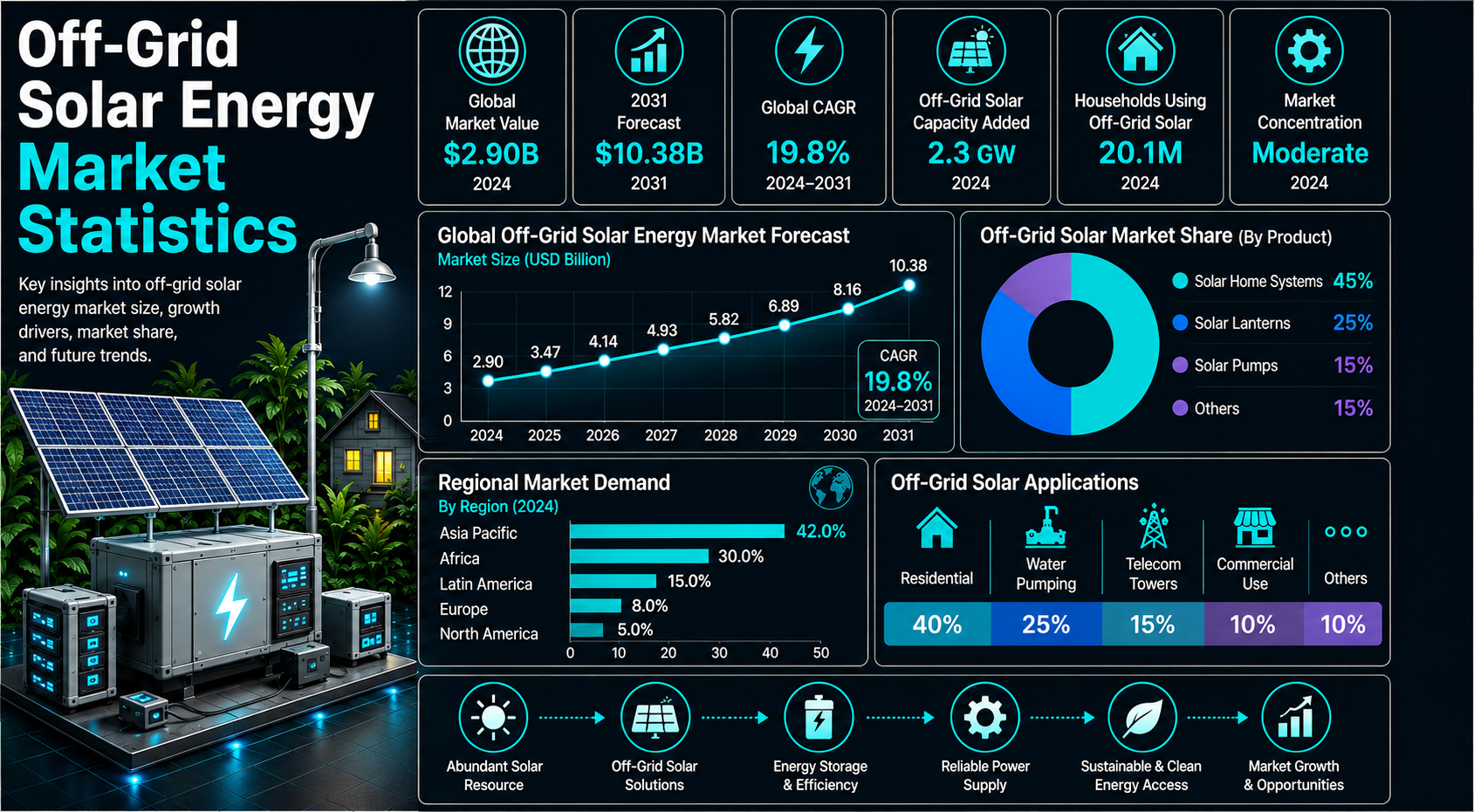
Off-grid solar energy is now one of the most important distributed-power markets in the world because it sits at the intersection of electricity access, rural affordability, climate resilience, and local economic development. The market includes solar lanterns, multi-light systems, solar home systems, PAYGo products, mini-grids, productive-use appliances, solar water pumps, cold storage, telecom power, schools, clinics, and remote commercial sites. That breadth makes the statistics more useful when they are read as a full access-and-services market rather than as a narrow solar equipment category.
The strongest off-grid solar statistics start with the electricity-access gap. Global access remains uneven, and the largest opportunity is concentrated in places where grid extension is slow, rural household demand is high, and solar resource quality is strong. Sub-Saharan Africa carries the largest unelectrified population, while South Asia, Southeast Asia, Latin America, and island communities continue to use distributed systems where geography or affordability limits central-grid expansion.
The market story becomes clearer when the numbers are read in sequence: access gaps define need, product sales show adoption, mini-grids reveal community-power potential, productive-use systems show income value, and financing determines how quickly customers can participate.
Executive Off-Grid Solar Benchmarks
The executive numbers define why the off-grid solar market remains important. They show the size of the electricity-access gap, the scale of distributed renewable energy reach, the concentration of demand in Sub-Saharan Africa, and the importance of financing models that can make systems affordable for households and small businesses.
The numbers that define the off-grid solar market
• The global population without electricity was estimated at 666 million people, showing that energy access remains a large and measurable market challenge.
• Sub-Saharan Africa accounted for about 565 million people without electricity, making it the central region for off-grid solar access planning.
• Distributed renewable energy solutions have reached more than 561 million people worldwide, showing that decentralized systems are already operating at meaningful scale.
• The global off-grid solar market is forecast to expand steadily through 2030 as solar home systems, mini-grids, and productive-use systems become more common.
• Solar home systems remain one of the core product categories because they move households beyond single-lamp access into lighting, charging, radio, fans, television, and appliance readiness.
• PAYGo solar continues to matter because many customers cannot pay the full cost of a solar home system upfront.
• Mini-grids are gaining attention because they can support household, community, business, school, clinic, and productive-use loads from one local power asset.
• Productive-use solar is becoming a stronger market layer because solar water pumps, refrigeration, cold storage, and agri-processing systems connect energy access to income.
• Battery storage is central to off-grid solar reliability because it turns daytime solar generation into evening and nighttime service.
• The most important country-level opportunities include Nigeria, Ethiopia, DRC, Kenya, Tanzania, Uganda, Rwanda, India, Bangladesh, Pakistan, Indonesia, the Philippines, Nepal, Peru, Brazil, and Colombia.
• Off-grid solar affordability is shaped by system cost, customer income, import duties, consumer finance, mobile-money infrastructure, and service network quality.
• Market growth depends on product quality because weak or short-lived systems can reduce customer trust in solar access solutions.
• Policy support matters because national electrification plans decide where grid extension, mini-grids, and standalone systems should work together.
• The strongest investment cases usually combine large access gaps, proven customer demand, reliable payment infrastructure, and clear regulation.
• Off-grid solar statistics should be tracked by both energy-access indicators and commercial indicators because the market includes social impact and business value.
| Market signal | Latest value | Why it matters |
|---|---|---|
| Electricity access gap | 666M people | Defines long-term access need |
| Sub-Saharan Africa gap | 565M people | Access concentration |
| DRE reach | 561M+ people | DRE scale |
| Solar home systems | Core household category | Links lighting and appliances |
| PAYGo solar | Financing driver | Eases upfront payment pressure |
| Mini-grids | Community power layer | Supports productive loads and local service |
|
Executive readout Off-grid solar statistics work best when access gaps, product sales, financing, storage, policy, and regional readiness are read together. |
Why Off-Grid Solar Now Matters
Off-grid solar matters because millions of households and businesses still need reliable electricity before a central grid connection becomes available or affordable. Grid expansion remains important, but it is often slow in remote areas, islands, conflict-affected regions, and low-density rural communities. Off-grid solar systems can deliver practical service sooner when the right product, financing, and maintenance model is in place.
This is also why the market should not be judged by access-gap data alone. A region can have major need, but adoption still depends on product affordability, distribution reach, installation quality, and customer service. The best-performing off-grid markets convert need into trusted service.
Energy-access and development signals
• An estimated 666 million people still lacked electricity, which keeps energy access near the center of global development planning.
• Sub-Saharan Africa represented about 85% of the global electricity-access gap when measured against the 565 million regional total.
• Rural households are the most important customer base for entry-level solar because grid extension costs are higher in low-density communities.
• Schools, health facilities, small shops, farms, and water systems create demand for off-grid solar beyond household lighting.
• Solar home systems can reduce reliance on kerosene lighting and phone-charging trips, improving household convenience and safety.
• Mini-grids can serve clustered demand where standalone systems are too small and grid extension is not yet viable.
• Productive-use solar can support irrigation, refrigeration, cooling, milling, welding, and small-business services.
• The SDG7 access gap shows that current progress is not fast enough without faster deployment of distributed solutions.
• Off-grid solar can also support climate resilience because it reduces dependence on diesel generators in remote or weak-grid areas.
• Energy access statistics are most useful when they separate household access, community services, and income-generating uses.
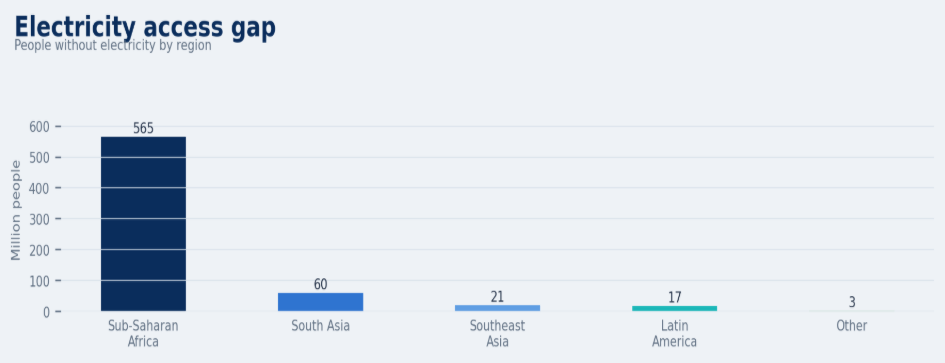
Figure 1. Sub-Saharan Africa carries the deepest access gap.
|
Access readout Off-grid solar grows fastest where grid expansion is slow, household demand is rising, and smaller systems can deliver first-time access. |
Global Market Size and Forecast
Market-size estimates vary because analysts define off-grid solar differently. Some forecasts focus on standalone systems, some include mini-grids, and others include broader distributed renewable energy, storage, and productive-use applications. The best way to read the market is to compare forecasts as directional signals rather than treating one figure as the entire market.
Market definitions can move numbers widely because lanterns, solar home systems, mini-grids, and productive-use assets have different customers, ticket sizes, service costs, and financing needs. A broad distributed-energy view is useful, but segment-level reading shows where revenue and adoption are actually forming.
Forecasts should therefore be read in layers: basic access from lanterns and small kits, household electrification from solar home systems, and community or enterprise value from mini-grids, pumps, cooling, and business systems.
Market-size and forecast benchmarks
• The off-grid solar market is commonly forecast to grow through 2030 as system affordability improves and energy-access programs expand.
• Solar home systems represent a major share of the household segment because they bridge the gap between basic lanterns and larger distributed power systems.
• Mini-grid forecasts are stronger in markets with dense rural settlements, productive-use loads, and supportive regulation.
• Productive-use solar expands the market beyond household access by connecting electricity to income generation.
• Battery storage increases the value of off-grid solar by enabling evening use, refrigeration, and more reliable community power.
• Regional growth is strongest when access need, mobile payments, consumer finance, solar resource quality, and service networks overlap.
• Forecast comparisons should separate product revenue, installed capacity, customer reach, and energy-service value.
• A market forecast of USD 6.8 billion by 2030 is a useful planning anchor for a broad off-grid solar market view.
• Growth remains sensitive to affordability because many customers need financing, subsidies, or PAYGo models to adopt larger systems.
• Import taxes, currency shifts, interest rates, and logistics costs can change system prices quickly in many off-grid markets.
• Investment data should be read alongside customer affordability because funding does not automatically convert into sustainable adoption.
• The strongest commercial markets are those where customers can pay, products last, and service teams can maintain systems after installation.
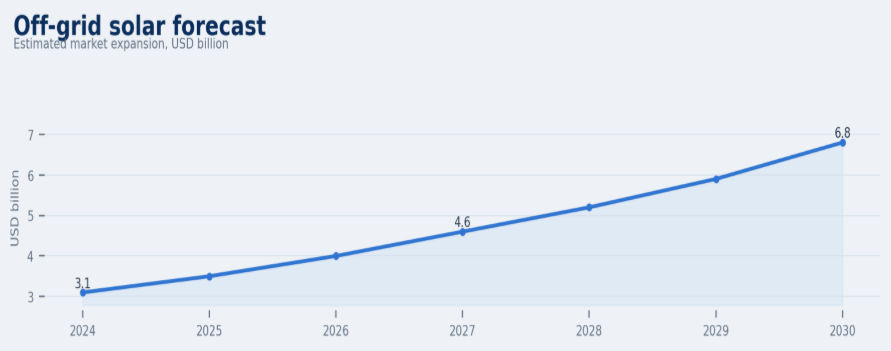
Figure 2. Forecasts point toward steady distributed-energy growth.
Forecasts should be read beside access demand because market value and energy need move together.
| View | Base year | Base value | Target year | Target value | Signal |
|---|---|---|---|---|---|
| Broad market | 2024 | USD 3.1B | 2030 | USD 6.8B | Approx. 14% |
| Solar home systems | 2024 | USD 1.2B | 2030 | USD 2.6B | Approx. 13% |
| Mini-grid growth | 2024 | USD 0.9B | 2030 | USD 2.1B | Approx. 15% |
| Productive-use | 2024 | USD 0.7B | 2030 | USD 1.8B | Approx. 17% |
|
Forecast readout Growth is led by access demand, SHS, mini-grids, PAYGo finance, storage, and productive use. |
Product Sales and Adoption
Product adoption is the most practical way to see how off-grid solar develops. Entry-level lanterns often introduce customers to solar, multi-light systems improve household comfort, and solar home systems provide a stronger service package. Over time, the adoption story becomes less about a single device and more about energy services that support households, farms, shops, and local institutions.
Sales data is especially useful because it shows what customers are actually choosing, not only what policy documents or forecasts expect. When customers move from basic lighting products into larger solar home systems, the market usually becomes more service-intensive. Companies need stronger distribution, installation, warranty support, credit management, and spare-parts availability.
Adoption data should balance volume with service depth. High sales in low-cost products can show broad reach, while fewer larger systems can still represent stronger revenue and deeper energy value.
Product sales and adoption benchmarks
• Solar lanterns remain the lowest-cost entry point for many households.
• Multi-light systems serve households that need more than one lighting point.
• Solar home systems add deeper value through charging, fans, TVs, and small appliances.
• PAYGo matters where upfront purchasing power is limited.
• Cash sales remain common for lanterns and small kits.
• Appliance bundles matter because customers want useful energy services.
• Quality-certified products protect customer confidence.
• After-sales service matters because systems need maintenance and battery support.
• Upgrade cycles show customers moving toward appliance-ready systems.
• Adoption is strongest when rural distribution and clear financing work together.
• Solar products become more valuable when they support education, business hours, cooling, and water.
• Sales data should be read beside household impact.
• Solar home systems also support phone charging and digital inclusion.
• Product sales slow when inflation, duties, currency pressure, or financing costs reduce affordability.
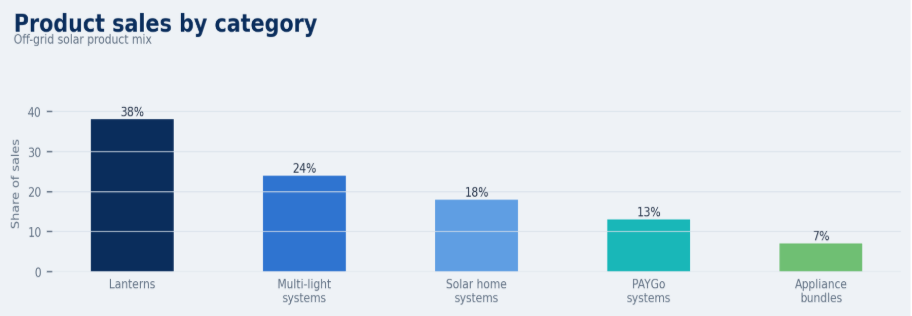
Figure 3. Product sales are moving beyond basic lighting.
| Product type | Main use case | Market role |
|---|---|---|
| Solar lantern | Entry-level lighting | First-access product |
| Multi-light system | Household lighting | Improves comfort and daily use |
| Solar home system | Lighting, charging, appliances | Core household product |
| PAYGo system | Financed access | Eases upfront payment |
|
Adoption readout Product sales show the market moving from basic lighting into household and income-generating energy services. |
Solar Home Systems and Household Electrification
Solar home systems sit at the center of the household off-grid market. They give families a practical step between very small lighting products and more complex community systems. Their value depends on the size of the system, battery quality, appliance compatibility, repayment terms, warranty support, and whether the household can upgrade over time.
Household systems also create a measurable upgrade path. A customer may begin with lighting and phone charging, then move toward television, fans, refrigeration, or small enterprise use. That progression is important because it turns one-time access into repeat demand for larger systems, better batteries, and stronger service contracts.
Household solar benchmarks
• Entry-level solar home systems usually focus on lighting and phone charging, which are often the first high-value services for households.
• Mid-level systems can support multiple lights, radios, fans, and longer evening use.
• Larger solar home systems can support televisions, higher charging demand, and small appliance use.
• Household adoption depends heavily on affordability because many rural customers cannot pay the full system price upfront.
• PAYGo models help spread cost over time, but they also require good repayment management and customer support.
• Battery performance affects customer satisfaction because households expect evening service after daytime charging.
• Solar home systems can improve study time, household safety, communication access, and daily convenience.
• Service networks matter because broken components, weak batteries, or poor installation can reduce customer trust.
• Upgrade pathways are important because households may begin with a basic kit and later demand larger energy services.
• Household solar adoption is strongest where rural demand, finance, mobile payment, and trusted distribution overlap.
• Affordability gaps remain a limiting factor, especially when food, transport, and currency pressures reduce disposable income.
• Household electrification data should be compared with appliance adoption because electricity value rises when useful devices become affordable.
| System level | Typical services | Household value |
|---|---|---|
| Entry system | One or more lights, phone charging | First electricity access and reduced kerosene reliance |
| Mid-level system | Multiple lights, radio, fan | Better daily comfort and communication access |
| Larger SHS | TV, appliances, small business use | Higher household and income value |
|
Household readout Solar home systems matter because they convert first-time electricity access into usable power for lighting, communication, education, entertainment, and small appliances. |
Mini-Grids and Distributed Renewable Energy
Mini-grids are different from standalone products because they can serve multiple users through one local distribution network. They are most useful where households, businesses, farms, schools, clinics, telecom towers, or water systems create enough demand to support a shared power asset. In many rural markets, the strongest mini-grid projects depend on anchor loads and productive-use demand.
Mini-grid growth benchmarks
• Mini-grids can support higher loads than most standalone household systems, making them useful for community power.
• Solar hybrid mini-grids combine solar, batteries, and sometimes diesel backup to improve reliability.
• Anchor customers such as telecom towers, clinics, schools, water systems, or commercial users can strengthen project economics.
• Productive-use loads improve mini-grid viability because they raise daytime demand when solar generation is available.
• Tariff design is a central challenge because developers need revenue while customers need affordable power.
• Regulatory clarity matters because mini-grid developers need rules for licensing, tariffs, grid arrival, and compensation.
• Battery storage is one of the largest cost and reliability factors in solar mini-grid design.
• Remote logistics can raise capital and maintenance costs, especially in island, forest, mountain, or conflict-affected regions.
• Mini-grids can reduce diesel dependence where remote businesses or communities rely on generator power.
• Community demand assessment is important because overestimating usage can weaken project performance.
• Mini-grid market growth is strongest where policy support, anchor demand, concessional finance, and local service capacity align.
• A mini-grid pipeline should be evaluated by projects installed, projects planned, customer connections, storage capacity, and commercial load share.
• Mini-grids and standalone systems should not be treated as competitors in every market because they often serve different levels of demand.
• The best electrification plans use grid, mini-grid, and standalone systems together rather than forcing one model into every location.
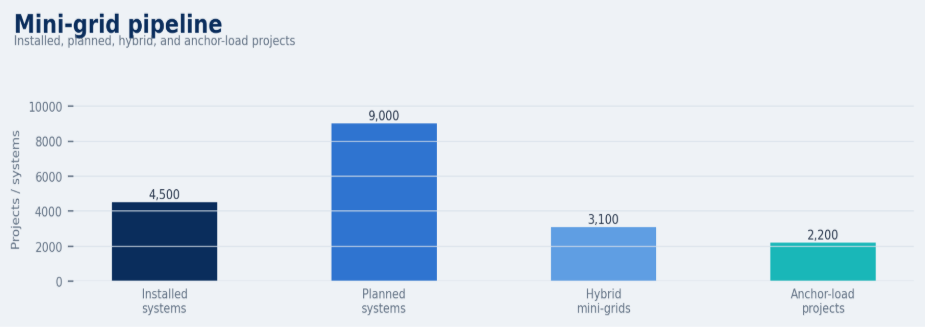
Figure 4. Mini-grid pipelines rely on productive and anchor loads.
| Mini-grid model | Best-fit market | Main constraint |
|---|---|---|
| Village mini-grid | Clustered rural communities | Demand density |
| Commercial mini-grid | Shops, farms, productive loads | Tariff design |
| Hybrid mini-grid | Reliability-focused sites | Storage and backup cost |
| Anchor-customer model | Telecom, clinics, schools, water systems | Contract stability |
|
Mini-grid readout Mini-grids work best where community demand, productive loads, and anchor customers support reliable local power. |
Productive-Use Solar Applications
Productive-use solar is the part of the market that most clearly links electricity access to income. A household light improves daily life, but a solar water pump, cold room, mill, refrigerator, or business kit can change how a farm or enterprise operates. This is why productive-use solar is increasingly included in off-grid solar market analysis.
The strongest productive-use opportunities usually appear where equipment, finance, training, and market access work together. A pump, cold room, or refrigerator only creates value when farmers, shop owners, or health workers can use the equipment often enough to justify the payment.
Productive-use benchmarks
• Solar water pumps are one of the most important productive-use applications because irrigation can improve agricultural output.
• Solar cold storage can reduce food loss by keeping produce, fish, dairy, or medicine at usable temperatures for longer.
• Solar refrigeration supports rural shops, clinics, and agricultural value chains where grid power is weak or unavailable.
• Solar milling and agri-processing can keep more value inside rural communities by reducing transport and processing barriers.
• Small enterprise power supports phone charging, barber shops, tailoring, welding, retail, lighting, and other local services.
• Productive-use systems usually require larger power capacity than basic household systems, which makes financing more important.
• Customer training matters because income-generating equipment must be used, maintained, and matched to local demand.
• Solar water pumps require careful sizing because pump depth, water demand, and crop needs vary by location.
• Cold storage projects require business planning because revenue depends on throughput, utilization, and customer willingness to pay.
• Productive-use solar can strengthen mini-grid economics when it increases daytime electricity consumption.
• Women-led businesses can benefit from reliable power when financing, training, and market access are available.
• Agricultural solar systems are strongest when paired with value-chain support, not only equipment distribution.
• The productive-use segment is more complex than lighting because it involves energy, equipment, credit, training, and market demand.
• Income-generating applications help off-grid solar move from a welfare access story into a rural economic-development story.
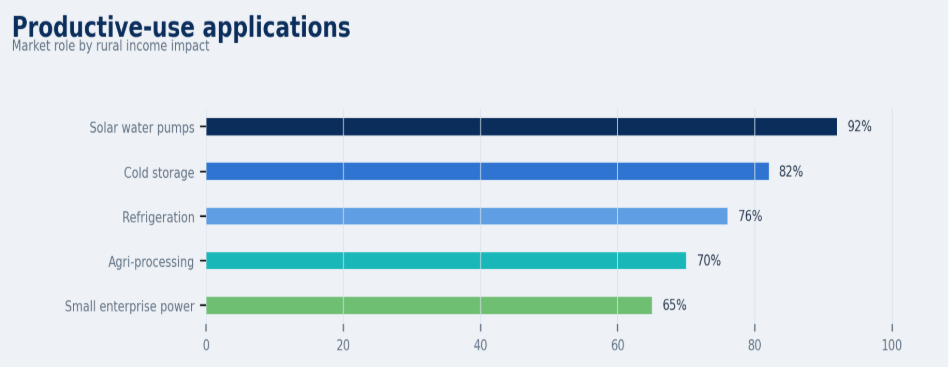
Figure 5. Productive-use solar links power with income activity.
| Application | Energy service | Economic value |
|---|---|---|
| Solar water pump | Irrigation | Higher farm output |
| Solar cold storage | Cooling | Lower food loss |
| Solar milling | Processing | Local enterprise and value retention |
| Solar refrigeration | Preservation | Health and retail value |
| Solar business kit | Small enterprise power | Income and longer hours |
|
Productive-use readout The market strengthens when systems support income, agriculture, cooling, and small business activity. |
Battery Storage and Reliability
Battery storage is the reliability layer that makes off-grid solar useful after sunset. Without storage, solar generation is strongest when household evening demand has not yet arrived. With storage, systems can support lighting, phone charging, refrigeration, productive use, and essential services for more hours of the day.
Storage and reliability benchmarks
• Lithium-ion batteries are increasingly used in newer solar home systems and mini-grids because of better cycle performance.
• Lead-acid batteries remain present in legacy and low-cost systems but often have shorter usable life.
• Battery replacement cost is an important customer issue because a system can become unusable when storage fails.
• Storage sizing affects whether systems can support evening lighting, refrigeration, fans, or business loads.
• Mini-grid storage design must balance reliability, cost, demand peaks, and battery lifecycle.
• System uptime is a key metric because customers judge solar access by service availability, not panel capacity.
• Battery monitoring can improve maintenance by identifying weak performance before full system failure.
• Storage cost pressure can slow adoption when customers need larger systems but cannot finance them affordably.
• Recycling and responsible battery management are becoming more important as deployments grow.
• Storage turns off-grid solar from a daylight technology into a full energy-service solution.
| Battery type | Market role | Key challenge |
|---|---|---|
| Lithium-ion | Newer SHS and mini-grids | Higher upfront cost |
| Lead-acid | Legacy low-cost systems | Shorter lifecycle |
| Hybrid storage | Mini-grids and commercial sites | System design complexity |
|
Storage readout Battery storage turns daytime solar generation into usable household, business, and community power after sunset. |
Regional Off-Grid Solar Market Intelligence
Regional analysis is essential because off-grid solar does not grow in the same way everywhere. The strongest markets combine large access gaps, rural demand, good solar resources, consumer finance, mobile-money infrastructure, supportive policy, and service networks. A region can have strong solar resource but weak adoption if affordability and distribution are not solved.
Regional signals worth separating
• Sub-Saharan Africa is the largest access-opportunity region because it accounts for about 565 million people without electricity.
• Nigeria is one of the most important off-grid solar markets because its population scale, unreliable grid access, and rural demand create large distributed-energy needs.
• Kenya is often used as a PAYGo and solar-home-system benchmark because mobile money and solar distribution developed earlier than in many peer markets.
• Ethiopia, Tanzania, Uganda, Rwanda, and DRC are important because access gaps remain large and rural communities need scalable solutions.
• South Asia remains important because India, Bangladesh, Pakistan, and Nepal each have different combinations of rural access, solar affordability, and productive-use demand.
• Bangladesh has long experience with solar home systems, making it a useful reference point for household solar adoption history.
• India’s off-grid opportunity includes productive-use solar, irrigation, rural enterprises, and reliability solutions where grid quality varies.
• Pakistan’s distributed-solar demand is shaped by electricity cost, reliability needs, rural access, and affordability pressure.
• Southeast Asia has strong island and remote-community opportunities, especially where mini-grids can replace diesel or improve weak-grid service.
• Indonesia and the Philippines are important because geography makes centralized grid service more complex across islands.
• Latin America’s off-grid need is concentrated in remote communities, Amazon regions, rural health facilities, and hard-to-reach sites.
• MENA opportunities are often linked to agriculture, water pumping, desert communities, remote sites, and resilience needs.
• Regional comparisons should separate electricity access need, consumer ability to pay, policy support, distribution networks, and productive-use potential.
• The best regional markets are not always those with the highest access gap; they are those where access need can be converted into reliable adoption.
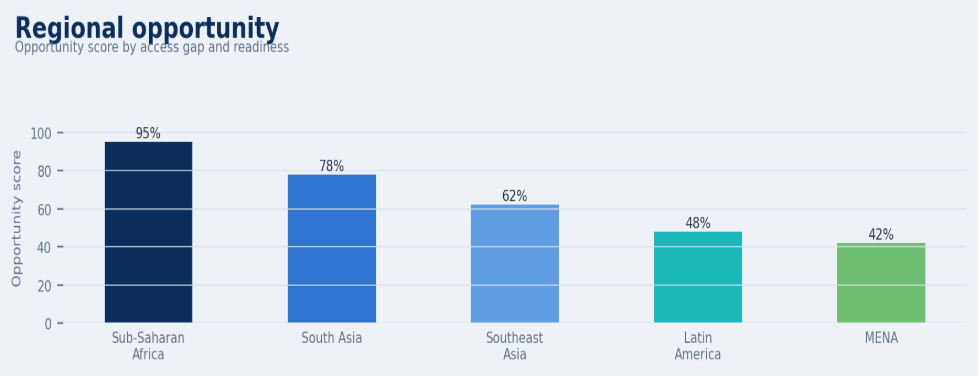
Figure 6. Regional opportunity depends on access gaps and readiness.
| Region | Market position | Main opportunity | Main constraint |
|---|---|---|---|
| Sub-Saharan Africa | Largest access gap | SHS, PAYGo, mini-grids | Affordability |
| South Asia | Mature solar-use pockets | SHS, pumps, microenterprise | Policy and income variation |
| Southeast Asia | Island and remote demand | Mini-grids, diesel replacement | Geography and logistics |
| Latin America | Remote community need | Amazon, rural sites, institutions | Service reach |
| MENA | Remote and agricultural demand | Pumps, desert sites, commercial power | Financing |
|
Regional readout Adoption is strongest where access gaps, rural demand, mobile-money ecosystems, solar resources, and policy support overlap. |
Country-Level Off-Grid Solar Statistics
Country-level data prevents the article from becoming too broad. Two countries can sit in the same region but have very different affordability, payment infrastructure, policy, currency, logistics, and service conditions. This is why country-level signals are essential in off-grid solar market planning.
Country-level analysis separates addressable demand from reachable demand. A large unelectrified population is not enough if roads are weak, import costs are high, consumer finance is scarce, or service networks are thin.
Kenya and Nigeria show the difference. Kenya is often read through PAYGo maturity, mobile-money readiness, and distribution experience; Nigeria is read through scale, weak-grid demand, mini-grid potential, and the need for scalable finance.
Country signals worth separating
• Nigeria is a major off-grid solar market because its large population, unreliable power supply, and rural access needs create demand for solar home systems and mini-grids.
• Kenya remains important because PAYGo solar, mobile-money use, and rural distribution networks have supported a more mature off-grid ecosystem.
• Ethiopia has significant rural electrification needs and can benefit from standalone systems, mini-grids, and institutional solar.
• Tanzania combines rural household demand with PAYGo potential and productive-use opportunities in agriculture and small business.
• Uganda remains relevant because solar home systems and mini-grid models can serve communities where grid service is limited.
• DRC has one of the largest access gaps, but logistics, affordability, and infrastructure make delivery more challenging.
• Rwanda is important because coordinated electrification planning can combine grid, mini-grid, and standalone systems.
• India’s off-grid solar opportunity includes irrigation, rural enterprises, appliance use, and reliability solutions for weak-grid areas.
• Bangladesh provides a long solar home system history and shows how household solar can scale when financing and distribution align.
• Pakistan has growing distributed-solar demand linked to electricity costs, reliability concerns, and rural energy needs.
• Indonesia needs off-grid and mini-grid approaches for remote islands and communities where grid extension is expensive.
• The Philippines has island electrification opportunities where solar mini-grids and storage can reduce diesel reliance.
• Nepal’s off-grid opportunity is shaped by mountain geography, remote communities, and small-scale productive use.
• Peru, Brazil, and Colombia show how Latin American off-grid demand often concentrates in remote forest, river, and rural communities.
• Country readiness should be judged by access need, customer affordability, financing infrastructure, service networks, import conditions, and policy clarity.
| Country | Market signal | Why it matters |
|---|---|---|
| Nigeria | Large unelectrified and weak-grid population | Major SHS/mini-grid opportunity |
| Kenya | PAYGo and SHS maturity | Financing-model benchmark |
| DRC | Very large access gap | High need, difficult logistics |
| India | Productive-use and rural solar demand | Scale opportunity |
| Bangladesh | SHS experience | Mature household solar history |
| Pakistan | Reliability and affordability demand | Strong distributed-solar case |
| Indonesia | Island communities | Mini-grid and storage opportunity |
| Peru/Brazil/Colombia | Remote access gaps | Rural and Amazon demand |
|
Country readout Country growth depends on affordability, payments, rural density, policy, logistics, and appliance demand. |
Financing, PAYGo, and Investment Trends
Financing is one of the most important off-grid solar market issues because many customers need electricity but cannot afford full upfront payment. PAYGo solar, microfinance, results-based financing, subsidies, blended finance, and commercial investment each solve part of the affordability challenge. The market scales when finance supports customers and companies without creating unsustainable repayment pressure.
Finance data should also be read with customer protection in mind. Installment models expand access, but they work best when terms are transparent, products are durable, and customers understand the payment schedule. Sustainable growth depends on both repayment health and long-term customer value.
Finance and PAYGo benchmarks
• PAYGo solar remains central because it converts a large upfront system purchase into smaller payments over time.
• Mobile-money infrastructure improves PAYGo adoption because it makes recurring customer payments easier to collect.
• Cash sales work better for smaller systems or higher-income customers, but they limit reach among lower-income households.
• Microfinance can support larger systems, productive-use appliances, and small enterprise solar investments.
• Results-based financing can help companies reach poorer or harder-to-serve customers by paying for verified outcomes.
• Blended finance is important because purely commercial capital may be too expensive for many access markets.
• Consumer repayment performance is a key business metric because weak collections can damage provider finances.
• Affordability remains one of the most important limits on larger solar home systems and productive-use equipment.
• Currency depreciation can raise local system prices when products or components are imported.
• Interest rates affect companies because inventory, receivables, and PAYGo portfolios require working capital.
• Investor confidence improves when policy is clear, product quality is strong, and customer service networks are reliable.
• Financing should be matched to system value because household lighting products, productive-use assets, and mini-grids carry different repayment profiles.
• The best PAYGo models combine transparent terms, reliable products, strong customer support, and careful credit assessment.
• Off-grid solar investment should be evaluated by customer reach, repayment health, margins, service cost, and long-term asset performance.
| Financing model | Customer fit | Market challenge |
|---|---|---|
| Cash sale | Higher-income customers | Lower reach |
| PAYGo | Low-upfront customers | Repayment risk |
| Microfinance | Rural households and enterprises | Credit screening |
| Results-based financing | Public-access projects | Verification burden |
| Blended finance | Scale-up and hard markets | Funding complexity |
|
Finance readout PAYGo and blended finance matter because many customers need electricity but cannot pay the full system cost upfront. |
Policy, Climate, and SDG7 Readout
Policy determines whether off-grid solar becomes an organized energy-access solution or a fragmented product market. The best policy environments clarify where standalone systems and mini-grids fit, reduce unnecessary cost barriers, protect customers through quality standards, and coordinate grid extension with distributed solutions.
Policy alignment is especially important when grid extension, mini-grids, and standalone systems serve the same national access plan. Clear rules reduce uncertainty for companies and help governments avoid duplicated investment, stranded assets, and underserved communities.
Policy and climate benchmarks
• SDG7 keeps electricity access at the center of global energy planning, but current access gaps show that faster deployment is needed.
• National electrification plans are stronger when they define grid, mini-grid, and standalone system roles clearly.
• Import-duty relief can reduce system costs and improve affordability for rural customers.
• Quality standards protect customers by reducing the risk of weak products and early failures.
• Mini-grid regulation improves investment confidence when licensing, tariffs, and grid-arrival rules are clear.
• Results-based funding can help reach customers who are expensive or difficult to serve commercially.
• Climate finance can support off-grid solar where it replaces diesel, kerosene, or unreliable fossil-fuel generation.
• Humanitarian energy access is important for refugee settings, displaced communities, clinics, and emergency services.
• Schools and health facilities can anchor off-grid solar demand while improving social outcomes.
• Policy support is most effective when it addresses cost, quality, finance, planning, and consumer protection together.
• Weak policy can raise market risk even when customer demand and solar resources are strong.
• Off-grid solar should be included in national energy planning as a service-delivery tool, not only a product import category.
| Policy lever | Market effect | Risk if missing |
|---|---|---|
| Quality standards | Protects customers and trust | Weak products enter market |
| Import-duty relief | Reduces system cost | Systems stay unaffordable |
| Mini-grid regulation | Enables investment | Developers face uncertainty |
| Results-based funding | Expands access | Growth slows in harder markets |
| Electrification planning | Coordinates grid and off-grid | Market fragmentation |
|
Policy readout Off-grid solar scales faster when standards, import rules, financing support, and national electrification planning work together. |
How to Read Off-Grid Solar Statistics
The same off-grid solar statistic means different things to different readers. Investors look for bankability, repayment, and scale. Governments look for access gaps, affordability, and planning tools. Solar companies look for product-market fit, distribution reach, and service cost. NGOs look for social impact, inclusion, and affordability. Utilities look for where mini-grids, grid extension, and standalone systems fit together.
This reading method keeps the article close to practical decision-making because it links market demand with customer outcomes.
This keeps the analysis useful for planning, investment, and market entry decisions.
A practical reading method avoids treating every statistic equally. Access-gap figures explain need, product sales show adoption, and investment figures show funding interest, but strong analysis connects all three with affordability and service quality.
A useful scorecard asks four questions: where is the access gap largest, where can customers afford products or financing, where do service networks exist, and where does policy allow standalone systems and mini-grids to scale?
| Reader | What to watch | Why it matters |
|---|---|---|
| Investors | Forecasts, PAYGo, repayment, country risk | Shows bankability |
| Governments | Access gaps, subsidy design, regulation | Guides planning |
| Solar companies | Product sales, service networks, affordability | Market readiness |
| NGOs | Schools, clinics, gender impact, affordability | Impact |
| Utilities | Mini-grids, grid-extension gaps, rural demand | Shows integration |
|
Decision readout The strongest analysis connects access need, affordability, finance, storage, regional readiness, and productive-use value. |
Metrics Off-Grid Solar Leaders Should Track
A strong off-grid solar market scorecard should measure both access and business performance. Access metrics show where electricity is needed. Commercial metrics show whether providers can scale sustainably. Service metrics show whether customers receive reliable value after installation.
The strongest off-grid solar markets show adoption, affordability, reliability, and customer value improving at the same time.
| Metric | Why it matters |
|---|---|
| Unelectrified population | Measures total need |
| Rural access rate | Shows off-grid relevance |
| Product sales | Tracks adoption |
| PAYGo share | Shows financing dependence |
| Mini-grid capacity | Community-power scale |
| Battery storage cost | Affects reliability economics |
| Appliance adoption | Shows productive-use maturity |
| Customer repayment rate | Signals financing health |
| System uptime | Measures service quality |
| Policy support | Country readiness |
Off-Grid Solar Energy Market Statistics FAQ
What is the off-grid solar energy market?
The off-grid solar energy market includes solar products and systems that provide electricity without relying on a central grid connection. It covers solar lanterns, multi-light kits, solar home systems, PAYGo systems, mini-grids, solar water pumps, cold storage, refrigeration, and remote commercial or institutional power systems.
The FAQ section should be read as a quick decision guide. The questions separate market definition, regional opportunity, product types, financing models, storage value, and the main barriers that shape adoption.
How large is the off-grid solar market?
The market size depends on definition. A narrow view may count only standalone solar products, while a broad view includes solar home systems, mini-grids, storage, and productive-use applications. A practical forecast view places the broader market on a path toward several billion dollars by 2030.
Why is off-grid solar growing?
Off-grid solar is growing because many households and businesses still need reliable electricity, while grid extension is slow or costly in remote areas. Falling solar costs, battery storage, PAYGo financing, mini-grids, and productive-use applications also support growth.
Which region has the biggest off-grid solar opportunity?
Sub-Saharan Africa has the largest access-driven opportunity because it accounts for the majority of people without electricity. South Asia, Southeast Asia, Latin America, and MENA also have important off-grid markets, especially in rural, island, agricultural, or weak-grid areas.
Why is Sub-Saharan Africa important?
Sub-Saharan Africa is important because about 565 million people in the region lack electricity. That creates major demand for solar home systems, PAYGo products, mini-grids, institutional solar, and productive-use systems.
What are solar home systems?
Solar home systems are standalone systems designed to power household services such as lights, phone charging, radios, fans, televisions, and small appliances. They are larger than lanterns and often include a panel, battery, controller, lights, and connectors.
What are solar mini-grids?
Solar mini-grids are local power networks that serve multiple customers from one generation and distribution system. They can support households, businesses, schools, clinics, water systems, and productive-use loads.
What is PAYGo solar?
PAYGo solar is a financing model that lets customers pay for solar products in small installments rather than paying the full cost upfront. It is often enabled by mobile money and remote system control.
Which countries lead off-grid solar adoption?
Important country markets include Nigeria, Kenya, Ethiopia, Tanzania, Uganda, DRC, Rwanda, India, Bangladesh, Pakistan, Indonesia, the Philippines, Nepal, Peru, Brazil, and Colombia. Each country has a different mix of access need, affordability, finance, policy, and logistics.
How does battery storage affect off-grid solar?
Battery storage makes off-grid solar more reliable by storing daytime solar generation for evening and nighttime use. It supports lighting, refrigeration, phone charging, productive use, and mini-grid reliability.
What is productive-use solar?
Productive-use solar refers to solar systems that support income-generating activity. Examples include solar water pumps, cold storage, refrigeration, milling, agri-processing, and small enterprise power.
What are the biggest barriers to off-grid solar growth?
The biggest barriers include affordability, financing cost, weak customer repayment, import duties, poor product quality, remote logistics, limited service networks, unclear mini-grid regulation, and policy uncertainty.
Final Takeaway
Off-grid solar energy market statistics show a sector that is larger than household lighting and more practical than a single revenue forecast. The market is built around energy access, affordability, household services, mini-grids, productive-use equipment, battery storage, financing, and country-level readiness.
The most important signal is still access need. A market with 666M people without electricity, including 565M in Sub-Saharan Africa, cannot be judged only by revenue forecasts. It must also be read through affordability, product quality, repayment health, maintenance networks, and whether solar systems deliver useful power after installation.
For companies, the best opportunities are not only the largest population gaps. They are the places where customers can pay, service teams can maintain products, financing terms are transparent, and useful appliances make electricity valuable every day. For governments and donors, the same data helps separate quick household-access wins from longer community-power investments.
This is why country-level reading matters. A forecast can show market value, but the strongest practical signals come from customer payment capacity, product durability, after-sales reach, battery replacement cost, appliance usefulness, and whether rural households or businesses can turn electricity into daily value. These operating signals decide whether demand becomes lasting adoption.
Sub-Saharan Africa remains the largest access opportunity, while South Asia, Southeast Asia, Latin America, and MENA add important demand through rural households, weak-grid areas, island communities, agricultural systems, schools, clinics, and remote businesses. The market is regional in scale, but country conditions decide how adoption happens.
Solar home systems and mini-grids remain the core infrastructure layer, while PAYGo finance and blended funding help address affordability. Battery storage improves reliability, and productive-use solar makes the market more economically powerful by connecting electricity to water, cooling, agriculture, retail, and small enterprise growth.
The key takeaway is that off-grid solar should be evaluated as a distributed energy-service market rather than simply a hardware market. Industry leaders need to consider access gaps, product sales, customer affordability, repayment performance, mini-grid readiness, storage reliability, policy support, service quality, and demand for productive energy uses as interconnected factors. Effective cost and service management, supported by tools such as a contractor invoice template, can also help businesses maintain clearer financial records as these distributed energy projects expand.
That is why the strongest off-grid solar market reading keeps access, affordability, reliability, finance, and productive-use demand connected.


